Author: Sidney Ocanagil-Tunstall
At this moment in time, there’s an expectation for labs to store their whole slide images (WSI) inevitably. Individual WSIs range from 1-4GB with storage requirements persistently increasingly. At scale, histopathology labs look to store these growing volumes of data, long term. Designing how you plan to bank this information from day one is a necessity for successful digital pathology deployment, avoiding potential pitfalls and unforeseen costs.
Once slides are digitised, they become part of a growing digital biobank, valuable not just for diagnosis, but for research, education, and AI algorithm development. The downside: storing vast volumes of data is not cheap and if lab managers are looking to maximise value, their approach needs to be canny.
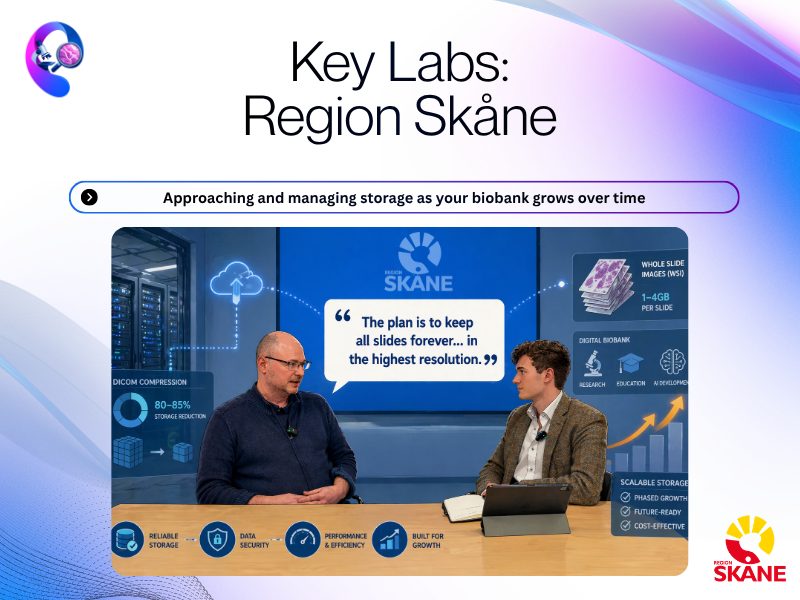
At Region Skåne, Sweden, where digital pathology has been implemented at scale, the Pathology News team sat down with Andreas Malm, System Manager. Andreas was responsible for infrastructure and IT architecture during Region Skåne’s digital pathology implementation phase. Thanks to Andreas’ insights, the Pathology News team got a glimpse into what a successful deployment of storage architecture looks like from the early days of adoption and at scale.
“Storage was kind of the main focus… to start pathology and at large scale which was what we were planning to do.”
From the outset, Region Skåne made a decision that would shape their entire storage strategy.
“The plan is to keep all slides forever… in the highest resolution.”
Planning for inevitable growth
With Region Skåne opting for an on-premise storage solution the team had to consider how they would deal with rising storage volumes. Rather than reacting to storage pressure as they arose, Region Skåne planned ahead.
“We are ready to increase the storage capacity… but right now we have as much as we need for like one or two years.”
This rolling horizon approach allows their system to scale in phases, avoiding both under-provisioning and unnecessary upfront cost. Choosing a vendor that can support your storage demands in this fashion is of course essential but as the demand grows, how can labs make this sustainable?
One of the most significant steps Region Skåne has taken to address this challenge is the adoption of the DICOM file format.
“One year ago, we introduced DICOM… and that is the good way and easy way to shrink the storage size by 80, 85%.”
An 80–85% reduction is not a marginal gain; it fundamentally changes the storage economics. By standardising image formats and enabling more efficient compression, DICOM provides a pathway to reduce storage volumes without compromising image quality.
Storage is not just capacity – it’s strategy
What becomes clear from Region Skåne’s experience is that storage is not simply about adding more capacity. It requires ongoing optimisation, forward planning, and trade-offs. Decisions from increasing capacity to employing compression methods are shaped by a balance of:
- Clinical value
- Technical feasibility
- Financial sustainability
Unlike other parts of the infrastructure, storage does not plateau. It grows continuously, quietly becoming one of the most significant long-term costs in digital pathology.
Design with scale in mind
With the advent of digital pathology, your banked slides are growing into living datasets. Region Skåne’s approach highlights three key principles to doing this successfully at scale:
- Assume and prepare for indefinite growth
- Plan capacity in cycles, not absolutes
- Streamline file sizes and anything else you can from the start
The bigger picture
Approaching infrastructure design in digital pathology deployment is awash with potential pitfalls and hidden costs, especially for those labs that do not plan effectively. But for those labs that follow the lessons that we can learn from Region Skåne, it becomes clear how storage can be approached to futureproof their systems. With longevity as a priority and scanning throughput a known, histopathology labs should be able to predict their storage expenses and support their workflows as they continue to scale.
No audio available for this article yet.
No quiz available for this article yet.