By David Clark
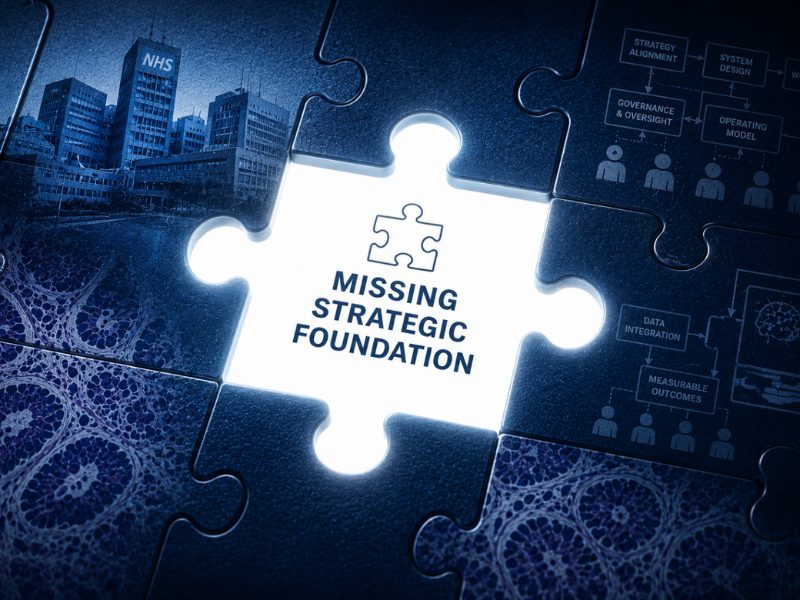
The NHS has invested over £100 million pounds into digital pathology systems and AI over the past decade. However, the implementation strategy linking funding, system design, workforce, governance and a new operating model for histopathology was incomplete, and there were no clearly defined goals against which success could be measured. It pushed funding for infrastructure and scanners into a system unprepared for the system-wide change those scanners represented. What followed was the predictable outcome of a process that treated digital pathology as a technology implementation rather than re-engineering the complex systems that deliver Histopathology across the NHS in England.
This is the first of a series of 4 articles that examines the NHS digital pathology program through the lens provided by research into the root causes of the delivery underperformance that undermine large-scale, complex projects (megaprojects).
Bent Flyvbjerg, Professor of Major Programme Management at the University of Oxford and one of the world’s leading authorities on the delivery of large-scale projects, identified this pattern through a study of more than 16,000 projects worldwide. The pattern is so consistent he named it the Iron Law of Megaprojects: over budget, over time, under benefits, over and over again. His research establishes what usually happens to large, complex projects. Only 0.5% of large-scale programmes deliver their intended benefits on schedule and within budget. Flyvbjerg’s insight is not that projects fail because people make bad decisions. It is that systems without clear goals, honest risk assessment, and structured planning reliably produce bad outcomes regardless of the quality of the people inside them. The NHS digital pathology deployment provides a compelling case study of that dynamic.
The concepts from Flyvbjerg’s research are used throughout this series as they become relevant to the digital pathology programme. Together they provide a framework for understanding why well-intentioned programmes so often fail to deliver the benefits they promise.
The Planning Fallacy: A System Set Up to Fail
Based on my experience of leading a successful implementation of a fully digital workflow in Nottingham, digital pathology is not an upgrade to an existing service. It is a fundamental redesign of how cellular pathology is delivered. First, the pathologist no longer needs to be in the same physical location as the specimen. A whole slide image can be reported from anywhere, and an identical image can be viewed simultaneously by any number of pathologists at any instant. Second, the digital image is machine-readable. Computational pathology tools, developed using artificial intelligence, can analyse that image in ways that are simply impossible with a microscope.
This technology carries genuine potential, but when NHS investment was committed on a national scale, there had been no systematic assessment of what was actually achievable in the short and medium term, within the constraints of available resources, existing NHS pathology infrastructure, and a workforce that had never been asked to undertake a transformation of this kind. Similarly, a rapidly growing number of vendors were developing AI-powered digital pathology tools, yet there was no structured evaluation of which tools could improve the effectiveness and efficiency of the service, how they could be implemented safely, what they would cost at scale, or how a workforce already stretched beyond capacity would acquire the technical, regulatory, and operational expertise the new systems would demand.
A transformation of this magnitude demanded a structured, system-wide analysis of what the new service model should look like, what it would require, and what it would displace. That analysis needed to happen before procurement began, and it needed to involve every part of the system with a stake in the outcome: the Trusts responsible for delivering cellular pathology services, the professional bodies representing the workforce, the pathology networks coordinating cross-site delivery, and the cancer alliances whose patients depend on timely, accurate diagnosis. However, this work was not done, and without that shared analysis, it was impossible to agree on goals, and without agreed goals, it was impossible to assess risk systematically or design a coherent implementation plan.
This is precisely the trap Flyvbjerg identifies. When goals are absent, organisations default to what they can control: procurement. The tangible act of acquiring scanners created the appearance of progress while the harder questions remained unanswered: what are we actually building, and for whom, and by when. Every Trust, every network, every laboratory made locally rational decisions within a system that had not given them the tools to make collectively rational ones. What happened was the predictable outcome of a system that had never been designed to succeed.
Flyvbjerg’s first principle, “Think slow, act fast“, demands precisely the kind of heavy upfront investment in planning and consensus-building that the digital pathology rollout bypassed. The slow work is not bureaucratic caution. It is the process by which a system about to be fundamentally redesigned builds the shared understanding necessary to act coherently at scale. Without it, speed is not an advantage. It is how you arrive at the wrong destination faster, or as has happened in many places, you find yourself stranded when the funding runs out mid-journey.
The consequences of that missing foundation became concrete the moment implementation began. The critical path was already blocked by dependencies that should have been visible from the start. That is where Part 2 begins.
Explore more from the series
- How NHS digital pathology obeyed the Iron Law of megaprojects – Part 1: The Strategy Gap and the Iron Law
- How NHS digital pathology obeyed the Iron Law of megaprojects – Part 2: The Critical Path and the LIMS Trap
- Part 3: Engagement, Training, and the Sustainability Cliff
- Part 4: The Masterbuilder’s Path to Recovery
References
Flyvbjerg, B. and Gardner, D. (2023) How Big Things Get Done. London: Macmillan.