Author: Sidney Ocanagil-Tunstall
“It’s not gonna be me.”
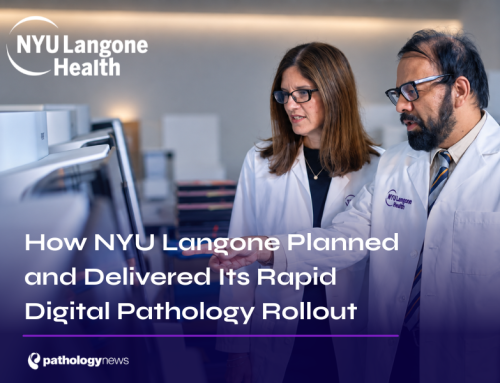
That was the reaction of some pathologists when NYU Langone first announced that the department was going digital. It is an understandable response. Moving to digital pathology asks experienced specialists to replace the instrument around which they have built their medical careers with an entirely different way of observing and navigating a case.
Yet just over one year later, NYU Langone had moved its large, subspecialised surgical pathology department to a 100% digital sign-out model without losing any pathologists in the process. And what’s more, some of those who had been most resistant to the change had become its strongest supporters.
For laboratories planning their own transition, the question is not simply how NYU Langone deployed the technology so quickly. It is how it brought its pathologists with it.
Pathologist Adoption Was Its Own Workstream
According to Dr Joan F. Cangiarella, Executive Vice President, Chief Academic Officer, the answer began with communication.
“The key of not having the challenges was communication,” she told Pathology News, “and the fact that we really had an intensive change management team.”
Workforce adoption was not left to the technical implementation team or expected to happen naturally once the scanners and workstations arrived. NYU Langone drew upon dedicated change-management expertise from the wider institution, working alongside Dr Syed T. Hoda, Clinical Associate Professor and Director of BST Pathology, to facilitate conversations within the department.
Engagement continued through planning sessions, meetings and lunches. Dedicated rooms were also established where pathologists could encounter the digital reporting environment before it became part of their everyday work.
This was less a single training event than a sustained process of making the unfamiliar increasingly familiar.
From Looking Down a Microscope to “Driving a Slide”
The significance of this preparation becomes clearer when Cangiarella describes the physical change being asked of the pathologists.
“You’re sitting at a microscope, and this is what you do all day long,” she said. “And now, like, you’re driving a slide and…you’re playing…a video game in some sense.”
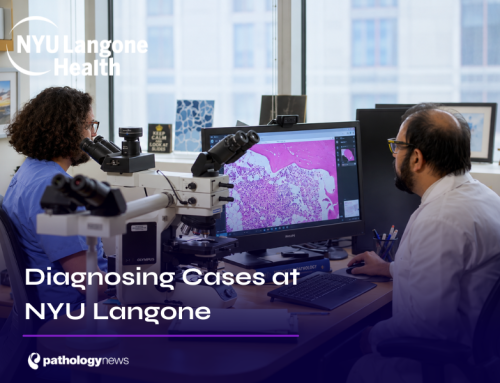
Digital pathology changes more than the location of the image. It changes how the pathologist physically interacts with the case: moving from microscope optics and stage controls to a display and digital navigation device.
NYU Langone gave its pathologists early opportunities to experience that difference. They could begin using the apparatus, become accustomed to navigating whole-slide images and explore the different devices available to them.
Cangiarella stressed the importance of “going early and getting them used to those things”, while showing pathologists that “there are options for what you could use”.
This gave pathologists some agency over how they adapted to the new environment. The destination had been decided, but there was flexibility in how individuals became comfortable working within it.
Support Was Extensive, but the Destination Was Clear
That distinction sits at the centre of NYU Langone’s approach. The institution provided communication, time, practical exposure and different ways of interacting with the platform. What it did not provide was a permanent choice between digital and analogue practice.
“You need to be saying from day one, ‘We are going digital. Everyone is going digital,’” Cangiarella said.
Hoda experienced the resistance directly. Some pathologists contacted him to ask whether they could remain outside the digital workflow.
“I would get calls asking if I could opt out,” he recalled. “They’d say, ‘Can I opt out of digital pathology?’”
His answer was unambiguous.
“Every single pathologist is going to be doing it. So, there is no opt-out. It’s just the way we function now.”
Taken in isolation, that position could sound uncompromising. In practice, it was accompanied by the structured support pathologists needed to make the transition. NYU Langone offered choice in how people adapted, but not uncertainty over whether the department itself would become digital.
That certainty appears to have been important to the speed of the implementation. Rather than waiting for every individual to become enthusiastic before proceeding, the organisation made the direction of travel clear and then concentrated on helping people reach it.
Why a Hybrid Workflow Was Not an Option
There was also an operational reason for avoiding permanent exceptions.
Allowing some pathologists to continue working from glass would not simply have preserved an individual preference. It would have required the laboratory to maintain separate processes for distributing digital cases and delivering physical slides.
As Cangiarella put it: “Then you wind up having two workflows.”
This is where workforce adoption and laboratory transformation become inseparable. If cases must regularly fall back into an analogue pathway to accommodate individual preferences, the laboratory cannot realise the full operational value of going digital. Staff must continue moving, tracking and retrieving glass slides alongside the new digital process.
Cangiarella said that other institutions had acquired the necessary equipment but had not completed the transition because people had been allowed simply not to use it. For NYU Langone, universal adoption was therefore not only a cultural ambition. It was a requirement for establishing one coherent departmental workflow.
The Dangling Carrot
The move also offered pathologists benefits that were difficult to provide within a microscope-dependent service.
“I think the work-from-home thing was also the added bonus,” Cangiarella said.
Digital reporting enabled greater flexibility for pathologists with long commutes or responsibilities at home. Cangiarella described the ability to work from home as “a game changer”.
That flexibility was not treated as an automatic consequence of installing digital pathology. It required support from both the department and the wider institution, as well as careful decisions about when pathologists still needed to be present.
“It’s a careful balance,” Cangiarella explained, because a department must retain “the ability to communicate and be in person and see people and…educate residents”.
NYU Langone’s model therefore did not dispense with the physical department. It created flexibility around diagnostic work while preserving in-person interaction, education and departmental life.
That gave pathologists a tangible return from the transition. They were not merely being asked to exchange a familiar instrument for a screen. Digital pathology changed where and how they could work.
From Naysayers to Advocates
The clearest indication of how the transition was received came from the people who had initially been least convinced.
“The people that were the naysayers are the ones who absolutely love it,” Cangiarella said. “It’s like…night and day for some people.”
Hoda reported receiving calls from pathologists who had changed their minds: “A lot of them have actually called and said, ‘Hey, I love this now…It’s changed my days.’”
Cangiarella and Hoda also confirmed that nobody left the department because of the move to digital pathology.
The benefits have extended into recruitment. Cangiarella said prospective employees had contacted NYU Langone specifically because they wanted the opportunity to work digitally and remotely. At a time when the supply of pathologists remains a concern, the working model created through digitisation has become part of the department’s appeal.
The Next Generation May Need Less Convincing
The same transition that required careful management among established pathologists may feel more natural to the next generation. Hoda noted NYU Langone had experienced considerable interest from medical students, with pathology increasingly seen as resembling radiology in its use of digital images and screen-based practice.
He recalled medical students sitting around a multi-headed microscope during a teaching session without knowing how to use it because they had progressed through their education with little exposure to microscopes.
“This resonates strongly with the younger population going into…medicine,” he said.
For NYU Langone, however, successful adoption did not depend upon waiting for a new generation of digitally minded pathologists. The department had to help its existing workforce make the transition and do so at the same pace as the wider implementation.
Its approach combined two principles that can easily be mistaken for opposites. Pathologists were given time, practical exposure, equipment options and access to dedicated change-management support. At the same time, leadership was unequivocal that digital pathology would become the department’s standard way of working.
The support made the change manageable. The mandate prevented individual opt-outs from preserving an analogue pathway and leaving the laboratory with two competing workflows.
That may be the most transferable lesson from NYU Langone’s experience. Workforce engagement did not mean waiting for unanimous enthusiasm before proceeding. It meant recognising the scale of the change, giving pathologists the support needed to adapt and maintaining a clear departmental commitment throughout. That combination enabled NYU Langone to move quickly without leaving its pathologists behind.