by Christos Evangelou, MSc, PhD – Medical Writer and Editor
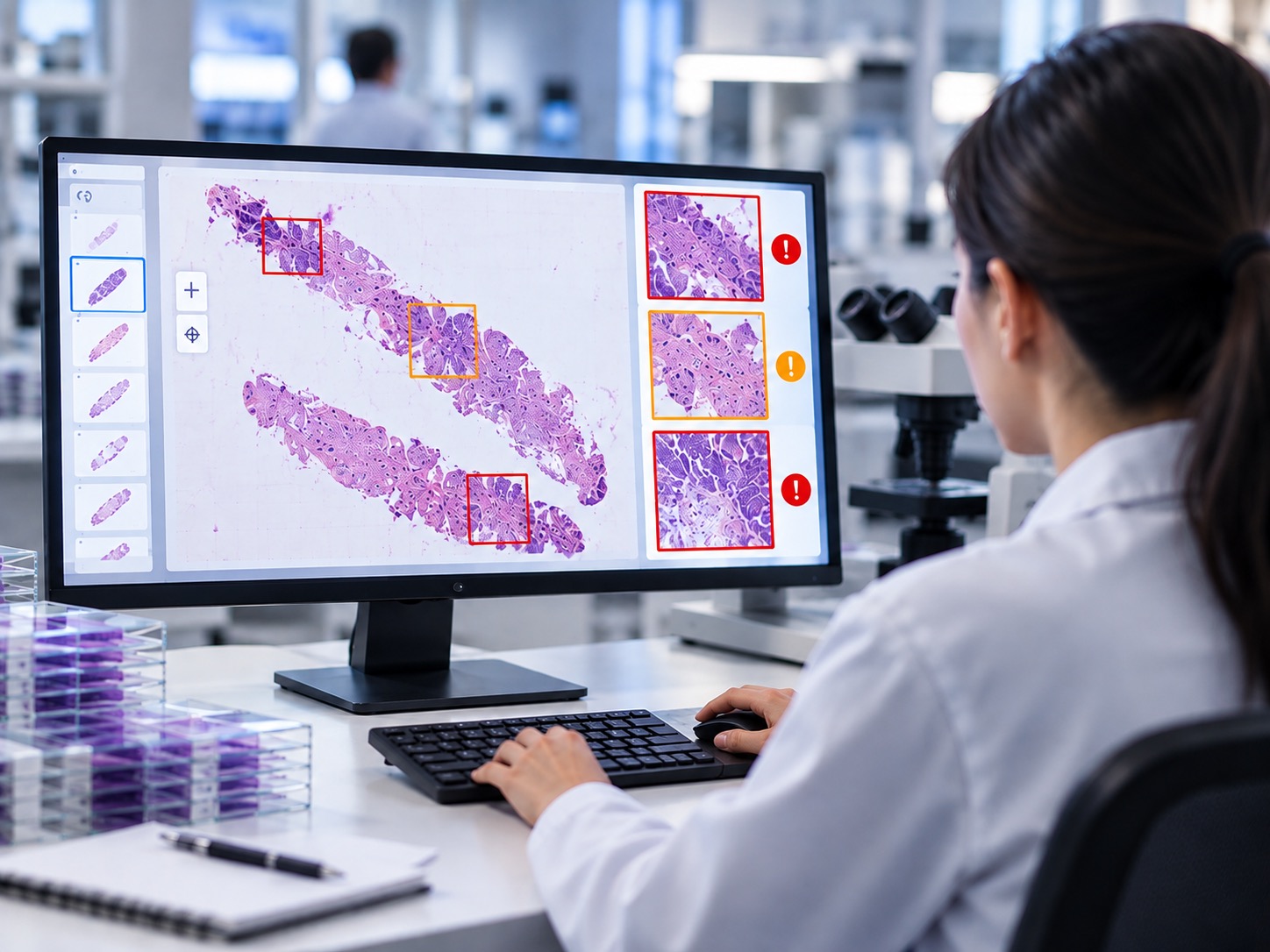
A new retrospective study investigated whether PathProfiler, an open-source AI tool, could catch quality issues in digital prostate needle biopsies. Across 226 whole slide images (WSIs) of prostate needle core biopsies, PathProfiler flagged suboptimal cases with high sensitivity and negative predictive value. According to the authors, these findings support PathProfiler as a valuable tool for the automated quality control of prostate biopsies, allowing rapid identification of cases requiring manual review.
The study was published in the Journal of Histotechnology.
Study Rationale
Out-of-focus regions, folded tissue, faded staining, dust, air bubbles, and cracked coverslips can compromise the quality of WSI and, unlike on a glass slide under a scope, can't always be fixed by simply refocusing, explained corresponding author Gonçalo Borrecho, a biomedical scientist at the Centro Hospitalar e Universitário de Coimbra (ULS Coimbra), who carried out the study at the Centro de Anatomia Patológica Germano de Sousa (CAPGS) through a partnership between his doctoral program and CoLAB TRIALS, whose partner network includes CAPGS. Checking for these problems has traditionally fallen to histotechnologists doing it by eye.
"Manual quality control, as it is traditionally performed, is laborious, qualitative, and inherently exposed to inter- and intra-observer variability, while consuming scarce technical time," Borrecho said. "We were also acutely aware that the next generation of AI-assisted diagnostic tools demands technically sound images to perform reliably."
CAPGS is a high-volume pathology laboratory, processing around 180,000 samples a year across three scanners; having a technician to check every prostate biopsy WSI isn't realistic.
PathProfiler, developed and validated by Haghighat and colleagues at the University of Oxford, is a free, open-source tool trained on prostate tissue, Borrecho explained. "The question we asked ourselves was disarmingly simple — does it actually work in our real-world setting?"
Methodology
The research team retrospectively analyzed all 226 H&E-stained prostate needle core biopsy WSI processed at CAPGS during the final three months of 2024. Each slide was re-scanned at 40x, anonymized with the open-source WSIANON tool, and run through PathProfiler.
PathProfiler returns a usability score from 0 to 1, plus separate focus and H&E staining quality scores from 0 to 10, along with heatmaps showing where it detected folded tissue, focus problems, staining issues, or other artefacts. To check whether those numbers held up, five histotechnologists with more than a decade of experience each independently scored every WSI on the same 0–1 scale. The median of those five scores became the reference standard, with interobserver agreement reaching an intraclass correlation coefficient of 0.80. A reference score below 0.5 meant "requires review," and the same cutoff was applied to PathProfiler's output for the comparison.
Key Findings
Borrecho highlighted that "PathProfiler is fast and operationally feasible." The tool worked through all 226 WSIs in 1 hour, 9 minutes, and 22 seconds (about 19 seconds per slide).
The cohort averaged a usability score of 0.58 (median 0.70), with mean focus and H&E staining scores of 9.6 and 9.1 out of 10. Sixty-eight WSIs (30.3%) fell below the 0.5 usability threshold and were flagged for review; 42 of those (18% of the full cohort) scored 0.2 or lower, the cutoff used to define "severe" cases.
Against the reference standard, the confusion matrix came out to 18 true positives, 158 true negatives, 3 false negatives, and 47 false positives, giving 85.7% sensitivity, 77.1% specificity, 77.9% overall accuracy, and a negative predictive value of 98.1%. The AUC was 0.839 for the primary "needs review" cutoff and 0.921 for severely compromised slides.
"With a negative predictive value of 98.1%, the system is exceptionally reliable when it tells us an image is fit for diagnosis," Borrecho said.
The positive predictive value, by contrast, was 27.7%. Roughly three out of four flagged images turned out, on expert review, not to need any intervention. The authors explained that only about 9% of the images had quality problems, and the low prevalence of low-quality images may have contributed to the modest positive predictive value.
A Surprising Finding
A number of WSIs scored poorly not because of a scanning or staining problem, but because they contained peri- or extra-prostatic tissue. PathProfiler, trained on prostatic tissue patterns, flagged these regions as "other artefacts" and marked the usability score down.
"This was the genuinely unexpected finding," Borrecho said. "Rather than viewing this as a weakness of the algorithm, we came to see it as an inadvertent quantitative signal that may help monitor surgical sample quality." He explained that a false positive might flag "by-products of the resection technique itself."
Potential Implications
The authors noted that PathProfiler could serve as a first-line filter, flagging images that may need human review.
"With 85.7% sensitivity and 98.1% negative predictive value, PathProfiler reliably approves diagnostic-quality WSIs and flags those that warrant a second look," Borrecho said. "In practical terms, histotechnologists no longer need to spend time inspecting images that require no attention, and pathologists receive only cases that have already cleared a technical gate."
The heatmaps add further value, he said, by pointing reviewers directly to the problem area on a flagged slide.
Borrecho added that the staining scores prompted CAPGS to revisit and refine its protocol for replacing H&E reagents, reducing how often the lab needs to run replacement cycles.
Limitations and Future Work
The authors acknowledge the retrospective design as a key limitation of the study. Because these cases had already passed through diagnosis without reported issues, "severely compromised" WSIs were rare, limiting how precisely PathProfiler's performance on worst-case slides could be characterized.
The correlation between PathProfiler's scores and the human reference standard was moderate (Pearson r = 0.383), and the modest positive predictive value reflects "the algorithm's deliberately conservative calibration and the genuinely low prevalence of poor-quality WSIs in routine practice" and "leaves room for prospective threshold optimization."
Borrecho said that the team plans to extend this work prospectively, integrating PathProfiler with their laboratory information system, broadening the sample to other prostate specimen types, and pursuing multi-institutional validation with a panel of pathologists.
"Quality control deserves its share of the spotlight, particularly now, as digital and computational pathology come of age and the reliability of every downstream AI tool will hinge on the technical quality of the images they are asked to read," Borrecho noted. "Our hope is that quantitative tools of this kind will empower histotechnologists to evolve from manual reviewers into data-driven quality stewards."
This study was supported by Portuguese public funding through Investimento RE-C05-i02 – Missão Interface.
References
- Borrecho G, Rato L, Salgueiro P, Ferreira I, Madeira C, de Oliveira RC. Application of an open-source AI tool for quantitative quality control in whole slide images of prostate needle core biopsies – a retrospective study. J Histotechnol. 2026 Apr 17:1-14. doi: 10.1080/01478885.2026.2657106. Epub ahead of print. PMID: 41994924.