The following abstract is drawn from a recently published paper in the Journal of Pathology Informatics. We invite you to read the full paper and join the conversation, become a member of the Pathology News community to share your thoughts, ask questions, and engage with others around this work.
Authors: Agnes I. Udoha, Eduardo Eyzaguirreb, Vidarshi Muthukumaranab, Harshwardhan M. Thakerb
Abstract
Background
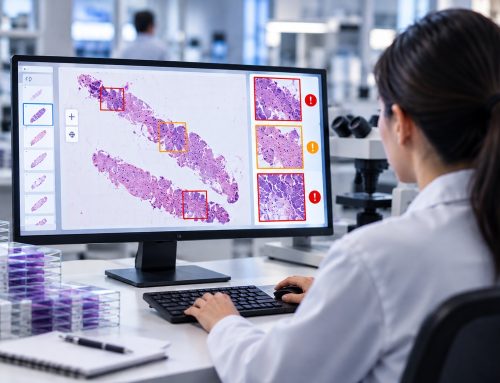
Pathologic evaluation of prostate needle biopsies is labor intensive and often requires ancillary immunohistochemistry (IHC), increasing cost and diagnostic turnaround time (TAT). Artificial intelligence (AI)–based decision-support tools may improve efficiency, but clinical deployment requires institutional validation and assessment of real-world impact.
Methods
Within a fully digital pathology practice, we performed institutional validation of an AI-assisted prostate biopsy decision-support tool using routine clinical cases, with pathologist-rendered diagnoses as ground truth. Following validation, the tool was implemented into routine sign-out. A retrospective pre–post analysis compared prostate biopsy cases signed out during three-month periods before and after implementation, excluding a transition month. Diagnostic TAT was defined as the interval from whole-slide image scan completion to final sign-out. IHC utilization was recorded. Weighted median TATs and IHC use were compared using standard statistical methods.
Results
The validation cohort met all predefined acceptance criteria, demonstrating high AI performance (sensitivity 91–100%, specificity 99%, positive predictive value 98%, negative predictive value 96%, area under the curve 0.97). Following clinical implementation, diagnostic turnaround time decreased by 30% and immunohistochemistry utilization decreased by 38%.
Conclusions
Institutional validation and clinical implementation of an AI-assisted prostate biopsy decision-support tool were associated with significant reductions in diagnostic turnaround time and IHC utilization. When deployed as an adjunct within a digital workflow, AI assistance may enhance efficiency while preserving pathologist responsibility for final diagnosis.
Read the full article: Validation, implementation, and impact of an AI model in routine practice for pathologic diagnosis of prostate cancer in an academic medical center – ScienceDirect
- aDepartment of Pathology, The University of Texas Medical Branch, Galveston, TX, United States of America
- bDepartment of Pathology, The University of Texas Medical Branch (UTMB), Galveston, TX, USA
No audio available for this article yet.
No quiz available for this article yet.