Author: Sidney Ocanagil-Tunstall
Digitising pathology is often framed as a question of scanners, AI, and software platforms. Beneath all of that sits a core challenge: infrastructure. At Region Skåne, where digital pathology has been implemented at scale, the team ensured solid infrastructure was in place from the early days to support their evolving workflow. Developing solid infrastructure that supports you as you grow is no easy task. The team in Lund set out one key metric to focus their infrastructure efforts.
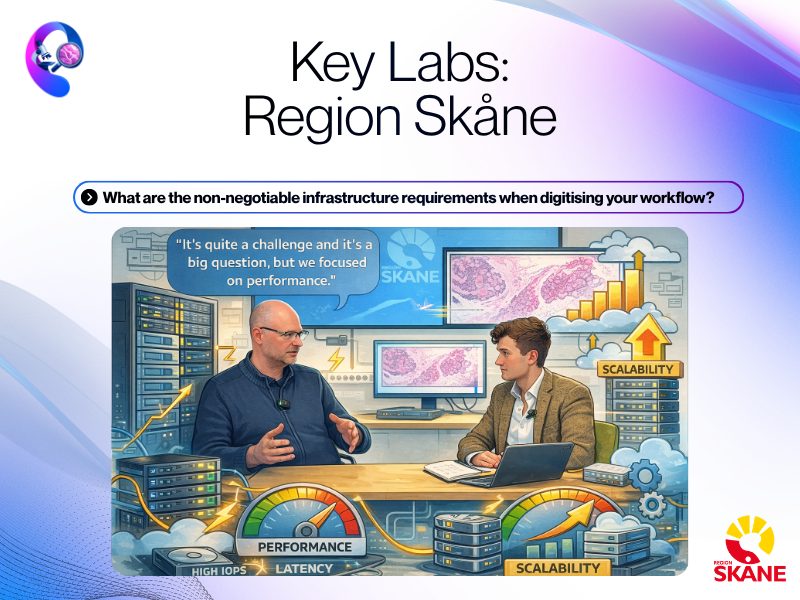
“It’s quite a challenge and it’s a big question,” says Andreas Malm, System Manager. “But we focused on performance.”
From day one, infrastructure was built around two non-negotiables: performance and scalability.
“The infrastructure must fulfil our requirements for performance in terms of latency for the network, IOPS for the discs, and how the image is presented on the screen for the end user.”
This is a critical distinction. In a digitised workflow, performance is not a backend concern, it is directly tied to diagnostic usability. If the delivery of whole slide images (WSI) to the pathologist is held back by the infrastructure, you’re hindering your diagnostic turnaround time (TAT) and influencing patient decisions.
Forever chasing better performance, your structure needs the flexibility to scale.
“Performance and scalability… due to performance, we always need to be able to scale up.”
Rather than designing for current demand, Region Skåne planned for continuous growth. Across storage, compute, and system load.
“Server side or just storage must be scaled up to whatever we need in the future.”
With scalability a priority and the flexibility it demands, vendor selection played a large role in forward selection.
“The vendors we talked to was open for any solution that was scalable.”
The vendors Region Skåne worked with had to offer their long term services so the team at Region Skåne could prioritise flexibility over fixed specifications, ensuring the system could evolve as volumes increased and new use cases emerged.
Performance starts with the network
One of the earliest focus areas was network infrastructure, often overlooked, but foundational to the entire system. This was another ‘day-one’ formality.
“When we started, we focused on network.”
Region Skåne set clear requirements from the outset:
-
5–10 GB/s on the server side
-
1 GB/s to every client workstation
-
Latency capped at 25 milliseconds
“We kind of have the best bandwidth possible… like five to 10 gigabytes on the server side. And towards the clients, we asked for one gigabit per second… and it was no problem. For the latency, we said like, we have a requirement, 25 milliseconds… no problem from any vendor.”
By locking in these thresholds early with their current and future requirements in mind, the team had given themselves the best chance of success, and limited the risk of stumbling over hurdles in time to come.
Sometimes you don’t need the very ‘best’
A recurring theme in Region Skåne’s approach is pragmatism. Despite asking for top-tier infrastructure, they found that the highest specification wasn’t necessary.
“We asked for the best, but we got the second best and that was good enough for us.”
This challenges a common assumption in digital pathology, that success requires premium, high-end infrastructure across every component. Instead, the focus was on, as many in the field agree it should be, meeting the requirements.
“You don’t necessarily need the best thing, you just need something that will meet your requirements… good enough.”
While many labs invest heavily in high-spec monitors and GPUs, Region Skåne found that you can build setups that might not be the shiniest or most expensive but they deliver for what you need them to.
Design for the future
Perhaps the most important lesson we can learn from infrastructure at Region Skåne is that infrastructure decisions here are not static. Even with strong initial planning, systems will need to evolve.
“You really need to try out and optimise on the way.”
Digital pathology is not deployed once, it is continuously refined. Performance requirements shift, data volumes grow, and workflows become more complex. For labs beginning their own digitisation journey, the takeaway is clear: define your non-negotiables early, but expect to iterate.
No audio available for this article yet.
No quiz available for this article yet.