Pathology News
admin

About admin@pathologynews.com

This author has not yet filled in any details.
So far admin@pathologynews.com has created 1089 blog entries.

November 2021

Publication Review – The human-in-the-loop: an evaluation of pathologists’ interaction with artificial intelligence in clinical practice

2025-11-24T10:22:02+00:00

Digital image analysis can fail due to poor slide quality or regressive performance when applied to data from sources that are not included in the training data. To overcome these problems, research is being done with human-in-the-loop (HITL) AI systems where the pathologists interact with DIA resulting in an improvement in performance.

Publication Review – The human-in-the-loop: an evaluation of pathologists’ interaction with artificial intelligence in clinical practice2025-11-24T10:22:02+00:00

Tulane University study uses artificial intelligence to detect colorectal cancer

2021-11-04T17:16:41+00:00

A Tulane University researcher found that artificial intelligence can accurately detect and diagnose colorectal cancer from tissue scans as well or better than pathologists, according to a new study in the journal Nature Communications.

Tulane University study uses artificial intelligence to detect colorectal cancer2021-11-04T17:16:41+00:00

Deep learning-based whole slide image segmentation can assist cancer diagnosis

2021-11-01T14:00:39+00:00

Researchers from the Department of Pathology, Memorial Sloan Kettering Cancer Center (New York, USA) and Weill Cornell Graduate School for Medical Sciences (New York, USA) recently developed an innovative deep learning-based method for multi-class breast cancer image segmentation. This new deep multi-magnification network outperforms other single and multi-magnification-based tissue segmentation methods and is likely to improve breast cancer diagnosis.

Deep learning-based whole slide image segmentation can assist cancer diagnosis2021-11-01T14:00:39+00:00

October 2021

Could cyber security be the next big healthcare emergency?

2021-10-26T07:30:30+00:00

With threats on the rise, Sectra’s Chris Scarisbrick considers the cyber security landscape including how far cloud adoption can help the NHS, and how functions like procurement are starting to think differently. Could vendors help? Even equipped with guidance and government support, the evolving threat might seem like an insurmountable challenge for many, especially for smaller organisations in healthcare that might have limited resource. But those organisations are not alone. Since the WannaCry attack hit headlines four years ago, an appetite to accelerate cloud strategies has accelerated in the NHS and UK public sector more widely. This has been complemented by public cloud vendors bringing more offerings to the market and bandwidth becoming accessible at more manageable price points. The significance of this is that moving some applications to the cloud could alleviate some or the burdens on pressured NHS IT and security teams. Technology providers can lend their expertise more easily in some instances and ensure that systems are patched without delay. Consistent deployment approaches achievable through the cloud for some solutions, could also help to avoid local mistakes and variation that could create vulnerability risks. This does not remove responsibility from trusts entirely. Cloud deployments need to be correctly configured to be secure, with appropriate resilience put in place. And there are varying degrees of responsibilities that NHS organisations might choose to outsource through the cloud to vendors. But the benefits of removing complexity from on-premise solutions is appealing for many in the health service – with the added benefit of being able to draw on the often far more extensive security expertise and resource of large cloud providers. Only a few years ago, placing a solution like a picture archiving and communication system (a platform used to examine crucial patient imaging) into the cloud, was a niche idea for trusts. Now, we are seeing the reverse, with cloud a key requirement in many major regional procurements. Preventing supply chain weaknesses Procurement in itself is an area where more and more NHS organisations are starting to pay even closer attention to cyber threats and resilience in the supply chain. Diligent organisations in the NHS have long required that suppliers meet a range of necessary standards, whether that’s the ISO27001 international standard on how to manage information security, or meeting Cyber Essentials Plus tests, for example.  If a vendor is certified in these kinds of areas, then confidence can be gained that the vendor is serious about cyber security. Companies meeting the requirements for these standards are usually known for making sure infrastructures are as secure as they possibly can be against outside influences, and that penetration testing is done to a required cadence. But it is only more recently that some procurements are starting to ask similar questions of the wider supply chain of a prime contractor. I have been stunned by the amount of vendors operating in the UK space that do not have the key standards. This is something many responsible companies do routinely check of their own subcontractors. Sectra has an approved supplier process for example, in which we are not allowed to include vendors in our solutions that don’t meet minimum requirements. And if we find vendors are not compliant, they either address the requirement or are removed from the process. But the existence of some companies in other supply chains, suggests this may not be a consistent approach across all prime contractors. It is welcome to see the NHS now asking these questions more routinely as part of the procurement process. When it comes to cyber security, you are only as strong as your weakest link. Where this is built into the process, the opportunity for assumption of checks being done is removed. Diligence is key, but not a guarantee Diligence at different levels of organisations from leadership down is a fundamental requirement. This article has covered only a small fraction of considerations in facilitating a cyber secure NHS. But there are no guarantees that any approach to cyber resilience will be successful, however well designed. Attackers can still find and exploit weaknesses, and in the case of healthcare the consequences for loss of data or loss of service can be severe for providers and for patients. Just as Professor Levi observes, it is not possible to prepare for every scenario. Organisations must have contingency plans for when things do go wrong.

Could cyber security be the next big healthcare emergency?2021-10-26T07:30:30+00:00

Tribun Health Launches New AI Computational Pathology Solution for Diagnostics, Prognosis and Drug Development

2021-10-21T08:58:41+00:00

Paris, France, Oct. 26, 2021 (GLOBE NEWSWIRE) -- Tribun Health (Formerly Tribvn Healthcare) today announced the launch of the next generation of its flagship image management system (IMS) - CaloPix 5, a next-generation AI-Powered Computation Pathology solution for diagnostics, prognosis, and drug development. CaloPix is considered by many as the gold-standard in digital pathology. It has been [...]

Tribun Health Launches New AI Computational Pathology Solution for Diagnostics, Prognosis and Drug Development2021-10-21T08:58:41+00:00

Improving Access to Cancer Screening Services Post COVID-19 [Guest Post From The American Cancer Society]

2021-10-20T18:11:07+00:00

Beginning in spring 2020, the number of cervical, colon and breast cancer screening tests dropped by more than 80 percent, according to data from the American Cancer Society and the National Comprehensive Cancer Network. Collaboration between multiple segments of the healthcare delivery system will be necessary to facilitate resumption of cancer screening services.

Improving Access to Cancer Screening Services Post COVID-19 [Guest Post From The American Cancer Society]2021-10-20T18:11:07+00:00

Calculation of Melanoma Mitotic Rate Standardized on Whole Slide Images

2021-10-19T13:55:24+00:00

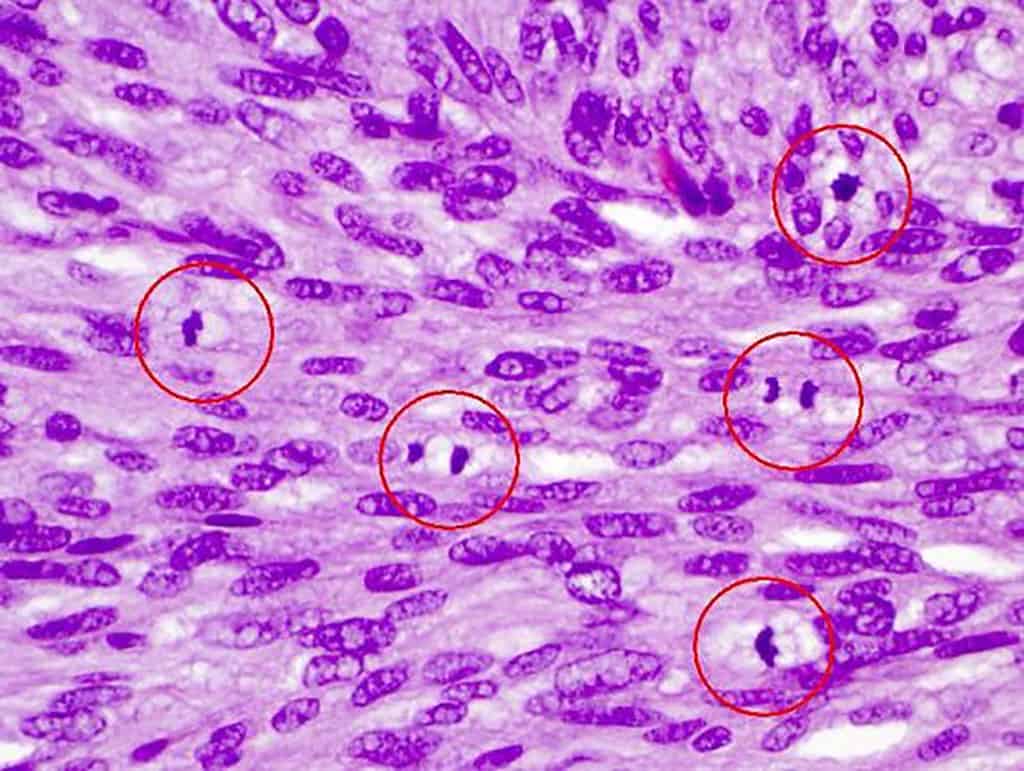
Mitotic rate is an important factor with prognostic relevance in melanoma as well as in other neoplasms. Higher mitotic activity correlates significantly with reduced survival, and is an important parameter in prognostic models offering tailored predictions of prognosis for individual patients with melanoma. Mitotic rate is an important factor with prognostic relevance in melanoma as well as in other neoplasms. Higher mitotic activity correlates significantly with reduced survival, and is an important parameter in prognostic models offering tailored predictions of prognosis for individual patients with melanoma.However, accurate mitotic figure counting on hematoxylin-eosin–stained sections can be labor-intensive and challenging. Ideally, the area of the lesion containing the most mitotic figures (the “hot spot”) is identified, and then the mitotic rate is calculated in a 1-mm2 region encompassing the hot spot. The recent availability of digital whole slide image (WSI) data sets from glass slides creates new opportunities for computer-aided diagnostic technologies.Pathologists at the University of Texas MD Anderson Cancer Center (Houston, TX, USA) established a standardized method to enclose a 1-mm2 region of interest for mitotic figure (MF) counting in melanoma based on WSIs and assess the method's effectiveness. They retrospectively searched their institutional pathology database and chose 30 melanoma cases with reported mitotic figures ranging from 0 to 28. The WSIs for these 30 melanoma cases were created by digitally scanning the original H&E-stained glass slides at ×20 magnification with a ScanScope digital pathology system (Aperio, Vista, CA, USA) with SVS format.Mitotic figures were defined as the unequivocal presence of extensions of chromatin (condensed chromosomes) extending from a condensed chromatin mass, corresponding to either a metaphase or telophase figure. For each WSI, the mitotic rate was evaluated by first finding the hot spot (i.e., the region of the lesion containing the most mitotic figures) and then counting mitotic figures beginning in the hot spot and then extending to the immediately adjacent non-overlapping viewing fields until an area of tissue corresponding to 1 mm2 was assessed. Fixed-shape annotations with 500 × 500-μm squares or circles were applied depending on the specimen orientation during mitotic figure counting, because this approach is able to achieve convenient annotation and efficient counting while ensuring easy transition from traditional glass slides.The scientists reported that of the monitors they examined, a 32-inch monitor with 3840 × 2160 resolution was optimal for counting MFs within a 1-mm2 region of interest in melanoma. When WSIs were viewed in the ImageScope viewer, ×10 to ×20 magnification during screening could efficiently locate a hot spot and ×20 to ×40 magnification during counting could accurately identify MFs. Fixed-shape annotations with 500 × 500-μm squares or circles can precisely and efficiently enclose a 1-mm2 region of interest. Their method on WSIs was able to produce a higher mitotic rate than with glass slides.The authors concluded that mitotic figure counting in melanoma using WSIs is equivalent to using glass slides and can be efficiently done in real practice. In terms of annotation methodology, they recommended fixed-shape annotations with 4 squares or 5 circles in a setting of 500 × 500 μm to cover a 1-mm2 region. The pathologist can easily enclose the region of interest of the tumor and effectively match up irregular tumor regions with position adjustments of the four squares or five circles. If the tumor has a large contiguous area, a single-square annotation of 1000 × 1000 μm can be used. Their methodology can be potentially extended to calculating mitotic rate in other tumors. The study was published in the October, 2021 issue of the journal Archives of Pathology and Laboratory Medicine. Related Links:University of Texas MD Anderson Cancer Center Aperio

Calculation of Melanoma Mitotic Rate Standardized on Whole Slide Images2021-10-19T13:55:24+00:00

Philips introduces next-generation Digital Pathology Suite – IntelliSite – to enhance diagnostic confidence and streamline pathology lab workflows

2021-10-18T10:32:29+00:00

Amsterdam, the Netherlands – Royal Philips (NYSE: PHG, AEX: PHIA), a global leader in health technology, today announced the launch of its next-generation digital pathology solution, moving digital pathology into the heart of enterprise-wide healthcare informatics.

Philips introduces next-generation Digital Pathology Suite – IntelliSite – to enhance diagnostic confidence and streamline pathology lab workflows2021-10-18T10:32:29+00:00
Go to Top