Pathology News
editor

About Editor

This author has not yet filled in any details.
So far Editor has created 929 blog entries.

June 2026

The Future of Pathology Part 3: The Delivery Problem and the Infrastructure of Intelligence

2026-07-01T08:34:22+00:00

by Rajendra Singh MD Professor of Pathology, University of Pennsylvania Co-Founder, PathPresenter After Part 1 and Part 2, many of you asked how the argument ends. This is where it lands. When a field reaches consensus, it usually means the real work is about to begin. Over the past two essays, I argued that the [...]
The Future of Pathology Part 3: The Delivery Problem and the Infrastructure of Intelligence2026-07-01T08:34:22+00:00

New Computational Pipeline Improves Resolution of Breast Cancer Spatial Analysis

2026-06-29T08:27:45+00:00

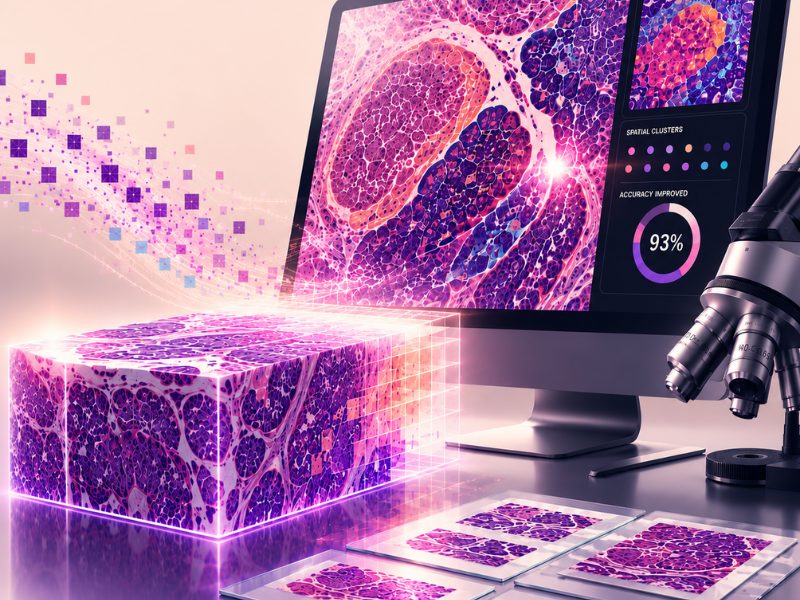
by Christos Evangelou, MSc, PhD – Medical Writer and Editor  A new computational approach developed by researchers at Karolinska Institutet improves the resolution of breast cancer spatial analysis by integrating AI-powered image analysis with spatial transcriptomics. The pipeline, which the researchers termed “computational tissue annotation” or CTA, uses machine learning to identify individual cell types in standard H&E-stained tissue sections, providing spatial insights into cellular neighborhoods and their molecular signatures in breast tumors. The study was [...]

New Computational Pipeline Improves Resolution of Breast Cancer Spatial Analysis2026-06-29T08:27:45+00:00

A Quantum Mechanics Approach to Artificial Intelligence Can Improve Cancer Outcomes

2026-06-30T09:51:28+00:00

Using principles of superposition and entanglement, researchers develop an AI framework to tailor patients' cancer treatment to their entire molecular background. By Mara Johnson-Groh, freelance science writer for American Institute of Physics Publishing’s Scilights, and Kelly Hermans, University of Utah Scientific Computing and Imaging Institute A version of this story was published on @theU For a [...]

A Quantum Mechanics Approach to Artificial Intelligence Can Improve Cancer Outcomes2026-06-30T09:51:28+00:00

TransBreast-Net: An Interpretable Vision Transformer Ensemble for Breast Cancer Histopathology Classification

2026-06-29T12:15:56+00:00

The following abstract is drawn from a recently published paper in Journal of Pathology Informatics | ScienceDirect.com by Elsevier. We invite you to read the full paper and join the conversation, become a member of the Pathology News community to share your thoughts, ask questions, and engage with others around this work. Authors: Khandaker Mohammad [...]

TransBreast-Net: An Interpretable Vision Transformer Ensemble for Breast Cancer Histopathology Classification2026-06-29T12:15:56+00:00

Lab Logic Brings Intelligent Case Orchestration to HALO AP® and HALO AP Dx

2026-06-30T14:55:52+00:00

Lab Logic is a configuration layer that enables labs to tailor HALO AP® to their preferred workflow, enabling any lab, regardless of case volume, to operate like an automated triage engine, continuously analyzing incoming slides; triggering AI-driven actions; and delivering the right cases to the right experts at the right time. Creating an Active Ecosystem [...]

Lab Logic Brings Intelligent Case Orchestration to HALO AP® and HALO AP Dx2026-06-30T14:55:52+00:00

Lumea Receives Global Recognition Award for Exceptional Achievement

2026-06-30T08:25:40+00:00

By Bianca Collings We are thrilled to announce that we received a global award for exception achievement from the international awards program The Global Recognition Awards™. We couldn’t be prouder of our team and the countless hours they’ve put into revolutionizing cancer diagnostics and digital pathology by raising the standard for tissue quality with our software and pre-analytical tech. We [...]

Lumea Receives Global Recognition Award for Exceptional Achievement2026-06-30T08:25:40+00:00

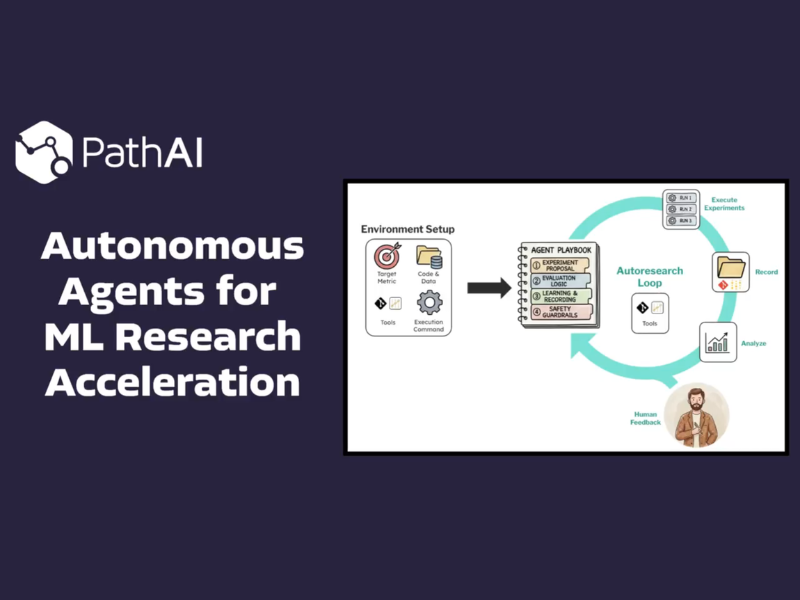
Autonomous Agents for ML Research Acceleration

2026-06-29T12:46:18+00:00

When Andrej Karpathy shared an autoresearch demo showing an agent improving a simplified single-GPU implementation of nanochat , it captured something many ML teams were already beginning to feel. Portions of our research resemble an agent loop, with much of our day-to-day ML model development work already following this structure: we form hypotheses, tune training recipes, [...]

Autonomous Agents for ML Research Acceleration2026-06-29T12:46:18+00:00

From Single-tumour to Pan-cancer AI Diagnostics

2026-06-29T11:00:16+00:00

Artificial intelligence is transforming the way cancer is diagnosed and treated. Dr Yuri Tolkach, from the University Hospital Cologne in Germany, shared his group's advances in developing AI-based tools for oncological pathology at the 12th Digital Pathology and Artificial Intelligence Europe congress in London. By Mark Nicholls During his presentation, Tolkach explained how algorithms [...]

From Single-tumour to Pan-cancer AI Diagnostics2026-06-29T11:00:16+00:00

UH Researchers Awarded $12M Grant to Advance AI, Data Science in Medicine

2026-06-26T10:34:17+00:00

Researchers at the University of Hawaiʻi Cancer Center and UH Mānoa John A. Burns School of Medicine (JABSOM) were awarded more than $12 million from the National Institutes of Health (NIH) to establish the Pacific Center for Artificial Intelligence and Data Science in Medicine (PAC-AID)—a new research center dedicated to accelerating biomedical discoveries through artificial intelligence and data science to benefit people in Hawaiʻi and the [...]

UH Researchers Awarded $12M Grant to Advance AI, Data Science in Medicine2026-06-26T10:34:17+00:00

Development and Validation of a Multi-Omics Model Integrating US-Derived and WSI-Based Features to Predict Lymph Node Metastasis in Ovarian Cancer: A Multi-Center Retrospective Study

2026-06-26T10:30:45+00:00

The following abstract is drawn from a recently published paper in Dovepress. We invite you to read the full paper and join the conversation, become a member of the Pathology News community to share your thoughts, ask questions, and engage with others around this work. Authors: Ge Yan,1,* Xiujuan Wu,2,* Peiting Zhao,3 Feng Zhou,1 Shaoze [...]

Development and Validation of a Multi-Omics Model Integrating US-Derived and WSI-Based Features to Predict Lymph Node Metastasis in Ovarian Cancer: A Multi-Center Retrospective Study2026-06-26T10:30:45+00:00
Go to Top