Despite the excitement around the use of AI models in digital pathology, most pathologists still do not use them in daily practice. The College of American Pathologists (CAP) aims to change that with the CAP AI Playground, a hands-on platform where pathologists can experiment with AI tools before implementing them in their institutions.
“AI is everywhere,” said Rajendra Singh, MD, Director of Dermatopathology and Digital Pathology at Summit Health, during his presentation.
“When we come to these conferences, when we open up a journal article, when we open up the news. But when we go back to our department, AI is nowhere.”
Singh and co-presenter Kevin Schap, Director of Clinical Informatics Initiatives at CAP, described this disconnect as a critical barrier to adoption. Despite widespread enthusiasm at conferences and in research literature, pathologists remain hesitant to integrate AI into their practice. The problem is not lack of interest, but rather lack of opportunity for practical evaluation.
“If you want to buy a car, you are not just going to say I am going to go online and buy a car,” Singh stated. “You want to actually test drive the car and see whether it is going to do the job that it is supposed to do. Once you do the test drive and feel very confident about it, you will say, Yes, I want this car.”
Singh highlighted that currently, pathologists’ exposure to AI comes primarily through polished vendor demonstrations at conferences or sales presentations. These demonstrations do not allow clinicians to assess whether tools will work with their data or integrate into their workflows. Without hands-on testing, pathologists cannot build the confidence needed to advocate for adoption within their institutions.
CAP AI Playground addresses this gap by creating a secure, web-based simulation environment that replicates a pathologist’s digital workflow. The platform requires no institutional integration; CAP members simply log in and start exploring. With nearly 20,000 pathologists worldwide already using the system, the reach extends far beyond the United States to serve CAP’s international membership.
The platform currently features seven vendors, though Schap indicated this number is expected to expand significantly. Pathologists can filter available models by specialty, use case, or regulatory status. Users can then launch actual cases to see how the AI performs.
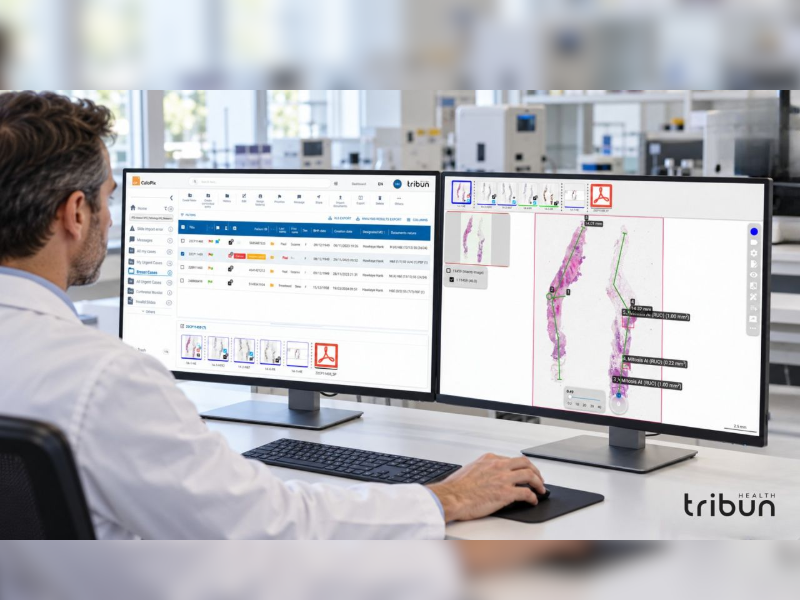
During the presentation, Schap demonstrated ArteraAI’s Prostate Test, which combines image analysis with biomarkers to generate prognostic reports for oncologists. Users can view whole slide images, toggle heat maps showing the AI analysis, and review complete reports that incorporate PSA levels, Gleason scores, and prognostic risk factors.
Other tools work differently. DeepLIIF, for example, provides quantification models where users actively annotate regions of a slide and watch the algorithm generate scores in real time. This variety helps pathologists understand the range of AI applications available.
A key feature on the roadmap will allow pathologists to upload their own slides for testing.
“I’m sitting at Sinai and I want to start using a prostate model. Now there are five or six different companies that have a prostate model,” Singh explained. “Every model is good, but do all of them work well with my data? That is more important to me.”
The platform will include de-identification features to protect patient privacy, and uploaded slides will remain the property of the user, stored securely with access restricted to the uploader alone.
To increase transparency, CAP is developing AI model cards, which are essentially “nutrition labels” for algorithms. These cards will detail training data, performance metrics, scanner compatibility, bias information, and relevant research papers. This standardized information helps pathologists assess whether a model suits their needs.
The platform also establishes direct feedback channels between pathologists and developers. “You may find a model that works fairly well, but you wish it had some sort of tweak,” Schap explained. By connecting end users with developers, CAP hopes to accelerate iterative improvements and ensure AI tools actually address clinicians’ needs.
CAP members can access the AI Playground at aistudio.cap.org using their standard credentials. Plans include expanding access to oncologists and other specialists to foster interdisciplinary collaboration around AI-driven diagnostic insights.