In recent years, the rise and demand for real-world data (RWD) has transformed the landscape of healthcare research and drug development. Biopharma has traditionally relied on data from randomized controlled trials (RCTs) to advance drug development pipelines, however, this data is at times limited by sample size, narrow inclusion criteria, and the large time and financial investments required to conduct clinical trials. RWD has garnered increasing interest for its use alongside data from RCTs due to their complementary nature. RWD expands the breadth and depth of available data by leveraging the vast amount of data collected throughout routine patient care such as EHR, claims, and molecular testing, etc. As the volume and variety of health-related data sources expand, the ability to collect, analyze, and apply RWD has become crucial for researchers and drug developers to generate novel insights across patient outcomes, treatment effectiveness, and disease progression.
Today, researchers are using RWD throughout the drug development lifecycle: from identification of novel biomarkers, to enhancing clinical trial design, validating findings, and supporting regulatory submissions. Because RWD enables the analysis of healthcare outcomes across large and diverse patient groups “in the wild”, using RWD alongside traditional RCT data comprises an approach that may ultimately prove more cost-effective and informative than either method alone.
Although the use of RWD has gained traction across biopharma R&D, researchers are often still limited in the types of data they’re able to access and analyze. This is often due to the raw, unstructured nature of data within EHRs, LISs, and beyond, which, without appropriate curation, are extremely difficult to unlock.
Real-World Histopathology Data: The Missing Modality
I am text block. Click edit button to change this text. Lorem ipsum dolor sit amet, consectetur adipiscing elit. Ut elit tellus, luctus nec ullamcorper mattis, pulvinar dapibus leo.
While clinico-genomic RWD has driven tremendous insights across the drug development lifecycle, there is a critical data modality that has been left untapped due to difficulties with data extraction and analysis – histopathology.
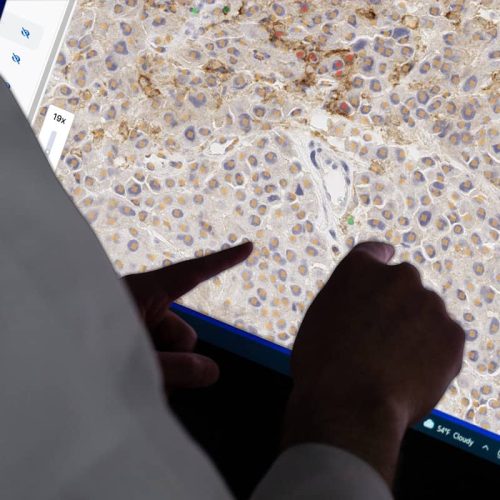
Pathology stands as an integral component for precise diagnosis of many different diseases. Despite its complexities and intricacies, advancements in digital pathology and AI-driven technologies are transforming what is possible with routine histopathology samples. Today, researchers can use standard hematoxylin and eosin (H&E)-stained samples to obtain a single-cell, spatially-resolved view of tissue structures and cell populations, as well as examine how patients respond to new therapies, understand prognosis, and even predict molecular biomarkers.
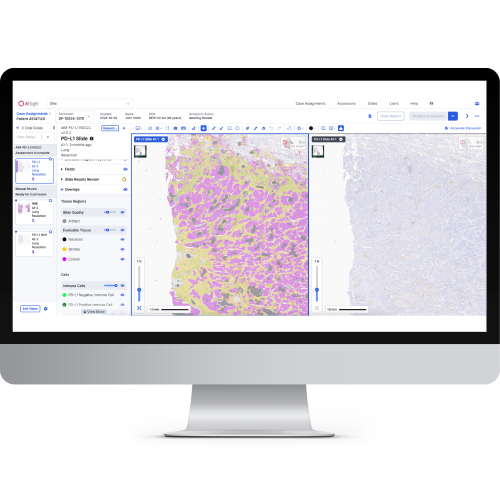
PathAI specializes in developing AI-powered products for the analysis of pathology WSIs, transforming unstructured digital images into structured pathology insights to advance precision medicine. This quantitative histopathology data unlocks completely new possibilities alongside other RWD, enabling a comprehensive understanding of the intricacies of diseases at a molecular, cellular, and now histological and anatomical level.
Transforming WSIs into data-driven insights: H&E images linked with AI-powered insights from PathExplore™ , the world’s first AI solution for rapid, high-resolution analysis of the tumor microenvironment from H&E WSI.
PathExplore delivers >300 histopathology features including:
- Total Area of Tumor Tissue
- Total Number of Lymphocytes
- Density of Lymphocytes in Cancer Stroma
- Number of Lymphocytes in Proximity to Cancer Cells
- Spatial Distribution of Tumor Infiltrating Lymphocytes, and more
Share this article


Follow us
Get Pathology News Delivered to Your Inbox