By Arturo Loaiza-Bonilla, MD, MSEd
A woman completes human papillomavirus (HPV) self-collection in a community clinic, receives an abnormal result, and then disappears into the space between screening and treatment.
A man with metastatic lung cancer has a genomic alteration that may make him eligible for a clinical trial, but the trial is 3 hours away, the eligibility language is complex, and nobody owns the next phone call.
A patient receiving chemotherapy reports worsening dyspnea through a digital symptom platform on a Friday evening. The alert exists — the dashboard updates. The algorithm has done its job. But the patient still needs a human response.
None of these patients suffers from a lack of medical knowledge, but from a failure of execution.
That realization became the central theme of an ASCO Educational Session I recently chaired at the 2026 annual meeting: “Tech That Scales: Artificial Intelligence and Digital Tools for Cancer Care in Low- and Middle-Income Countries and Counties.” The title intentionally pairs two worlds often discussed separately: low- and middle-income countries and underserved counties in the United States. Their infrastructure, reimbursement systems, laws, languages, workforce models, and public health capacities differ substantially, but their failure points overlap: the screening that never happens, the abnormal result that’s never followed up, the referral that never arrives, the symptoms that escalate at home, and the trial that exists but remains out of reach.
The companion chapter in the 2026 ASCO Educational Book, which I co-authored with Partha Basu, MD, PhD, Eric Lucas, MD, Connor Yost, MD, and Sanjeev Arora, MD, was built around a simple premise: The next era of oncology AI will not be won by the group that builds the most impressive model. It will be won by the group that builds the most reliable pathway.
In other words, implementation is the product.
The Great Translation Gap
In this year’s ASCO presidential theme, “The Science and Practice of Translation: Improving Cancer Outcomes Worldwide,” the word that matters most is not science; it is practice.
Oncology has never had more powerful tools. We can identify molecular drivers in days, read imaging and pathology with increasing computational support, monitor symptoms between visits, connect local clinicians to global expertise, and screen thousands of clinical trials against a single patient’s record in ways that would have been unimaginable a decade ago.
And yet, globally, millions of patients still fall through the cracks somewhere between discovery and delivery.
In the US, a striking geographic reality persists: many counties lack both active cancer clinical trials and access to local oncologists. Survival gaps between high-resource and low-resource settings remain profound — not because we do not know what good oncology looks like, but because good oncology is unevenly distributed.
This is what I call the Great Translation Gap: the distance between what medicine knows and what a patient can receive. AI, used poorly, will not close that gap. It will simply digitize it.
The Algorithm Is Not the Intervention
In this Practical AI series, we have explored large language models in medicine, AI-based clinical notes, the “gorilla in the room” in radiology, Moravec’s paradox, AI in mammography, cardio-oncology screening, and digital pathology. Across those topics, a pattern emerges: the algorithm may be the most visible part of the story, but it is rarely the most important. The intervention is the pathway, and the model is one component of it.
A cervical-screening AI model that improves image classification but leaves an HPV-positive woman without follow-up is not healthcare. A trial-matching system that generates an elegant PDF no one navigates is not access. An electronic patient-reported outcome platform that collects symptom data without an escalation protocol is not safety. A telehealth platform without local workforce capacity is not equity.
This is why I introduced the idea of “deployability” during the session. Deployability is not accuracy alone, it is accuracy plus staffing, logistics, training, quality assurance, governance, reimbursement, equity monitoring, downtime planning, and a human being who’s accountable for the next step.
Three Vignettes, One Lesson
Consider three versions of the same problem.
First, cervical cancer prevention. HPV self-collection is one of the most important access strategies in global cancer prevention. It can reduce dependence on pelvic exams, expand reach, and make screening more acceptable for patients who face stigma, distance, trauma, or limited clinician availability. But the value is not in collection alone. It is in the process: self-collection to result, result to triage, triage to treatment, treatment to quality assurance.
Now add AI-assisted visual evaluation. The promise is real — AI may help scarce teams prioritize who needs a colposcopy or treatment when specialist capacity is limited. But an impressive development may still lead to disappointing real-world performance. The question is not, “Can AI identify cervical precancer?” It is, “Can the program safely move a woman from risk to treatment without losing her?”
Second, workforce capacity. Project ECHO, presented in our session by Dr Sanjeev Arora, is one of the most important counterarguments to the assumption that expertise must always travel through referral. ECHO, a telementoring model that connects specialist hubs with community teams, moves knowledge, not every patient. It turns a hub-and-spoke structure into a learning system, allowing local teams to manage more complexity with specialist support. That distinction matters: Telemedicine often brings the patient virtually to the specialist, while ECHO moves expertise outward to the community.
Third, clinical trial access. AI-enabled trial prescreening can review complex protocols, interpret biomarkers, and prioritize likely matches far faster than manual workflows. In our work evaluating multi-agent AI and oncology-specific knowledge graphs, we have seen how these systems can reduce screening burden and increase the number of plausible trial options surfaced per patient.
But here again, the technology is not the endpoint. A trial match without clinician verification, consent support, transportation planning, language access, financial navigation, and trust-building is not enrollment — it is a signal. The signal must become an action, the action must have an owner, and the pathway must be measured until the patient either reaches the destination or the system understands why not.
The Four-Layer Cancer-Care Operating System
The AI session at ASCO was designed as a practical operating model rather than a tour of isolated tools, organized around four layers of the patient journey.
The first layer is entry into care: screening, risk identification, triage, and early detection. HPV self-collection and AI-assisted cervical triage belong here, as do mammography, lung screening, and other prevention strategies where reach and follow-up determine impact.
The second layer is workforce capacity: the ability to extend scarce expertise through Project ECHO, telementoring, remote consultation, and team-based learning. This is where systems stop asking every patient to travel to expertise and start moving expertise closer to the patient.
The third layer is continuity: electronic patient-reported outcomes, remote symptom monitoring, navigation, and escalation workflows. This layer keeps patients visible between visits, where many avoidable complications emerge.
The fourth layer is access to innovation: AI-enabled trial prescreening, decentralized and hybrid trial models, molecular navigation, and community-based referral pathways that help patients reach appropriate studies without requiring them to live near an academic medical center.
The value is not in any single layer but in the pathway. Screening expands entry; ECHO expands the team that can respond; remote monitoring keeps patients visible; trial prescreening opens access to innovation when standard care is no longer enough; technology that scales should do four things: reach, route, respond, and learn.
The End of Innovation Theater
Healthcare conferences have long rewarded novelty: the model, the app, the pilot, the dashboard. But patients do not benefit from pilots; they benefit from operating systems. A tool that cannot survive the ordinary chaos of care delivery is not scalable. If it assumes everyone has broadband, it will miss patients without it. If it assumes English literacy, it will miss patients who do not speak English. If it assumes transportation, it will miss patients who cannot travel.
This is where AI in oncology must become more clinically mature. We would never approve a drug because it worked in one idealized setting without asking about toxicity, generalizability, monitoring, dose adjustment, subgroup effects, and post-market safety.
We should not deploy AI differently. Before scale, we need to ask: What is the intended use? What population was represented in development? What are the failure modes? Who reviews false negatives and false positives? Who monitors drift? Who owns the alert? What is the nondigital fallback? What happens when the model is right, but the system cannot act?
A model without an operating plan is not innovation. It is a risk with a user interface.
Human-in-the-Loop Is Not a Disclaimer
One phrase appears constantly in clinical AI discussions: “human-in-the-loop.” Too often, it functions as a disclaimer rather than a design principle. It does not mean we place a clinician somewhere near the algorithm and hope judgment will magically appear. It means the workflow explicitly defines what the human is expected to do, when, with what information, under what authority, and with what accountability.
For a symptom alert, who responds and within what timeframe? What symptoms escalate immediately, what requires a same-day call, and what happens after hours? For a trial match, who verifies eligibility, who speaks with the patient, who discusses the option with the treating oncologist, and who addresses travel, lodging, insurance, language, and consent? For an AI-assisted triage result, who reviews image quality, who handles ungradable images, who communicates results, and who ensures treatment capacity exists before the screening campaign begins?
Human-in-the-loop is not a sentence in a policy document. It is an operating plan.
Moravec’s Paradox at the Bedside
In my prior writing on Moravec’s paradox, I discussed a recurring irony of AI: machines can perform tasks that look intellectually sophisticated while struggling with tasks humans find intuitive. In oncology, this paradox is everywhere. AI can summarize a 200-page protocol, classify an image, and detect a biomarker pattern across thousands of records.
But it cannot reliably know whether a patient will answer a call from an unfamiliar number. It cannot understand that a caregiver is overwhelmed unless someone asks. It cannot build trust in a community that has learned to be cautious of medical institutions.
This is not a weakness of AI. It is a reminder of what AI is for. The goal is not to replace the nurse navigator, the community health worker, the oncologist, the primary care clinician, the pathologist, or the trial coordinator. The goal is to focus their attention where it matters most. The best AI systems in cancer care will not remove humans from care; they will make human care more accessible, timely, and accountable.
The Hub-and-Spoke Contract
One of the most useful frameworks from the session was the hub-and-spoke model as an accountability contract. The hub owns what benefits from centralization: standards, quality assurance, model oversight, registry management, analytics, specialist support, navigation infrastructure, cybersecurity, and drift monitoring. The spoke owns what must remain local: patient education, sample collection, symptom capture, language adaptation, cultural context, transportation planning, and rapid escalation.
The hub should centralize complexity. The spoke should localize trust.
When this works, technology does not extract care from the community; it strengthens the community’s ability to deliver it. That distinction is critical. Too many digital-health models unintentionally bypass local clinicians, creating parallel systems that may look efficient but erode trust. A better model equips local teams with infrastructure they could not build on their own while preserving the relationships that make care acceptable and durable.
Grade the Technology Before You Scale It
Not every AI or digital tool is at the same readiness level; treating them as equivalent is how good intentions widen disparities. The maturity question should always come before the scale question.
Readiness tier
What it means
Representative tools
Ready to implement
Strong evidence to deploy in many settings, provided follow-up workflows, staffing, and quality safeguards are in place
HPV self-collection; Project ECHO; electronic symptom monitoring
Validate locally first
May perform well in some contexts, but device conditions, population differences, workflow variation, and subgroup performance must be assessed before broad use
AI-assisted cervical triage; AI-supported mammography; AI-enabled lung-screening support
Pilot under supervision
Promising, but must be evaluated as prioritization systems not as autonomous decision-makers
AI-enabled trial prescreening hubs; federated learning systems; multi-agent oncology workflows
The right question is not, “Is this AI impressive?” It is, “What evidence is sufficient for this specific use, in this specific population, with this specific failure mode?”
The 90-Day Closed-Loop Challenge
A practical implementation plan does not need to begin with a billion-dollar transformation. It can begin with one fragile handoff. Pick one: an abnormal screening result, a delayed biopsy, a symptom alert, a molecular report, a trial match, a missed referral. Then ask what it would take to close that loop in 90 days.
Timeline
Milestone
What you actually do
By day 14
Map the pathway
Define the target population. How many patients enter? Where do they drop off? What is the baseline time to resolution? Who is responsible? And where is responsibility ambiguous?
By day 30
Assign owners + risk register
No alert, abnormal result, or trial match exists without a human accountable for next action. Log the risks: privacy, consent, downtime, bias, staffing, language access, transportation, escalation.
By day 60
Train and test the workflow
Don’t test only the software. Test the phone call, the script, the referral order, the documentation field, the after-hours pathway, the ungradable-image process, the missed-appointment recovery plan.
By day 75
Launch the closed-loop registry
Track eligible patients, completion, abnormal results, referral, diagnosis, treatment, navigation needs, and unresolved cases.
By day 90
Review and decide
Stratify outcomes by site, rurality, race and ethnicity, language, insurance proxy, and digital access. Then choose scale, sustain, redesign, or stop.
Do not pilot a tool. Launch a closed loop.
What Should Be on the Dashboard?
The most important dashboard in AI-enabled cancer care is not the one with the most beautiful interface. It is the one that makes failure visible early enough to intervene. At minimum, it points in six directions.
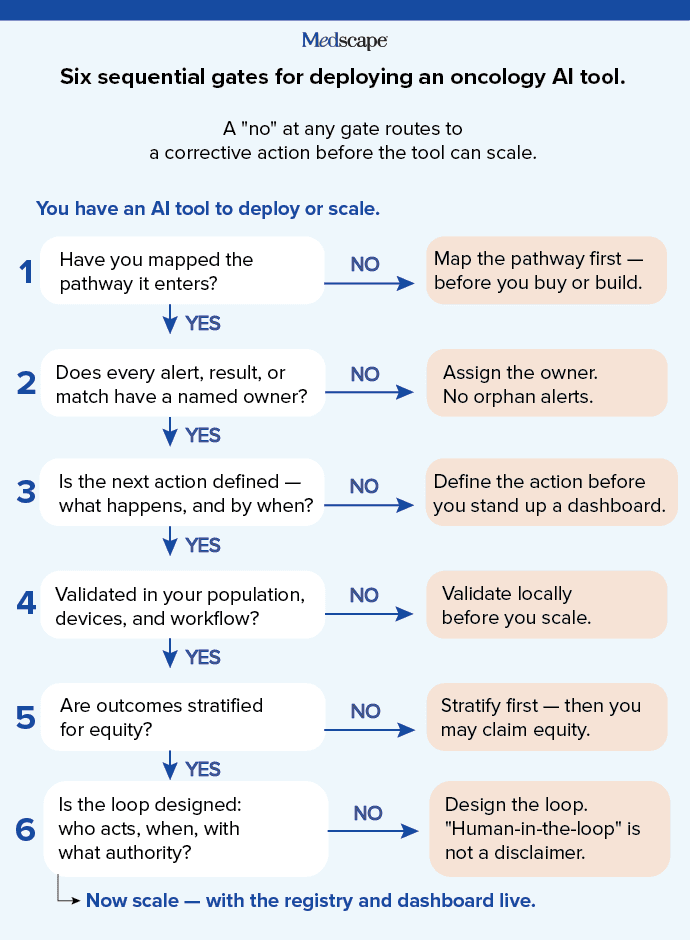
Access asks who was eligible, reached, accepted, or never contacted. Quality asks whether specimens, images, matches, and alerts were adequate. Timeliness measures the interval between risk and resolution at every handoff. Patient-centered outcomes ask whether the patient understood the next step and whether various barriers (eg, language, transportation, caregiver, cost, digital access) were cleared. AI safety watches for drift, reviews false negatives, and flags whether certain sites, devices, or populations are diverging. Equity asks who benefits, who is missed, and where the gap is widening.
What you stratify is what you are willing to be accountable for.
What This Means on Monday Morning
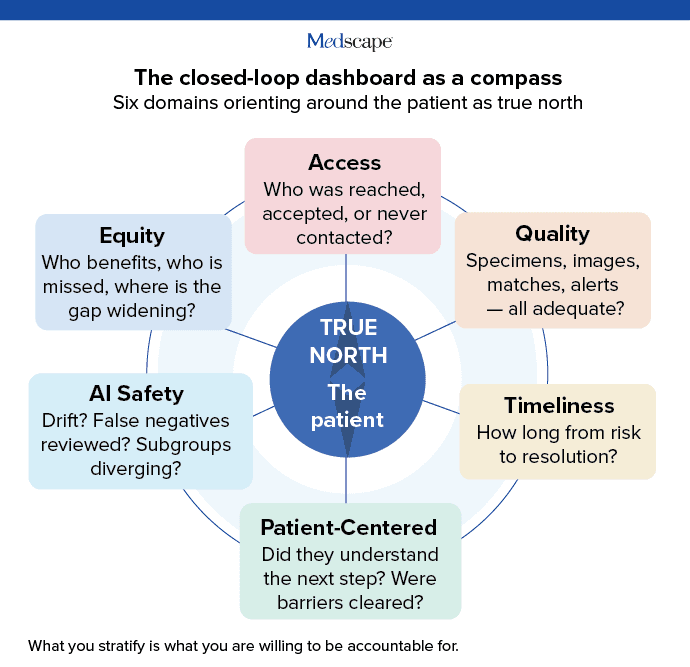
For oncologists, administrators, digital leaders, and researchers, the message is practical and sequential. Most failed deployments did not fail because the model was weak. They failed because someone scaled before an earlier question was answered. So, before the next tool goes live, walk the gates in order. Each one is a stop, not a suggestion: if the answer is no, you have your next task, not your launch date.
I left the ASCO session convinced that the future of oncology AI will be less about isolated intelligence and more about coordinated reliability. The model matters. The data matter. The interface matters. But none of those matter as much as whether the system can carry a patient from risk to resolution.
The patient who has never heard of AI, who lives 3 hours from the nearest trial site, who speaks a language no model was trained on, who shares a phone with family members, who depends on a caregiver, who may not trust the system, and who will never attend a scientific meeting — that patient is the benchmark.
The next decade of oncology AI will not be decided by who generates the most alerts. It will be decided by who ensures every meaningful alert becomes an action, every action has an owner, every owner has accountability, and every patient remains visible until the loop is closed.
That is technology that scales. And that is why implementation is the product.
Arturo Loaiza-Bonilla, MD, MSEd, is the co-founder and chief medical AI officer at Massive Bio, a company connecting patients to clinical trials using artificial intelligence. His research and professional interests focus on precision medicine, clinical trial design, digital health, entrepreneurship, and patient advocacy. Dr Loaiza-Bonilla serves as Systemwide Chief of Hematology and Oncology at St. Luke’s University Health Network, where he maintains a connection to patient care by attending to patients 2 days a week.
No audio available for this article yet.
No quiz available for this article yet.