By David Clark
Parts 1 and 2 described a system that moved fast without a plan, collided with dependencies it had not priced, and left its workforce operating two parallel workflows with no training infrastructure and no defined endpoint. Part 3 examines what that environment produced in human and organisational terms: why adoption stalled, why failing programmes continued, and why the financial model that was supposed to sustain digital pathology is now under serious strain.
The Adoption Problem
Even where LIMS integration was achieved and the technical prerequisites were in place, digital reporting did not become the default. Understanding why requires looking at how professional communities actually adopt new ways of working.
Everett Rogers’ diffusion of innovations framework, extensively applied in healthcare settings, identifies a consistent pattern in how innovation spreads through professional communities. A small number of innovators and early adopters, representing perhaps one in six clinicians, engage with new approaches on the basis of personal evaluation and direct experience. The vast majority require something different: visible evidence that peers they respect have adopted the practice, found it workable, and continued to use it. This social proof does not flow through formal communications or policy announcements. It travels along informal channels and personal networks: conversations at regional meetings, observations of colleagues reporting digitally, word of mouth about what actually works in practice. The same channels carry evidence of failure just as rapidly as evidence of success.
This dynamic had profound consequences for digital pathology adoption. The conditions required for social proof to operate — visible early success, credible opinion leaders reporting digitally as their default, peer networks carrying positive signals — were never systematically created. Instead, the informal networks that connect pathologists across laboratories and institutions carried a different signal: that implementations were stalling, that LIMS integration was harder than promised, that hybrid working was becoming permanent, and that the technology was not yet delivering what had been envisaged. The programme had inadvertently activated the social proof mechanism in reverse. It did not merely fail to generate positive momentum. It generated negative momentum that made subsequent adoption progressively harder. This was not professional conservatism. It was a rational response to a system that had not created the conditions for success to be visible.
The Commitment Fallacy in Practice
Flyvbjerg identifies the commitment fallacy as the tendency to lock in resources before goals and risks are properly understood. In the digital pathology rollout, a related dynamic played out at Trust and network level once implementations were underway: the tendency to continue in the face of clear evidence that the current path was not working.
Organisations that had invested in scanners, middleware, software licences, and staff time found it structurally difficult to stop, reassess, and redesign. The sunk cost was not just financial. It was reputational. Business cases had been approved, announcements had been made, and clinical and operational staff had been asked to absorb significant disruption. Acknowledging that the implementation needed fundamental redesign required admitting that the original plan had been flawed — a difficult position for any organisation operating within the NHS’s accountability frameworks.
There was also no systemic mechanism to support reassessment. No programme-level process existed to distinguish between implementations that needed more time and those that needed to be fundamentally redesigned. No shared criteria defined when it was appropriate to stop, what a redesigned approach should look like, or how additional support could be accessed. In the absence of that framework, the default was to persist. The commitment fallacy operated not because individuals made irrational decisions but because the system offered no structured alternative to continuing.
The Sustainability Cliff
Underlying the operational challenges is a financial problem that is now becoming acute. The initial wave of digital pathology investment was funded through centrally allocated capital budgets, designed to stimulate adoption and build momentum. What those budgets did not include was a sustainable revenue model for the years that followed.
Scanner infrastructure requires maintenance. Image management platforms carry ongoing licence costs. Middleware and integration software need support contracts. Network infrastructure must be maintained and upgraded. Archive storage of whole slide image files becomes an essential and unavoidable ongoing cost pressure. In a digital workflow with integrated AI, the whole slide image becomes part of the patient’s medical record, and retention is subject to GDPR and other regulatory standards. These are not one-off costs. They are recurring revenue commitments that land on laboratory budgets sized for glass slide pathology, not digital infrastructure. In many cases they were not included in the original business cases because the dependency analysis that would have identified them was never done.
As pump-priming funding runs out, laboratories are confronting a sustainability cliff. The choice in many cases is between absorbing costs that were never budgeted, finding efficiency savings from a digital workflow that has not yet delivered them, or allowing implementations to stall through lack of resource. None of these is a good outcome, and all of them were foreseeable. The joint report from a meeting co-chaired by RCPath and the Royal College of Radiologists at 10 Downing Street in October 2023 estimated that £200-300 million over five years would be required to reach full digitalisation. The answer to why the first wave proceeded without a financial model that anticipated this lies in the systemic failures already diagnosed: no goals were attached to the funding, no dependency analysis was required, and no gateway conditions existed to ensure readiness before capital was released.
Furthermore, for departments that implement successfully, there is an ongoing need for investment in additional scanner capacity to handle the inexorable yearly increases in workload predicted by the NHS. This necessitates continuous support for business cases within local Trust budgets to prevent scanning capacity from becoming a bottleneck that constrains future service delivery.
The way pump-priming capital funding flows through the NHS compounds these problems further. Money is pushed out from central bodies, often without clear goals attached or accountability frameworks to ensure delivery and value for money. This is compounded by a financial rule that is so embedded in NHS culture it is rarely questioned: capital allocations must be spent within the financial year in which they are allocated, irrespective of whether the receiving organisation is ready to spend the money wisely. The result is rushed procurement, compressed planning timelines, and decision-making that prioritises expenditure over value. In the context of digital pathology, where careful systems analysis, risk assessment, and integration planning were prerequisites that the system never required, year-end capital pressure actively rewarded the behaviours that produced failure. To state it plainly: it led to public money being wasted.
To compound that waste, stalled deployments are sitting on a time-bomb. When pump-priming funding runs out, laboratories will need to make the case for revenue funding from their host Trust to continue. A business case for ongoing investment in a project that has delivered no measurable benefits is unlikely to survive the scrutiny of a Trust Chief Financial Officer. The sustainability cliff is not a future risk. For many services, it is already the ground beneath their feet and it is starting to crack.
The Training Gap and the Strategic Commitment
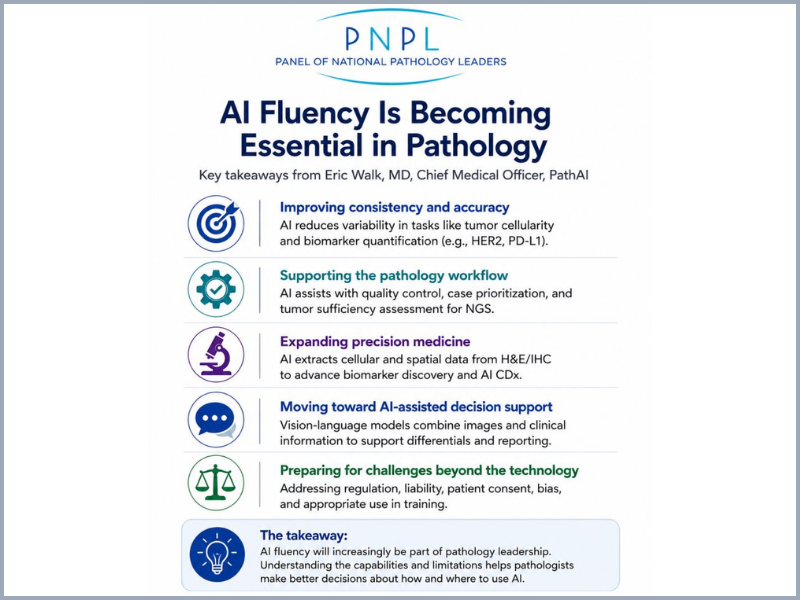
The professional bodies have not been absent from this transformation. In 2019, the Royal College of Pathologists published its Digital Pathology Strategy, committing explicitly to integrate digital pathology into curricula at all stages of training and to produce specific advice on the delivery of the FRCPath examination with digital pathology. The strategy was clear that the College should not merely engage with digital transformation but lead it. In October 2023, RCPath co-chaired a meeting at 10 Downing Street with the Royal College of Radiologists, making the case to government for £200-300 million of investment over five years to reach full digitalisation of NHS pathology services. The joint report from that meeting called on Medical Royal Colleges to update their specialty training curricula to include AI and digital pathology competences.
The documentary record across those four years is one of genuine engagement at the highest level. RCPath published, convened, and argued for the transformation with consistency and at the highest levels of government. That engagement deserves recognition on its own terms before the harder question is asked: why has the strategic commitment not yet been translated into the formal architecture of professional competence?
The 2021 curriculum — the GMC-approved document that defines what a CCT-holding histopathologist must demonstrate — contains no Capability in Practice specifying digital reporting or computational pathology competence. Eleven CiPs cover the full scope of histopathology practice. None requires a trainee to demonstrate that they can report from a whole slide image, evaluate an AI-assisted diagnostic tool, or work within a fully digital laboratory workflow. The syllabus lists “evolving ways of working: digital pathology and molecular pathology” as a topic area, but without assessable descriptors, measurable outcomes, or entrustment levels. A trainee completing CCT in 2026 is not formally assessed on digital reporting competence. That is not a reading of the document — it is the document.
This gap is not evidence of inattention. The 2019 strategy named the right objectives. The 2023 Downing Street meeting named the right recommendations. The structural constraints were real: embedding digital pathology competence in a GMC-approved curriculum requires validated training programmes, assessable standards, and accredited environments that did not exist at scale. As Flyvbjerg would predict, when the system does not create the conditions for the harder work to be done, the harder work does not get done.
The consequence is visible in the signal the current curriculum sends to the profession. Professional qualification frameworks define what the system considers essential. A consultant histopathologist who has never reported digitally, and a biomedical scientist whose Specialist Diploma required no digital pathology competence, have both met every formal requirement the system demands of them. For the vast majority of clinicians who look to professional norms and peer behaviour before adopting new practice, that signal carries more weight than any strategy document or government meeting. The informal networks through which social proof travels read the curriculum, not the commitments.
RCPath has the standing, the expertise, and — as the Downing Street meeting demonstrates — the political access to do more than restate the intention. The next curriculum revision is the concrete, dateable, GMC-approvable opportunity to translate six years of strategic commitment into an assessed competency. Embedding digital reporting and AI tool evaluation as named Capabilities in Practice, with defined entrustment levels and assessable descriptors, would not merely update a qualification. It would change the signal the profession sends to itself about what the future of cellular pathology actually requires. That is the architectural intervention the 2019 strategy promised and the next wave of investment must deliver.
What the First Three Articles Have Established
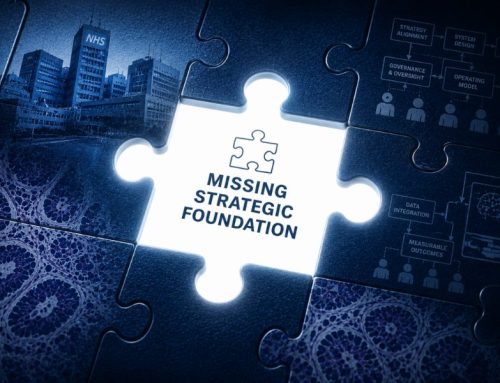
The first three articles in this series have dissected the causes of system-wide failure in the NHS digital pathology programme: a strategic void that preceded procurement, a critical path blocked by integration failures that the system could not learn from, an adoption dynamic that ran in reverse, a sustainability model that was never built, and a training framework that stated the right intentions without embedding them in the architecture of professional qualification.
This is a diagnosis, not a verdict. The actors inside this system — clinicians, laboratory managers, Trust executives, professional bodies, central funders — were not failing. They were responding rationally to a system that had not given them the conditions to succeed. That distinction matters because it points toward what recovery actually requires: not better people, but a better-designed system.
In Part 4 we apply Flyvbjerg’s Masterbuilder principles to that task. We begin where any honest assessment of this programme must begin — with what has actually worked, and with the question the system has never adequately answered: why have the lessons of success been so difficult to replicate at scale? That question cannot be answered by looking at the technology alone. The organisational dependencies, the boundary decisions, the contradictions between the investment strategy and the professional training it depended on, the financial model that was never built: these are not separate problems with separate causes. They are one system, seen from multiple directions.
Part 4’s starting point is a framework capable of seeing them that way — and of designing the next wave of investment around what it reveals.
Explore more from the series
- How NHS digital pathology obeyed the Iron Law of megaprojects – Part 1: The Strategy Gap and the Iron Law
- How NHS digital pathology obeyed the Iron Law of megaprojects – Part 2: The Critical Path and the LIMS Trap
- Part 3: Engagement, Training, and the Sustainability Cliff
- Part 4: The Masterbuilder’s Path to Recovery
No audio available for this article yet.