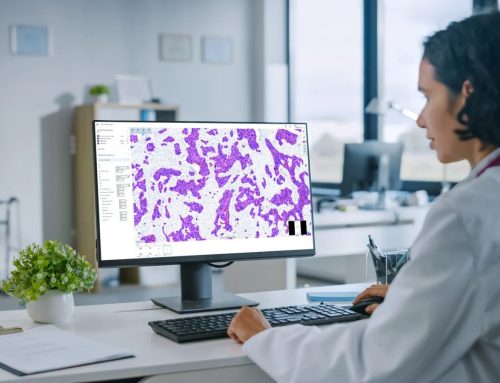
Traditionally, pathologists diagnose cancer and rare diseases by looking for abnormalities in tumor tissue and cells under a microscope. However, that is a time-consuming process often prone to errors. With the advent of whole slide imaging, pathologists are slowly migrating to a fully digital workflow.
Whole slide imaging involves digitizing tissue samples from glass slides using digital scanners, enabling clinicians in histopathology, immunohistochemistry, and cytology to view, manipulate, interpret, and store images to optimize their workflow. Digitization also allows pathologists to interpret images using computational approaches, with the potential to improve accuracy, reduce inter-observer variability, and provide new insights from a patient’s biopsy. Ultimately, digital and computational pathology workflows will help clinicians and researchers discover, diagnose, and treat diseases like cancer faster.
For interpretation, computational pathology requires meticulous preprocessing and algorithmic processing, which represent a challenge for traditional computers, on-premises, and cloud solutions. Loading whole slide images (WSIs) from a disk into memory and then processing the tiled image can be immensely time-consuming. With resolutions often surpassing 100,000 x 100,000 pixels, WSIs are extremely large files and amplify the computational burden.1

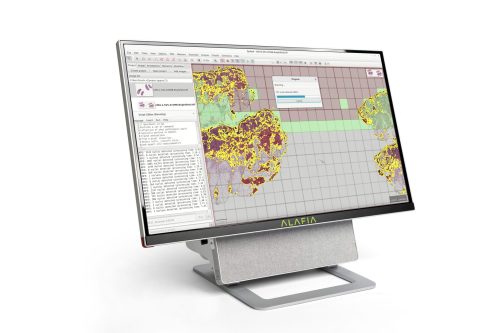
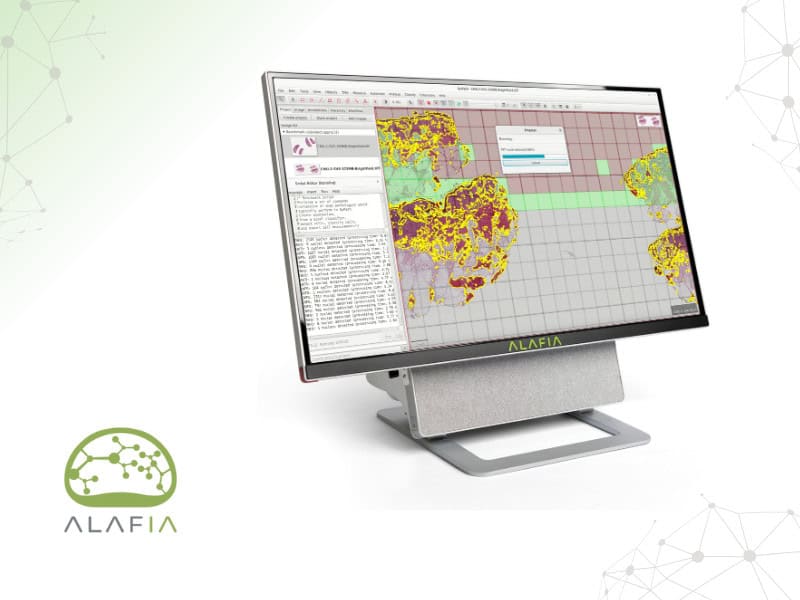
Figure: QuMark benchmark demonstration on the CMU-1 whole slide image (H&E-stained skin with sebaceous glands). The gif shows the original image application of a pre-trained pixel classifier, tile-based parallelized processing, and cell segmentation and classification within QuPath.
The turnaround time for most state-of-the-art diagnostic algorithms can range from one hour to multiple days. When a cancer patient is in the hospital or anxiously waiting at home for diagnostic results, every hour and day counts. What’s more, the cost to health systems and insurance companies can be upwards of tens of billions of dollars annually.
ALAFIA leverages high-performance computing (HPC) architecture to accelerate highly parallel workloads and algorithms commonly used in digital pathology, computational pathology, and spatial biology. Using QuPath, an open-source application for bioimage analysis, ALAFIA Supercomputers successfully executed QuMark, a standardized open-source benchmark developed by Dr. Mark Zaidi.2 QuMark uses a publicly available whole slide image (CMU-1) from an Aperio scanner via OpenSlide, and benchmarks QuPath’s ability to run a pretrained AI pixel classifier to generate annotations, perform cell segmentation and classification, and export measurement data. On the ALAFIA Supercomputer, the full workflow was completed in under 35 seconds.
“Speed is just one part of the story,” said Dr. Mark Zaidi. “Another key advantage over cloud computing is that hospitals are often reluctant to adopt cloud-hosted solutions due to the risk of PHIPA or HIPAA violations in the event of a data breach. By providing an on-premises solution that doesn’t require extensive HPC knowledge, ALAFIA are making digital pathology more secure and accessible for clinical practices.”
Below is an example of the performance delivered by the ALAFIA Supercomputer for operations typically carried out by a pathologist or bioinformatician in QuPath.

ALAFIA Supercomputers Computational Pathology Benchmark Results
To learn more about how to accelerate and execute a digital pathology migration and harness the full potential of your computational pathology tools, reach out to the ALAFIA team. The team have a private suite overlooking the beautiful Seaport Harbor and can offer you a live demonstration of the real time cancer diagnostic during BioIT, April 2-4th.
Learn More
Alafia Ai, Inc. (“ALAFIA”) provides interactive high-performance precision medicine personal supercomputers to perform real-time analysis and visualization of large and complex patient records at a clinician’s desk side.
In addition to his work on QuMark, Dr. Zaidi leads Spatial Multiomics Consulting, a specialist advisory firm offering expert guidance in digital pathology and spatial biology. The firm helps laboratories integrate cutting-edge spatial multiomics technologies into their workflows through personalized AI solutions, open-source tools, and tailored training — empowering researchers to drive innovation in biomedical research and precision medicine.
References
- Buntz, B. (2025) How the startup Alafia Supercomputers is deploying on-prem ai, Research & Development World. Available at: https://www.rdworldonline.com/how-the-startup-alafia-supercomputers-is-deploying-on-prem-ai-medical-research-and-clinical-care/ (Accessed: 02 April 2025).
- MarkZaidi (08 July, 2021) Markzaidi/QuMark: A standardized benchmark for evaluating QuPath performance, GitHub. Available at: https://github.com/MarkZaidi/QuMark (Accessed: 02 April 2025).
Source: ALAFIA