By David Clark
Part 1 closed with a prediction: the consequences of the missing strategic foundation would become concrete the moment implementation began. What followed presented as a series of isolated local difficulties. They were nothing of the kind. The same systemic failure played out across the country, laboratory after laboratory, each one rediscovering the same blockers, paying the same costs, losing the same time
The LIMS Trap
The Laboratory Information Management System is the operational backbone of every pathology service, managing the entire lifecycle of a specimen from receipt to result: tracking, workflow, reporting, and the communication of results to clinical teams. In most NHS laboratories, LIMS platforms are legacy systems, often decades old, built on vendor specific architectures with limited interoperability and local customisation deeply embedded in the operational routines of the service.
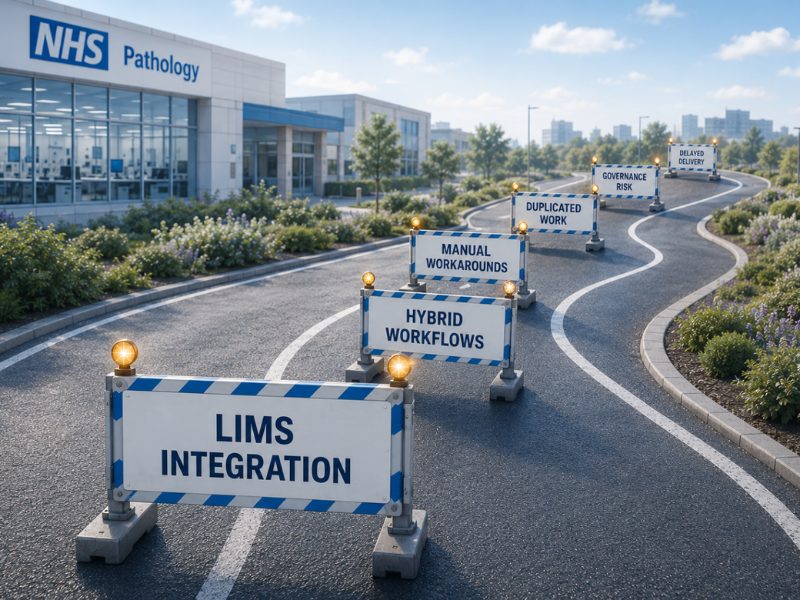
For digital pathology to function as a genuine operating model, the whole slide image must be linked to the patient record, the request, and the clinical workflow. That linkage runs through the LIMS. Without validated integration between the digital pathology platform and the LIMS, the pathologist reporting digitally is disconnected from the information system that gives the image its clinical meaning. The result is manual workarounds, duplicated data entry, broken audit trails, and governance risk. Without LIMS integration a scanner becomes an expensive impediment to the workflow. The dependency was documented before the scanners arrived: the College Bulletin was warning in 2017 that shared LIMS across networks would not happen without central funding, and that consolidation plans depended on it.
What came next is a classic example of what happens when Flyvbjerg’s first principle, “Think slow, act fast” is disregarded.
When LIMS integration was finally attempted, many implementations discovered that direct connection between the digital pathology platform and their existing LIMS was simply not possible without additional middleware, typically specimen tracking software that could bridge the two systems. This middleware had not been identified during planning, had not been costed, and had not been included in project budgets. Implementations stalled, waiting for additional funding that was uncertain, slow to materialise, and in some cases never came. Changes to LIMS in the NHS are generally slow and complex projects – for example at Barts Health, rationalisation of 3 LIMS into a single system required a multi-year programme of work. That scale of dependency, identified early enough, should have restructured the entire implementation sequence at a national level. Instead it surfaced after digital pathology contracts were signed and budgets were fixed, at precisely the point where course correction was most expensive and most difficult.
The Missing Feedback Loop
What makes this failure particularly instructive is not that LIMS integration was difficult. It is that when it emerged as a critical path blocker in early deployments, the system had no mechanism to recognise what that signal meant at programme level. Each trust treated it as a local operational issue. There was no structured process for detecting these early warning signs, reclassifying them as systemic risk, and propagating that learning across deployments that had not yet reached the same point.
Flyvbjerg emphasises the importance of tight, rapid feedback loops in both the early planning phases, where computer modelling can be useful, and in the implementation phase where he advocates a modular approach with “positive learning” to give real world feedback that can be used to improve each cycle of deployment.
The moment LIMS integration was identified as a blocker in any single deployment, it should have triggered a mandatory assessment of integration readiness across every site, becoming a gateway condition: no project funding agreed, no implementation plan signed off, until the integration pathway was mapped, costed, and sequenced. Instead, the same discovery was made independently in laboratory after laboratory. The NHS was generating the raw material for its own internal reference class, precisely the kind of real-world evidence Flyvbjerg argues should anchor programme planning. It went unused
The absence of a systematic mechanism for early identification and escalation of systemic risk guaranteed that the programme as a whole could not learn. The next wave of investment in digital diagnostics must place that kind of mechanism at the heart of programme design. Without it, the same patterns will repeat.
A System of Systems With No Design
LIMS integration was the most visible failure point, but not the only one. Digital pathology is a system of systems: whole slide scanners, image management platforms, LIMS, reporting interfaces, network infrastructure, information governance frameworks, and AI-powered computational pathology tools. For the whole to function, every component must be specified, integrated, and validated in relation to every other.
This is a systems engineering problem. It requires structured analysis that maps the full architecture before any component is procured, identifies the interfaces and dependencies between systems, and sequences implementation to respect those dependencies. That work was not done. Integration was assumed rather than specified and tested, and the full architecture of the intended operating model and system boundaries were never drawn. Systems that had never been designed to work together were expected to do so, and the workforce was left to solve in operational time problems that should have been resolved in planning.
The Hybrid Trap
Many laboratories found themselves running both in parallel, scanning slides and reporting digitally for some cases while continuing conventional microscopy for others, with manual processes bridging the gaps. For many services this became the default operating model, absorbing additional time and resources rather than releasing it.
This was compounded by the lack of a clear vision for the future operating model. Was it a fully digital workflow? The goals attached to funding were unclear – some set a target of 80% digital reporting (Nottingham) – there was no system-wide consensus around 100% digital reporting as the final goal.
A Lean analysis would have identified this immediately as a system generating waste at scale: duplicated effort, unnecessary handoffs, extended turnaround times, and a workforce carrying the cognitive burden of two fundamentally different workflows simultaneously. But Lean and systems design expertise was largely absent from deployment teams. Workflow redesign, the structured work of mapping the current state, designing a future state, and building the standard work to sustain it, did not happen.
The new workflow was layered on top of the old one. Hybrid systems carrying both glass slide and digital workflows are not uncommon several years into implementation. However, there is no published data on what proportion of cases are reported digitally in the NHS. The NICE Health Technology Assessment for Artificial Intelligence technologies to assist histopathology for prostate cancer diagnosis (ID ID6684) published in April 2026 reports that 25 of 27 pathology networks have begun digital reporting, approximately 80% of acute and specialist trusts are using digital images for primary diagnosis and about 51/130 acute trusts are digitally reporting more than 50% of cases. However the source for this data is not disclosed.
What This Means for the Workforce
The people working inside this system, consultant pathologists, biomedical scientists, laboratory managers, IT teams, were not failing to deliver digital pathology transformation. They were responding rationally to an environment that had handed them technology without architecture, integration, and a blueprint for redesign and transformation. The hybrid trap was the predictable result of imposing change on a system that had not been prepared to receive it.
By the time the scale of these challenges became clear, capital funding had already been committed and budgets fixed. The sunk cost fallacy then operated as a structural force: the path of least resistance was to keep going rather than stop, reassess, and redesign. The result was a workforce stretched across two operating models, neither fully functional, carrying costs the original business cases had not anticipated.
That is the position in which many services now find themselves. Part 3 examines what it means for engagement, training, and the sustainability of the programme as pump-priming funding runs out.
Explore more from the series
- How NHS digital pathology obeyed the Iron Law of megaprojects – Part 1: The Strategy Gap and the Iron Law
- How NHS digital pathology obeyed the Iron Law of megaprojects – Part 2: The Critical Path and the LIMS Trap
- Part 3: Engagement, Training, and the Sustainability Cliff
- Part 4: The Masterbuilder’s Path to Recovery
References
- Flyvbjerg, B. and Gardner, D. (2023) How Big Things Get Done. London: Macmillan.
- NICE Health Technology Assessment for Artificial Intelligence technologies to assist histopathology for prostate cancer diagnosis (ID ID6684) https://www.nice.org.uk/guidance/gid-ta11958/documents/final-scope?utm_source=chatgpt.com
No audio available for this article yet.