Color calibration and standardisation are complex. A significant degree of variation in color exists between different WSI systems. In addition, the method by which WSI systems observe color is different from the way the human eye does. The FDA is aware of this and emphasizes the importance of accurate and precise color reproduction in WSI systems. [1] The Sierra Slide is capable of correcting pixel color when altered by the scanning process, returning pixel color to its ground truth.
- U.S. Food and Drug Administration. (2016). Technical Performance Assessment of Digital Pathology Whole Slide Imaging Devices: Guidance for Industry and Food and Drug Administration Staff. IV(B)(1). Color Reproducibility. Retrieved from FDA
How It Works
Making Use Of ICC-standardised Color Profiles To Calibrate WSI Devices
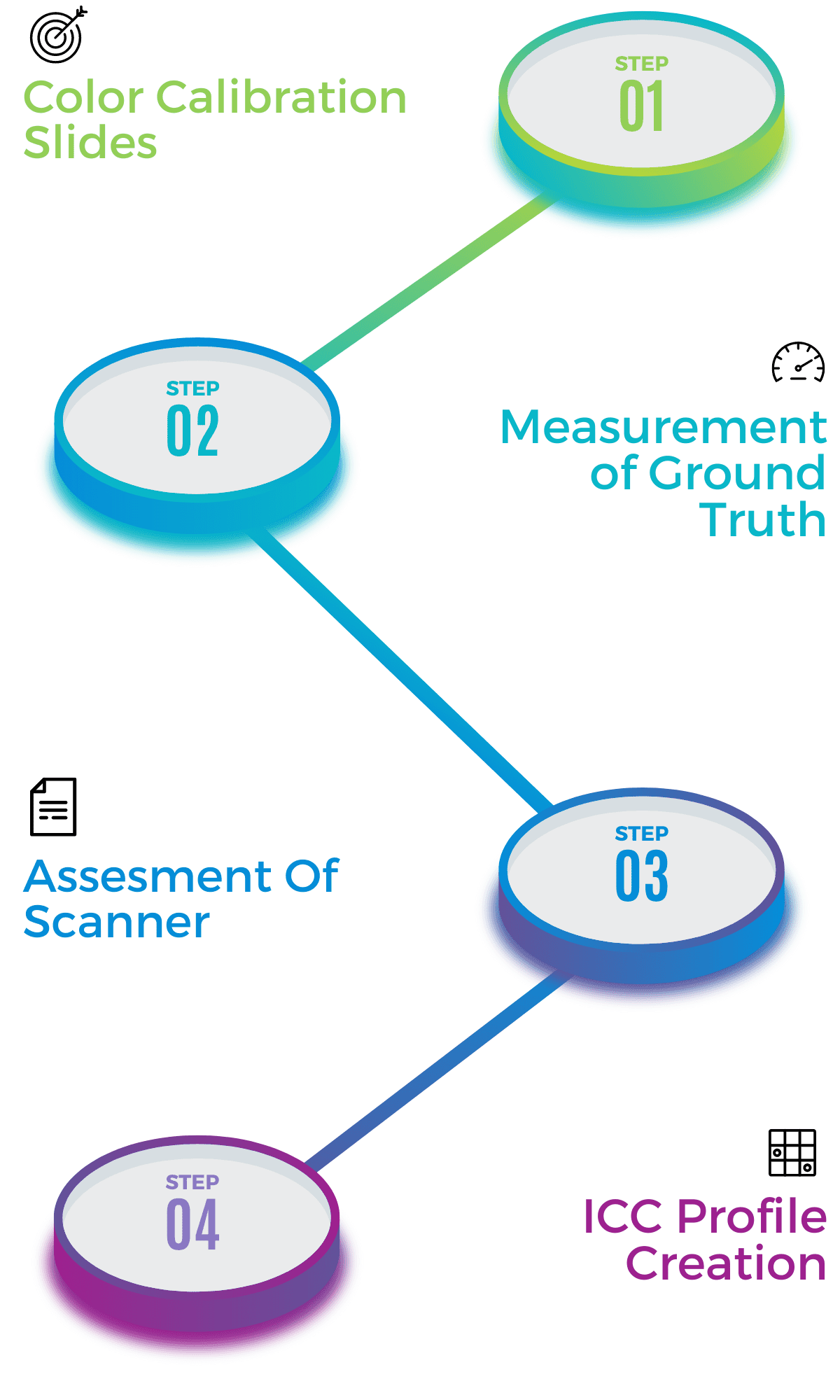
STEP 1: Production of Color Calibration Slides for Pathology
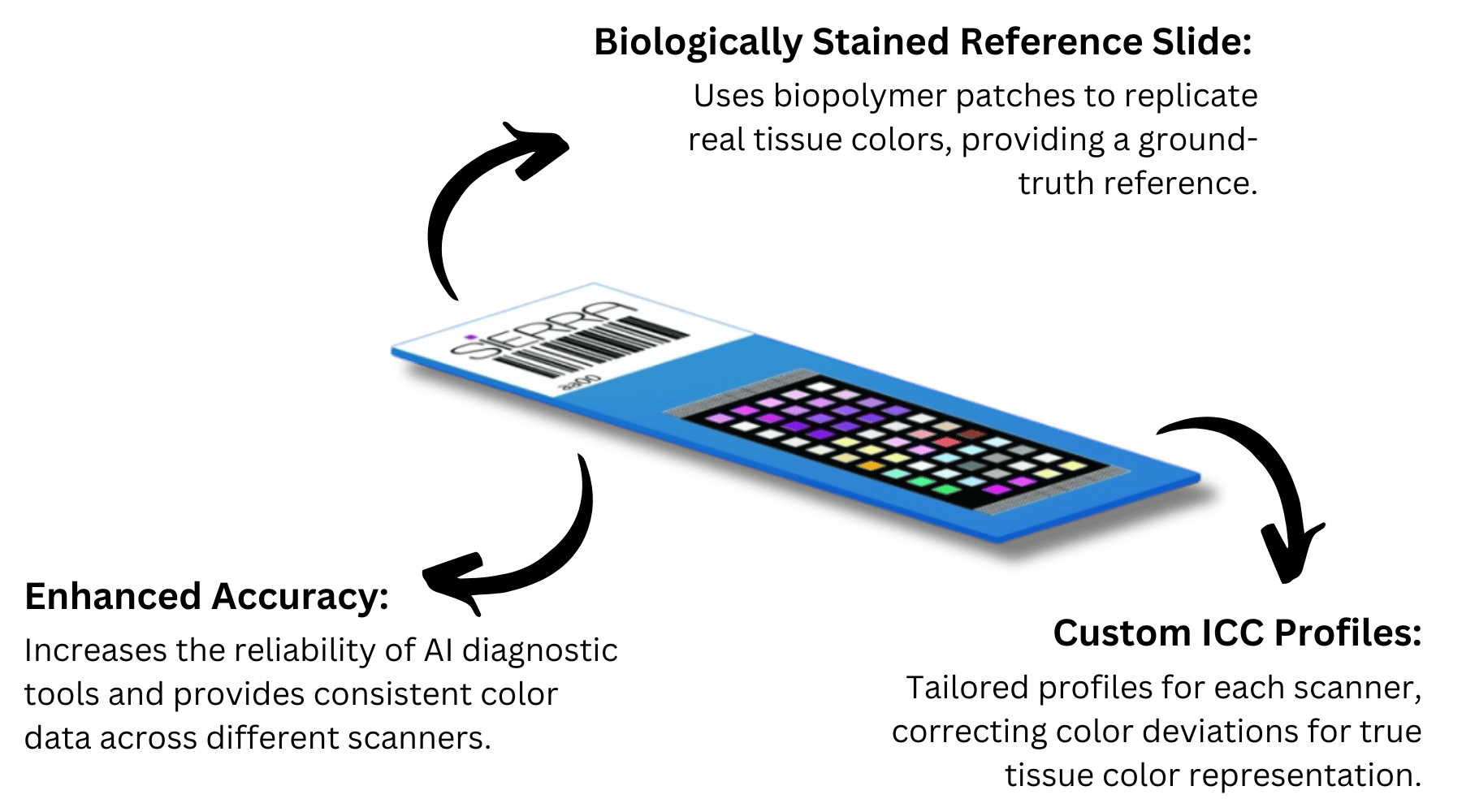
A slide with a number of histologically stained patches that precisely mimic stained tissue
Step 2: Measurement of Ground Truth
The spectral absorption of commonly used pathology stains is then measured using a high-precision spectrophotometer
Step 3: Assessment of Scanner
The Sierra slide is scanned by the WSI instrument to be calibrated. Error can be calculated by comparison to the real spectral data.
Step 4: ICC Profile Creation
With ‘error’ for each color quantified, generic color profiling can be updated with the device – specific ICC profile. This is used to correct the output so the digital image has ground truth color.
Deployment Opportunities For Sierra Color Calibration Slide
Often color calibration is discussed as an ‘end of process’ activity. In reality color calibration can be performed at many stages of WSI production and lifecycle.
- RETRO PROFILING –Manufacturers can color calibrate their installed base as part of routine software upgrades.
- PRODUCTION – Manufacturers can test and calibrate every scanner at the point of production.
- TECHNICIANS – Every lab armed with its own calibration slide and software can test and calibrate their scanners – checking them on a regular basis to ensure accuracy and uniformity.
- FIELD SERVICE ENGINEERS – Engineers have the ability to ensure their entire scanner portfolio remains in calibration alignment.
- DEVELOPMENT – Calibrate scanners being used for AI.
- GO-TO-MARKET – Facilitate means of measuring and calibrating all scanners used by clients to ensure quality of data and accuracy of AI software.











Reviews
There are no reviews yet.