Breakthrough study shows 87% concordance with genomic assays, opening new frontiers in precision oncology.
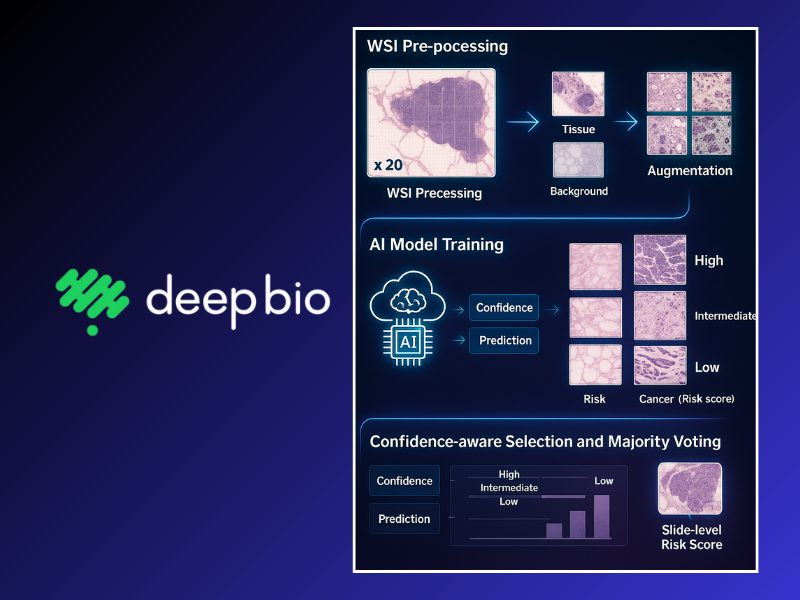
Deep Bio Inc., a global leader in AI-driven digital pathology, today announced the publication of its breast cancer recurrence risk prediction study in Nature Scientific Reports. The peer-reviewed research demonstrates that Deep Bio’s deep learning model can accurately predict recurrence risk from routine H&E-stained pathology slides — achieving 87.75% concordance with the Oncotype DX 21-gene assay.
By learning molecular-level features directly from tissue morphology, the model achieved 91.2% accuracy in identifying high-risk cases, showing strong correlation with histologic grade (Pearson r = 0.61). This innovation represents a potential shift in how oncologists assess recurrence risk, eliminating the need for costly and time-consuming genomic testing.
“Our AI demonstrates that critical genomic insights are already encoded in tissue morphology,” said Dr. Hyeyoon Chang, Head of Pathology AI Research at Deep Bio and co-corresponding author. “This finding opens the door to affordable, scalable precision oncology — especially where access to genomic testing is limited.”
The study, conducted in collaboration with Korea University Guro Hospital and the National Cancer Center, analyzed 125 early-stage, estrogen- receptor–positive, HER2-negative breast cancer cases. Class activation maps revealed that the AI model learned clinically relevant morphologic patterns, including mitotic activity and tubule formation, aligning closely with expert pathologists’ assessments.
“This breakthrough underscores how AI can bridge morphology and molecular biology,” said Sun Woo Kim, CEO of Deep Bio. “It not only accelerates diagnosis but also enables partnerships with pharmaceutical and research organizations to discover new prognostic and predictive biomarkers.”
Advancing Digital Pathology and Precision Medicine, Deep Bio’s research adds to growing evidence that deep learning can infer molecular and prognostic signatures directly from digital pathology. The company is actively seeking collaborations with biopharma companies, research institutions, and diagnostic laboratories to extend this work into large-scale validation studies and biomarker discovery projects.
About Deep Bio
Founded in 2015, Deep Bio Inc. develops AI-powered solutions for cancer pathology diagnostics, utilizing advanced deep learning technologies to enhance diagnostic precision and pathologist efficiency. The company specializes in in-vitro diagnostic medical device software (IVD SaMD) that integrates data-driven insights to support clinical decision-making.
Deep Bio’s flagship AI solution, DeepDx Prostate, marked with European CE-IVD, processes Whole Slide Images (WSI) to identify and segment cancerous lesions accurately.
The software provides comprehensive classification by Gleason pattern, precise tumor localization, and critical metrics such as Gleason score quantification and tumor volume assessment, essential for diagnosis, prognosis, and treatment planning.
This AI technology enables detailed analysis and reporting, supporting healthcare professionals with precise diagnostic insights. In 2024, Deep Bio was recognized for its innovation with the CES Innovation Award. The company remains committed to transforming pathology workflows and improving patient outcomes worldwide.
Share this article



Follow us
Get Pathology News Delivered to Your Inbox