by Christos Evangelou, MSc, PhD – Medical Writer and Editor
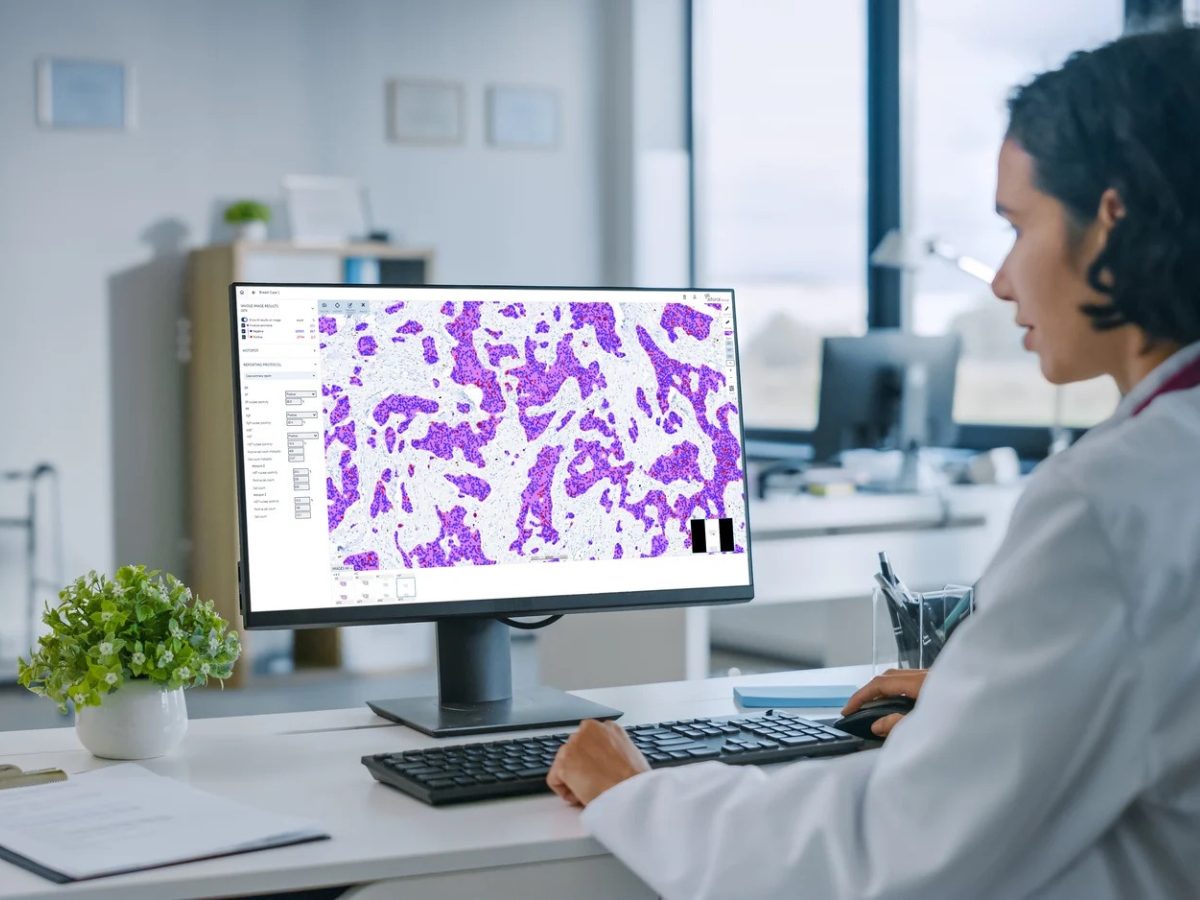
Digital pathology is revolutionizing how medical professionals analyze tissue samples, but its widespread adoption faces significant hurdles due to proprietary systems’ high costs and interoperability challenges. To address these challenges, researchers have developed Mainecoon, an open-source web viewer that integrates artificial intelligence (AI) capabilities with digital pathology workflows while adhering to DICOM standards. This open-source solution, validated through international testing and real-world implementation, promises to make advanced digital pathology tools more accessible to healthcare institutions worldwide.
The report was published in the Journal of Imaging Informatics in Medicine.
The Unmet Need in Digital Pathology
Although digital pathology offers several advantages over traditional microscopy, including remote analysis and AI-assisted diagnosis, its implementation faces several challenges, particularly in resource-limited settings.
“As AI gains traction in digital pathology, many AI model providers offer closed, all-in-one solutions, requiring hospitals to purchase proprietary systems,” explained Dr. Chung-Yueh Lien, Associate Professor at the National Taipei University of Nursing and Health Sciences. “This approach restricts pathologists who wish to use alternative AI models or develop their own, making it difficult for hospitals to integrate AI solutions from multiple vendors.”
The lack of interoperability forces hospitals to deploy separate, non-integrated systems, increasing operational complexity and hindering seamless workflows. Additionally, vendor lock-in limits flexibility in AI selection and reduces bargaining power, further slowing AI adoption and innovation.
“These barriers can particularly impact smaller hospitals or clinics in developing regions, preventing them from fully utilizing digital pathology’s potential,” Dr. Lien added.
Building an Integrated Solution
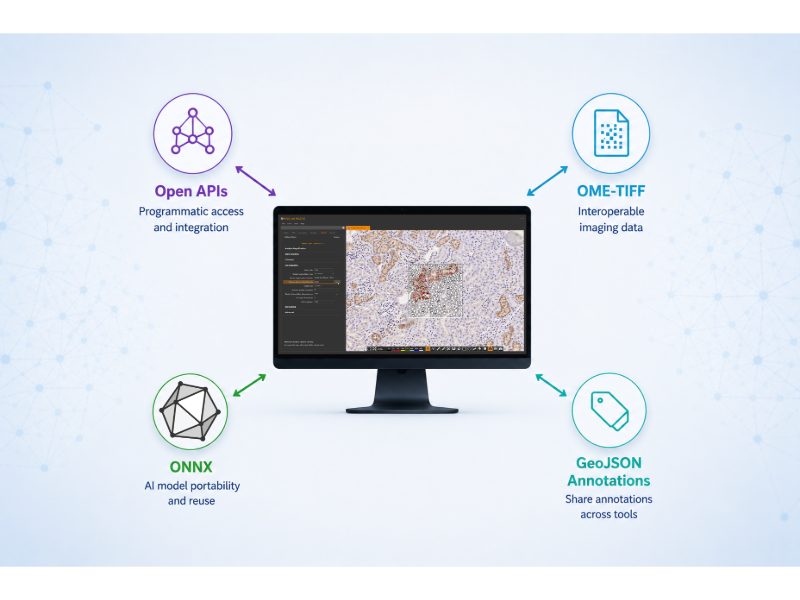
Recognizing the challenges in the implementation of digital pathology systems, researchers at the National Taipei University of Nursing and Health Sciences developed Mainecoon as a comprehensive solution that addresses both technical and practical aspects of digital pathology implementation. Mainecoon was developed using React for the frontend and Node.js for the backend, integrating it with an open-source PACS server called Raccoon.
The platform fully supports DICOM whole slide images (WSIs) and incorporates the Microscopy Bulk Simple Annotations standard for both manual and AI-generated annotations. In addition, the system uses Keycloak for OAuth 2.0 authentication, ensuring secure access control and user management.
“The DICOMweb protocol is secured using TLS to encrypt connections between all OAuth nodes, including the viewer, AI services, and the PACS server,” Dr. Lien noted. “This guarantees the confidentiality and integrity of data during transmission.”
To address the challenge of handling large annotation files, the team implemented streaming and batch-processing techniques. The team also incorporated an AI model for detecting non-alcoholic steatohepatitis (NASH) features in liver biopsies to validate the performance of the platform in clinical settings.
Performance and Scalability
The implementation of streaming technology and batch processing improved data loading efficiency and annotation rendering times. For example, when handling polygon annotations with 335,628 entries, the streaming approach reduced rendering time from 16.74 seconds to 5.59 seconds. Moreover, the system was able to handle WSIs ranging from 0.11 GB to 8.46 GB. First-frame loading times varied from 0.43 to 7.13 seconds on a 54 Mbps Wi-Fi network, demonstrating practical usability in real-world conditions.
Interoperability Validation and Clinical Implementation
Mainecoon participated in the 2024 DICOM WG26 Annotation Connectathon, where it demonstrated successful interoperability with more than ten other vendors. This validation confirmed the ability of the platform to integrate seamlessly with existing digital pathology infrastructure.
“During the Connectathon 2024, we conducted interoperability tests with vendors including Google, 3DHISTECH, Airamatrix, caMicroscope, National Cancer Institute Imaging Data Commons, Pramana, and Techcyte,” Dr. Lien said. “Our results demonstrated the integrity and compatibility of image annotations across different systems.”
Furthermore, pathologists at the National Cheng Kung University Hospital were able to deploy Mainecoon for NASH detection, providing real-world validation of the system’s practical applicability. The implementation included handling diverse pathology cases and integrating with existing hospital workflows.
“The NASH detection model identifies lipid droplet distribution within hepatocytes, quantifies their proportion, and classifies disease severity, providing valuable insights for pathologists in assessing disease progression,” Dr. Lien explained. “By automatically annotating affected regions, AI significantly reduces interpretation time while maintaining consistent pathological analysis based on imaging features.”
Technical Challenges and Solutions
During development and testing of Mainecoon, the team encountered several technical challenges. The conversion of images to DICOM format initially resulted in coordinate system misalignments. The team addressed this challenge by implementing mapping calculations using the DICOM tags TotalPixelMatrixRows and TotalPixelMatrixColumns attributes.
To address challenges with uploading large pathology images, the team implemented a hybrid approach using the C-STORE protocol for image uploads and STOW-RS for annotations. This solution effectively managed timeout issues while maintaining efficient data transfer.
In addition, the team implemented memory management strategies to prevent browser crashes when handling hundreds of thousands of annotations. These optimizations included systematic release of unused annotations and DOM structure optimization.
“When transmitting and processing large annotation data on the frontend, we found that some WSI annotations range from 50 MB to 100 MB, causing significant delays in data transmission,” Dr. Lien explained. “To effectively improve performance, we optimized transmission efficiency using streaming and batch data processing techniques, which significantly enhance performance and efficiency. Streaming technology allows data to begin rendering before the WSI annotation request is fully completed, thereby reducing waiting time and accelerating data display.”
Future Directions
Looking ahead, the research team has outlined a roadmap for expanding the capabilities of Mainecoon.
“We plan to enhance its capabilities by incorporating additional DICOM annotation types and structured reporting features,” Dr. Lien shared. “These include parametric maps, comprehensive 3D structured reports, saliency maps, and segmentation. We will also provide enhanced image handling capabilities, including JPEG2000 lossless compression and decompression support and ICC profile display for accurate color representation.”
The team’s focus on bridging the gap between AI and clinical digital pathology remains central to their development strategy for Mainecoon.
“As we push forward with integrating digital pathology and AI into clinical applications, our focus will be on experimenting with and validating multiple AI models to optimize diagnostic workflows,” Dr. Lien emphasized. “By prioritizing open standards and AI-driven advancements, we are committed to accelerating the adoption of AI-assisted pathology diagnosis, ultimately bridging the gap between research innovations and real-world clinical applications.”
References
- Hsu CW, Yang SW, Lee YT, et al. Mainecoon: Implementing an open-source web viewer for DICOM whole slide images with AI-integrated PACS for digital pathology. J Imaging Inform Med. Published online February 18, 2025. doi:10.1007/s10278-025-01425-6
No audio available for this article yet.
No quiz available for this article yet.