The following abstract is drawn from a recently published paper in Journal of Pathology Informatics. We invite you to read the full paper and join the conversation, become a member of the Pathology News community to share your thoughts, ask questions, and engage with others around this work.
Authors: Zsolt Bedőházia,b, András Biriczb, Oz Kilimb, Nick Fosterc, Barbara Gregusd, Anna-Mária Tőkésd, Péter Pollnere,f, István Csabaib, Beatrice S. Knudseng
Abstract
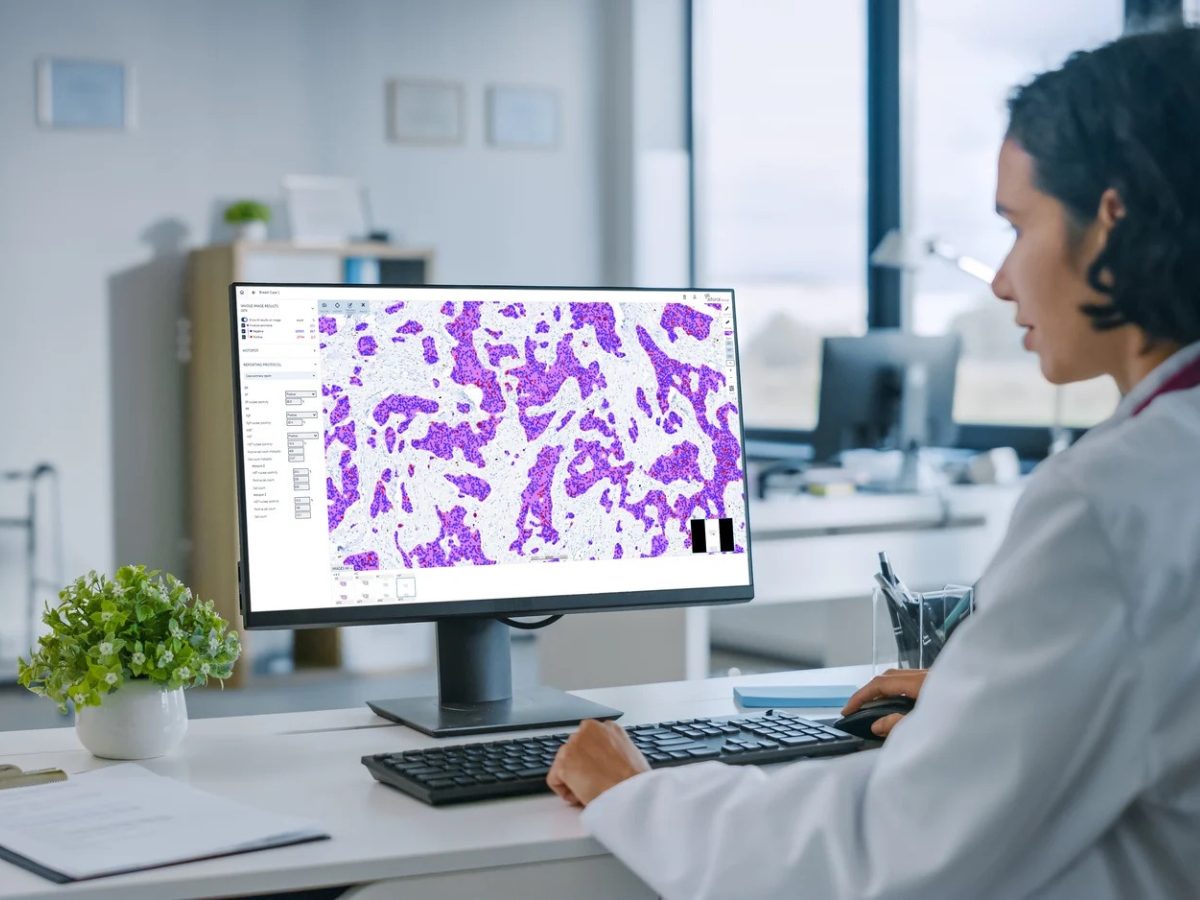
Artificial intelligence shows promise for evaluating primary breast cancer, including nodal status and molecular subtype. Here, we present a resource-aware deep learning pipeline that combines a Vision Transformer feature extractor with an attention-based multiple instance learning (MIL) aggregator to predict pathological tumor-node-metastasis (pTNM) stage from hematoxylin and eosin whole-slide images (WSIs). Motivated by deployment in constrained settings, we operate at 2.5× magnification (≈4.0 μm/pixel), well below the 20–40× typically used in computational pathology. For feature extraction, we evaluated three backbones: (1) the UNI foundation model, (2) UNI fine-tuned on the BReAst Carcinoma Subtyping (BRACS) dataset, and (3) a ResNet-50 fine-tuned on BRACS. The embeddings from the best-performing UNI fine-tuned network were used as input to the MIL model, which was trained and validated on 247 WSIs from 214 patients in the internal cohort. Performance was assessed on three test sets: an internal hold-out from the same cohort (82 WSIs from 72 patients), curated subsets of the Nightingale High-Risk Breast Cancer Prediction (NG) dataset (9489 WSIs from 574 patients), and TCGA-BRCA (731 WSIs from 678 patients), all preprocessed identically at 2.5×. The pipeline achieved area under the receiver operating characteristic curve values of 0.663, 0.672, and 0.632 for the internal, NG, and TCGA-BRCA test sets, respectively. Whereas operating at 2.5× may limit access to fine cellular cues, our results indicate that stage-relevant information can still be captured at this resolution. This study provides a transparent, compute-efficient WSI-only baseline for pTNM stage prediction from WSIs, supporting feasibility in resource-constrained environments.
Read the full article: Deep-learning-based breast cancer stage prediction from H&E-stained whole-slide images in resource-constrained settings – ScienceDirect
- aELTE Eötvös Loránd University, Faculty of Informatics, Budapest, Hungary
- bELTE Eötvös Loránd University, Department of Complex Systems in Physics, Budapest, Hungary
- cUniversity of Chicago Booth School of Business, Nightingale Open Science, Center for Applied Artificial Intelligence, Chicago, USA
- dSemmelweis University, Department of Pathology Forensic and Insurance Medicine, Budapest, Hungary
- eSemmelweis University, Data-Driven Health Division of National Laboratory for Health Security, Health Services Management Training Centre, Faculty of Health and Public Administration, Budapest, Hungary
- fELTE Eötvös Loránd University, Department of Biological Physics, Budapest, Hungary
- gUniversity of Utah, Department of Pathology, Salt Lake City, USA
No summary available for this article yet
No audio available for this article yet.
No quiz available for this article yet.