The following abstract is drawn from a recently published paper in Journal of Pathology Informatics. We invite you to read the full paper and join the conversation, become a member of the Pathology News community to share your thoughts, ask questions, and engage with others around this work.
Authors: David A. Cluniea,⁎, Brian Naporab, John Grothc, Mustafa Yousifd, Gitesh Shelare, Tamás Sárgaf, Sean Bormang, Charles Chengh, Philipp Plewai, Luís Bastião ilvaj, Ryan Birminghamk, Kenneth Philbrickl, Matti Pellikkam, Richard Prestonn, Lucas Tatao, Drew Andersonp, Frank Yangp, Andrey Fedorovq, Saurav Patelr, JiHae Kwons, Michael Knappt, Ty Usreyu, Francisco José Carrasco Tenav, Emilio Madrigalw, Dennis Wangx, Chung-Yueh Lieny, Louise Collinsz, Arjan Somersaa, Aditya Saxenaab, Eric Martinac, Mohannad Hussainad, C.Y. Lien ae, Paul Cramaf, Johan Doréag, Filipe Carreiraah
Abstract
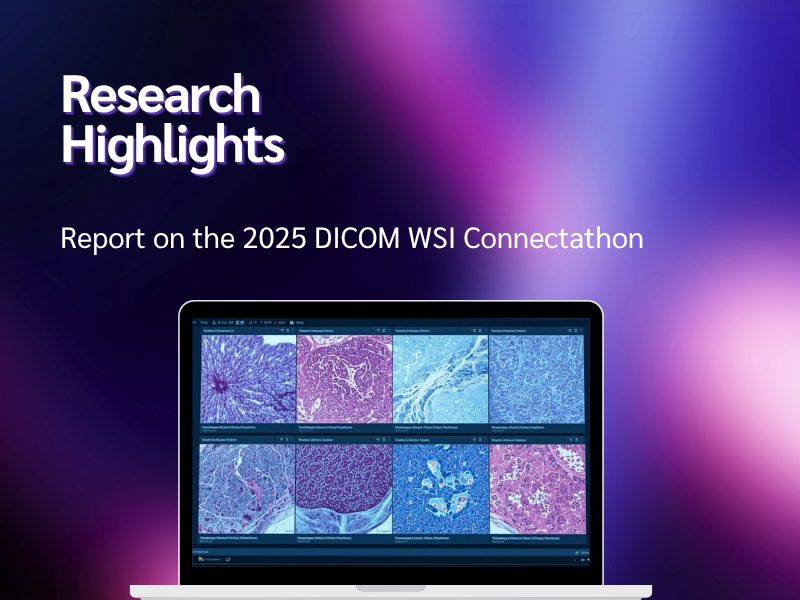
Implementation of a standard such as Digital imaging and Communications in Medicine (DICOM) is key to all aspects of interoperability in whole-slide imaging. But the devil is in the details, so practical testing and demonstration of specific features are needed to show the path forward for practical clinical deployment, select the appropriate profile of features, and identify gaps and opportunities for improvement. The most recent Connectathon was conducted for this purpose, as a virtual Internet-mediated event. Thirty-two (32) implementers in the role of Acquisition Manager (AP-LIS) (2), Acquisition Modality (scanner) (9), Image Manager/Archive (PACS, IMS, or VNA) (7), Image Display (viewer) (15), and Evidence Creator (annotation source) (8) participated. The AP-LIS provided HL7 V2 metadata identifying and describing patients and specimens in response to a slide barcode-based query, which was then incorporated by the scanner into standard DICOM whole-slide microscopy images, which were encoded as tiled pyramids using the TILED_FULL pattern. These images were transferred to the archive using the standard DICOM protocol, and made available for virtual microscopy viewing using the standard DICOMweb mechanisms for query and retrieval of metadata and selected frames. Human and algorithm generated annotations were produced and stored in the standard DICOM annotation format, and transferred and retrieved for display, also using the standard DICOMweb mechanisms.
Read the full article: Report on the 2025 DICOM WSI Connectathon – ScienceDirect
- aPixelMed Publishing
- bGestalt Diagnostics
- cEndeavor Health Northshore
- dUniversity of Michigan (Michigan Medicine)
- eCitiusTech
- f3DHISTECH
- gAgfa
- hAixMed
- iAstraZeneca
- jBMD Software
- kEmory University
- lGoogle
- mGrundium
- nHamamatsu
- oHologic
- pHuron
- qBrigham and Women’s Hospital
- rIdentify.bio
- sInfinitt
- tJ4Care
- uLeica
- vMeditecs
- wMGB
- xNCKU-ALOVAS
- yNTUNHS
- zPathQA
- aPhilips
- abEvident Scientific (formerly Pramana)
- acProscia
- adRadical Imaging
- aeSong Yi System
- afTechcyte
- agVisiopharm
- ahVoicebrook
No audio available for this article yet.
No quiz available for this article yet.