by Christos Evangelou, MSc, PhD – Medical Writer and Editor
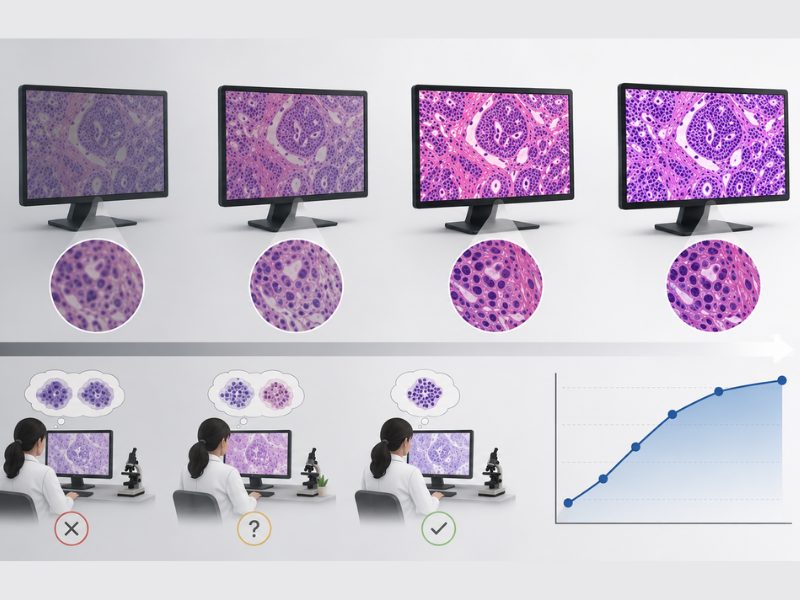
Researchers at ADC Therapeutics, IQVIA Laboratories, and Barco NV compared three categories of digital displays for efficient diagnosis and accuracy. The study showed that the screen a pathologist reads on can make a considerable difference to diagnostic accuracy, with medical-grade displays achieving higher concordance with microscopy than professional- and consumer-grade displays.
The study was published in the Journal of Pathology Informatics.
Study Rationale
Digital pathology has been gradually replacing the conventional light microscope in clinical and research laboratory settings. Whole-slide imaging allows pathologists to review cases remotely, collaborate across institutions, and feed images into AI-assisted diagnostic tools.
Amanda Hemmerich, MD, FCAP, Global Director of Digital Pathology Innovation at IQVIA Laboratories and a corresponding author on the study, explained that, in contrast to scanner quality and viewing software, little is known about the impact of display quality on diagnostic accuracy.
“As we continue to adopt digital pathology, pathologists need to have excellent visual tools to perform their medical responsibilities,” Hemmerich stated in an interview with Pathology News. “For decades, these duties were accomplished with a brightfield microscope for H&E and IHC slides and a darkfield microscope for immunofluorescence, but we now have the capability of reviewing any type of case at one universal workstation. For that, pathologists need the best monitor possible.”
Before committing to a monitor procurement decision for their laboratory, the team wanted empirical data on how the quality of the display would affect diagnostic efficiency and accuracy.
Key Findings
For H&E slides, the medical-grade monitor achieved 100% concordance with the microscope for both observers. Both the Fujitsu and the Dell displays demonstrated 85% concordance with the microscope for Observer 1 and 95% for Observer 2.
Observer 1, who had less digital pathology experience, fell below the 90% concordance threshold on both the Dell and Fujitsu. Observer 2 crossed the 90% threshold on both but still did not reach the perfect concordance achieved on the medical-grade display. Hemmerich explained that even where diagnostic accuracy was reached, the experience of getting there differed.
“Though our pathology assessors were able to arrive at a diagnosis regardless of the monitor used, it came down to the comments received by the pathologists,” Hemmerich said. “The pathologists stated the medical-grade monitor had clearer cellular detail with no evidence of pixelation.”
The consumer-grade display received criticism for suboptimal color reproduction, uneven illumination, and reduced cellular detail. The medical-grade monitor, by contrast, was described as offering uniform illumination, superior color fidelity, and sharp nuclear detail without pixelation.
For IHC slides, both observers achieved 100% concordance with the microscope for HER2 and AMACR on every display type. For MLH1, Observer 1 showed 80% concordance on the medical-grade display, and Observer 2 showed 100% concordance across all modalities. However, the authors emphasized that with only five MLH1 cases, the sample is too small for definitive conclusions. The discordant observer also had less digital pathology experience, and the authors note that MLH1 interpretation can be inherently difficult due to low-level or heterogeneous loss of staining.
Why the Professional-Grade Monitor Did Not Perform Differently From the Consumer Model
The Fujitsu professional-grade display, which has a similar resolution to the medical-grade monitor, showed the same concordance rates as the Dell consumer display. The authors attribute this finding to the fact that the Fujitsu monitor lacks embedded calibration hardware and automated quality assurance mechanisms. Without those features, luminance and color fidelity may deteriorate over time. Consumer-grade and professional-grade displays are also generally optimized for visual appeal or cost rather than the kind of standardized, long-term accuracy that diagnostics require.
Study Implications
According to the authors, if a department is investing in digital pathology infrastructure, the display should not be selected on the basis of consumer or general-purpose professional specifications alone. For H&E image analysis, the difference between medical-grade and other displays led to a considerable diagnostic discordance in this study.
Hemmerich emphasized that the study also raises a broader point about job satisfaction and clinical quality, noting that the subjective experience of using a better display has consequences beyond diagnostic accuracy.
“Experts will have stronger job satisfaction if they are able to use the tools they find to be superior,” Hemmerich said.
Future Work
The authors acknowledged that the dataset was relatively small, and with only two pathologists participating, statistical power was insufficient to perform formal statistical analyses, so results are reported as descriptive. The MLH1 findings in particular cannot support conclusions about display-related effects given the sample size.
The study also assessed all displays against slides scanned at 20x magnification, leaving open questions about performance at higher effective magnifications where pixelation and resolution limitations might be more impactful.
Hemmerich outlined two directions for their follow-up work: “One route is to increase the image sample size to also include low and ultra-low expression IHC biomarkers such as HER2 and include darkfield samples. A second route is to review the more technical differences between the monitors and pathologist reviews to highlight the importance of display calibration for color accuracy and luminance stability.”
This research did not receive any specific grant from funding agencies in the public, commercial, or not-for-profit sectors. Two of the authors are employed by BARCO, the company that manufactures the medical-grade display evaluated in this study.
References
- Saini ML, Hemmerich A, Banach-Ovens A, Manssens H, Dougan R, Kimpe T, Cochran JD. Comparison of digital displays for efficient diagnosis and accuracy. Journal of Pathology Informatics. 2026 Jan 14:100544.
No audio available for this article yet.
No quiz available for this article yet.