The following abstract is drawn from a recently published paper in Journal of Pathology Informatics | ScienceDirect.com by Elsevier. We invite you to read the full paper and join the conversation, become a member of the Pathology News community to share your thoughts, ask questions, and engage with others around this work.
Authors: Benjamin Adjadja,b, Pierre-Antoine Banniera,b, Guillaume Horenta, Sebastien Mandela, Gary Klajer, Aurore Lyon, Kathryn Schutte, Ulysse Marteau, Valentin Gaury, Laura Dumont, Thomas Mathieu, Reda Belbahri, Benoît Schmauch, Eric Durand, Katharina Von Loga, Lucie Gillet
Abstract
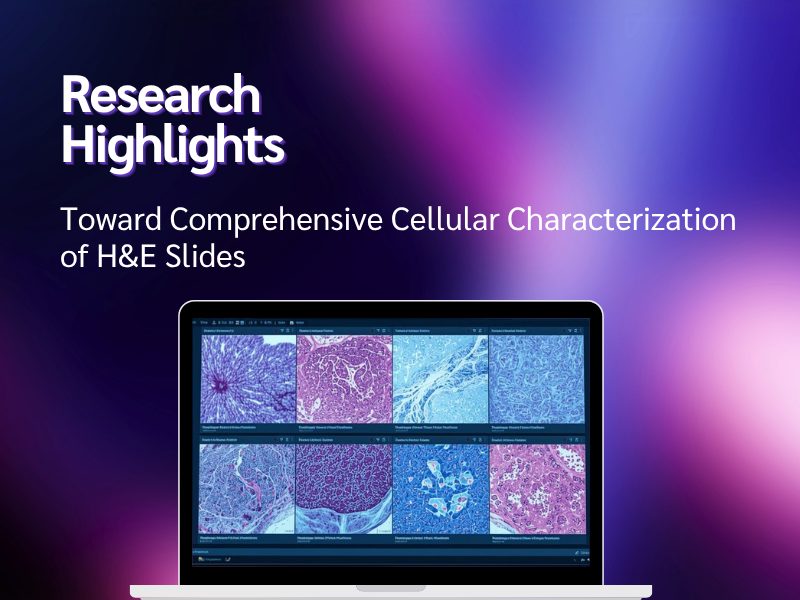
Cell detection, segmentation, and classification are essential for analyzing tumor microenvironments (TME) on hematoxylin and eosin (H&E) slides. Existing methods suffer from poor performance on understudied cell types (rare or not present in public datasets) and limited cross-domain generalization. To address these shortcomings, we introduce HistoPLUS, a state-of-the-art model for cell analysis, trained on a novel curated pan-cancer dataset of 108,722 nuclei covering 13 cell types. In external validation across 4 independent cohorts, HistoPLUS outperforms current state-of-the-art models in detection quality by 5.2% and overall F1 classification score by 23.7%, whereas using 5× fewer parameters. In addition, we show that HistoPLUS robustly transfers to two oncology indications unseen during training and allows interpretable biomarker discovery in downstream tasks, outperforming clinical baselines and prior deep learning methods. To support broader TME biomarker research, we release the model weights and inference code.
Read the full article: Toward comprehensive cellular characterization of H&E slides – ScienceDirect
Owkin France, Paris, France