AIVIS, a leading AI-based digital pathology company, presented new research results at ESMO Asia 2025 demonstrating that AI assistance can significantly enhance consistency and diagnostic accuracy in HER2 immunohistochemistry (IHC) interpretation for breast cancer. The abstract showed that AI-assisted reading improves inter-observer agreement among pathologists and strengthens consistency in identifying patients with HER2-low and HER2-ultralow expression.
Expanding Diagnostic Demands for HER2-Low and Ultralow Cases
Targeted therapies directed against varying levels of HER2 are extending clinical benefit beyond the traditional binary distinction between HER2-positive and HER2-negative, demonstrating efficacy in patients with HER2-low and HER2-ultralow tumors.¹˒² As therapeutic eligibility expands, accurate and reproducible HER2 IHC assessment is becoming increasingly critical for informed treatment decisions.¹˒² However, prior studies continue to report inter-observer variability in HER2 interpretation, particularly in low-expression categories, highlighting the need for tools that improve diagnostic consistency.¹˒²
AIVIS Clinical Findings
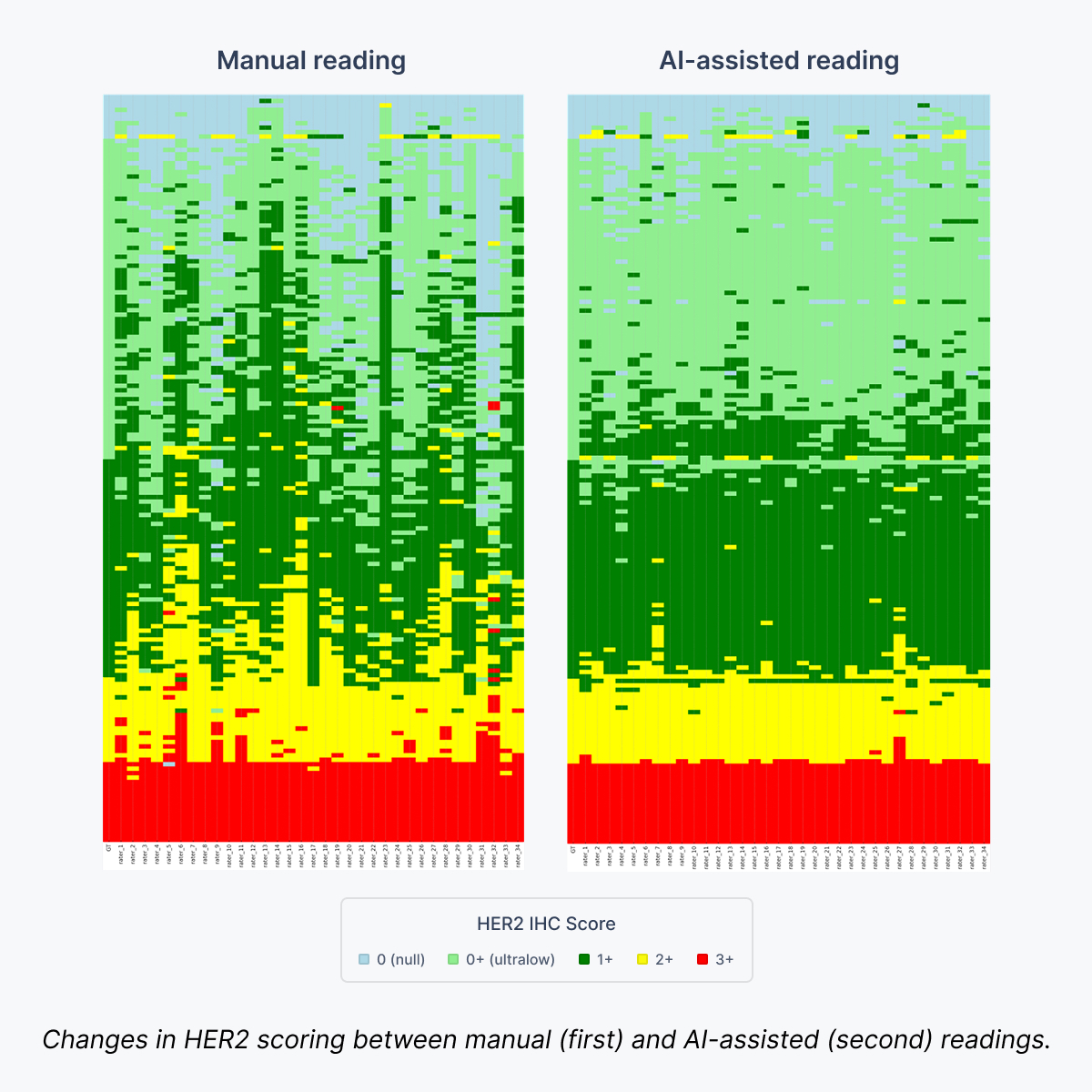
AIVIS conducted a large-scale reader study in collaboration with Samsung Medical Center and the Breast Pathology Study Group of the Korean Society of Pathologists to evaluate whether AI assistance could reduce interpretation variability in HER2 IHC assessment. The study compared manual readings with AI-assisted interpretation using Qanti® Breast HER2, AIVIS’s AI-based quantification solution.
AI assistance resulted in statistically significant improvements across multiple endpoints³:
- 39.6% increase in inter-observer agreement
(Fleiss’ kappa 0.5181 to 0.7232; p < 0.0001) - 16.7% improvement in accuracy for HER2 1+ cases
(0.7586 to 0.8853; p < 0.0001) - 16.4% improvement in accuracy for HER2-ultralow cases
( 0.7397 to 0.8610; p < 0.0001)
Together, these results suggest that AI-assisted HER2 IHC interpretation may help reduce the risk of under- or over-treatment, particularly in borderline cases where therapeutic eligibility has historically been difficult to determine.
Advancing Precision Medicine Through AI and Collaboration
“By enabling consistent and reproducible HER2 IHC evaluation, AI-assisted reading can enhance diagnostic accuracy and support more reliable identification of HER2-low and HER2-ultralow patients,” an AIVIS spokesperson said. “Our goal is to establish a globally recognized diagnostic reference for HER2 through multi-national, multi-center validation in real-world clinical settings.”
The company noted that these findings align with a strategic memorandum of understanding (MOU) signed earlier this year with AstraZeneca Korea, and are expected to contribute to the advancement of a biomarker-driven diagnostic ecosystem in breast cancer. Building on the momentum from ESMO Asia 2025, AIVIS plans to further expand collaborative research with global pharmaceutical companies and clinical research institutions.
About AIVIS
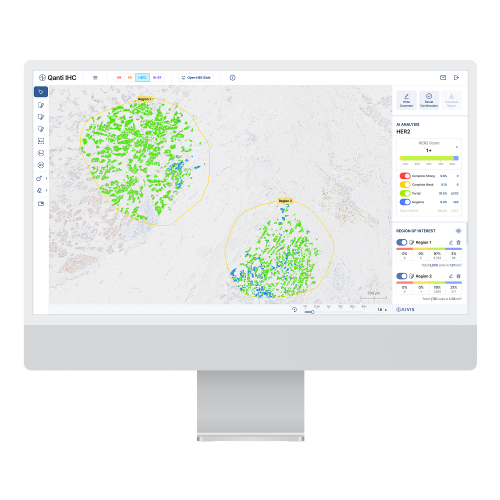
AIVIS is a South Korea-based medical AI company driving innovation in digital pathology. Its flagship solution, Qanti IHC, provides automated quantification of key biomarkers—including ER, PR, HER2, and Ki-67—with exceptional capability in detecting HER2-low and ultralow cases. Backed by MFDS approval and a growing global presence, AIVIS is dedicated to advancing diagnostic accuracy and enabling AI-powered precision medicine worldwide.
References
- Wolff, Antonio C., et al. “Human epidermal growth factor receptor 2 testing in breast cancer.” Archives of pathology & laboratory medicine 147.9 (2023): 993-1000.
- Albuquerque, Daniel Arruda Navarro, et al. “Systematic review and meta-analysis of artificial intelligence in classifying HER2 status in breast cancer immunohistochemistry.” npj Digital Medicine 8.1 (2025): 144.
- Cho, E. Y., et al. “132eP A Nationwide Study of Interobserver Agreement and Accuracy in HER2 Immunohistochemistry According to the 2025 CAP HER2 Scoring Guideline and the Impact of Augmented Intelligence on HER2 Interpretation.” Annals of Oncology 36 (2025): S1809-S1810.
Share this article


Follow us
Get Pathology News Delivered to Your Inbox