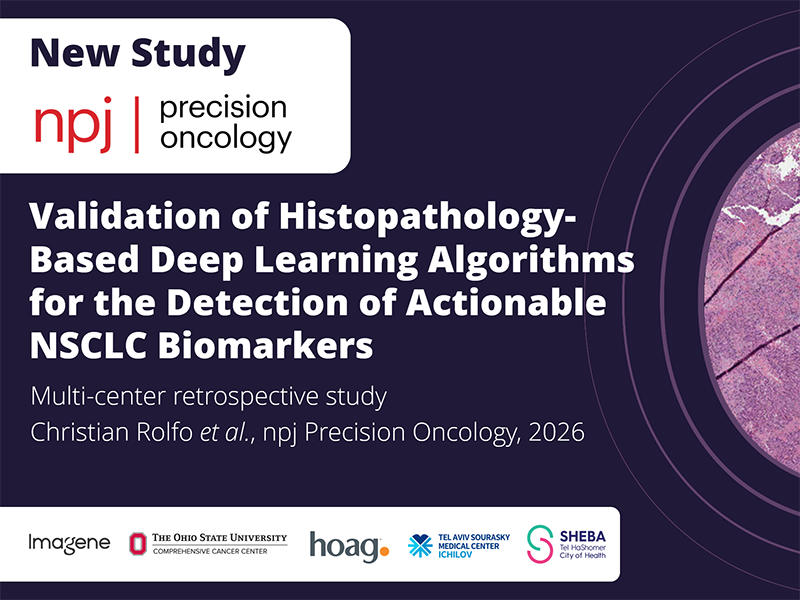
The following abstract is drawn from a recently published paper in Nature – npj Prescision Oncology. We invite you to read the full paper and join the conversation, become a member of the Pathology News community to share your thoughts, ask questions, and engage with others around this work.
Authors: Christian Rolfo, Efrat Ofek, Yoash Barak, Jonathan Weidenfeld, Razan Imad Haj, Yosef Molchanov, Alexander Loebel, David R. Braxton, John S. Cupp, Rinat Yacobi, Chen Mayer, Francesco Drago, Camila Avivi, Nurit Paz-Yaacov, Assaf Avinoam, Jonathan Zalach, Addie Dvir, Inbal Gazy, Nir Peled, Damien Urban, Jair Bar, Dov Hershkoviz & Iris Barshack
Abstract
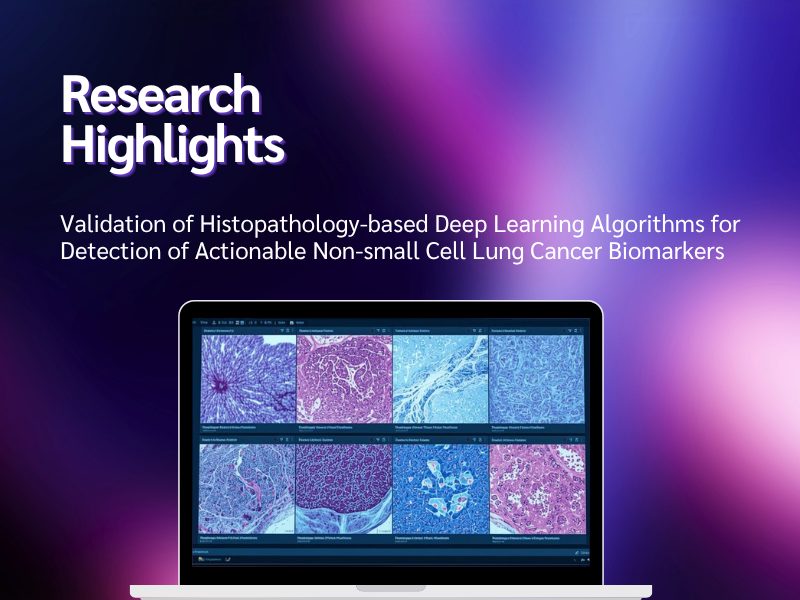
Non-small cell lung cancer (NSCLC) patient management relies on molecular analysis to determine eligibility for targeted therapy. Furthermore, neoadjuvant immunotherapy is primarily suitable in the absence of specific genomic alterations. However, significant challenges remain, including suboptimal molecular testing and patients being assigned to non-optimal treatment strategies. Here, we present AI classifiers for the identification of EGFR, ALK, BRAF and MET alterations directly from hematoxylin and eosin (H&E)-stained tissue using CanvOI 1.1, a digital pathology foundation model. Their performance was evaluated on an independent validation dataset of 968 NSCLC samples. The classifiers achieved AUCs of 0.87 for EGFR, 0.96 for ALK, 0.88 for BRAF and 0.83 for MET. Moreover, they demonstrated high accuracy in identifying cases lacking alterations. Our results highlight the potential of deep-learning tools for the detection of NSCLC biomarkers and specifically the identification of tumors without EGFR or ALK driver alterations, supporting more informed clinical decision-making.
Read the full article: Validation of histopathology-based deep learning algorithms for detection of actionable non-small cell lung cancer biomarkers | npj Precision Oncology
Affiliations
No audio available for this article yet.
No quiz available for this article yet.
Share this article



Follow us
Get Pathology News Delivered to Your Inbox