


This webinar will start at 8:00 PDT, 11:00 EDT, 16:00 BST
Summary
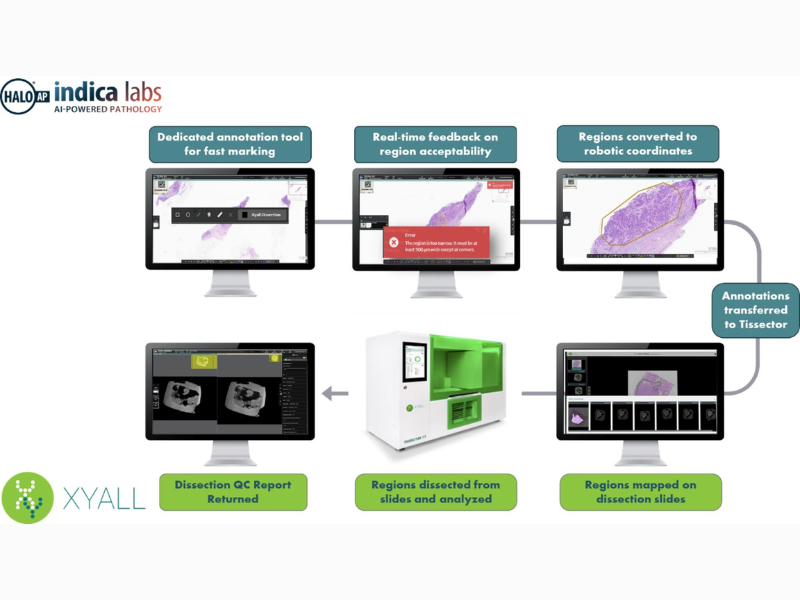
Tissue macro-dissection is the process of physically scraping specific regions of tissue from a histological slide to enrich for that feature for downstream analysis. The overall process is extremely labor-intensive and requires highly skilled staff with a steady hand to collect the requisite amount of tissue scrapes needed for analysis. As the team at the National Cancer Institute (NCI) aims to scale up its capacity and expand macro-dissection efforts, we sought to automate and integrate the macro-dissection pipeline for improved throughput, consistency, and functionality.
To achieve this, we teamed up with Indica Labs and Xyall to develop an end-to-end solution for automating macro-dissection. We leverage functionality in HALO AP®, which is used to assess the quality of the section, identify the target region(s) for dissection, and determine the number of tissue scrapes required. Furthermore, from the data collected, we aim to build more accurate models for predicting the number of tissue scrapes needed and assessing tissue quality for downstream assay suitability.
Learning Objectives
- Learn about the challenges of hand macrodissection and how NCI worked with Indica Labs and Xyall to automate this process
- Learn about NCI’s workflows featuring HALO Macrodissection Solutions
- Learn about the integration between HALO AP® and the Xyall Tissector automated tissue dissection platform
Presenter

Scott M. Lawrence, MS, HT(ASCP)
Algorithm Engineer IV, Associate Scientist
Leidos Biomedical Research
Scott has worked in the field of histotechnology for over 20 years. During this time, he has developed a broad background in all facets of histology and pathology. In recent years, Scott has specifically focused on multiplex immunofluorescence, quantitative digital pathology, and AI development in digital pathology. His expertise in traditional histopathology methods, combined with proficiency in information systems, has enabled him to design and manage digital pathology programs across three separate groups within the NCI.
Currently, Scott leads the digital pathology group that supports the Division of Cancer Epidemiology and Genetics (DCEG) at the NCI. The team manages more than 1.5 million images across several studies and efforts and provides image and data curation, assay development, and analytical support. In addition, Scott consults on and helps identify strategic digital pathology initiatives for the NCI, including supporting the enterprise deployment of HALO and HALO AP®.
