by Christos Evangelou, MSc, PhD – Medical Writer and Editor
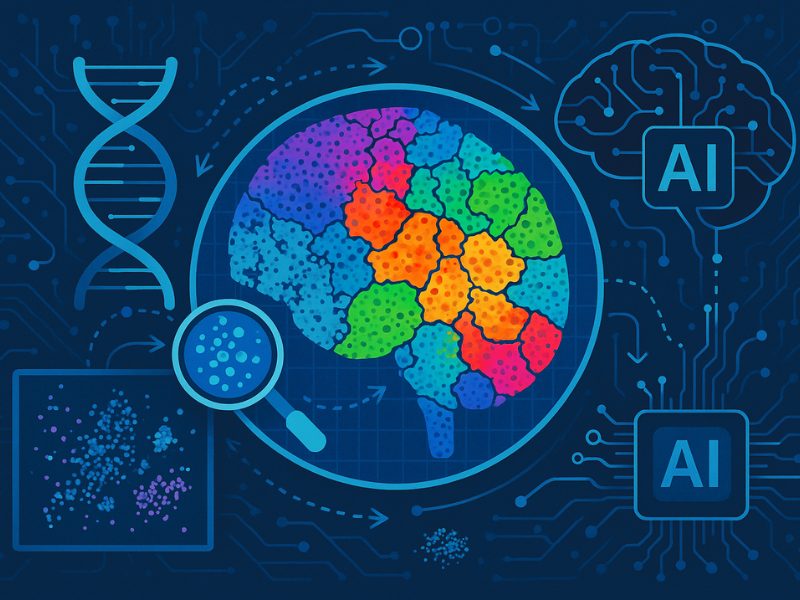
Researchers at Harvard University and the University of Pennsylvania have developed an autonomous AI system to automate the analysis of complex spatial transcriptomics data. The study demonstrates that this Spatial Transcriptomics AI Agent, called STAgent, can convert weeks of expert analysis into minutes of automated processing while providing biologically meaningful insights into human pancreatic development.
The report is currently under peer review and is available as a preprint on bioRxiv.
The Bottleneck in Spatial Biology
Spatial transcriptomics technologies allow scientists to simultaneously capture gene expression and spatial location within intact tissues. However, interpreting spatial transcriptomics datasets typically requires specialized expertise across computational biology, statistics, and domain knowledge. To address this challenge, researchers developed an AI agent that integrates multimodal reasoning capabilities with specialized computational tools for spatial transcriptomics.
"Large language models aren't inherently designed for analyzing complex spatial data, so we had to develop robust retrieval-augmented code generation systems and visual reasoning prompting techniques,"
explained Dr. Jia Liu, corresponding author from Harvard University.
Dr. Liu emphasized that, unlike conventional machine learning approaches limited to narrow, predefined tasks, STAgent leverages the emergent capabilities of multimodal large language models to adapt to novel data, execute multi-step analyses, and generate biologically meaningful insights through a form of scientific reasoning that mimics human expertise.
Tracking Pancreatic Islet Maturation In Vivo
The researchers applied STAgent to study the in vivo maturation of human pluripotent stem cell-derived pancreatic cells (SC-pancreas) transplanted into immunodeficient mice. This model is helpful for testing treatments for diabetes.
Previous studies using single-cell RNA sequencing to analyze transplanted pancreatic cells lacked spatial resolution, leaving questions about cell composition and interactions unresolved.
To address this gap, the team refined STARmap, an imaging-based spatial transcriptomics approach, to profile SC-pancreas grafts at 4, 16, and 20 weeks post-transplantation. STAgent then autonomously analyzed this high-dimensional spatiotemporal gene expression dataset.
STAgent Identifies Developmental Patterns in Maturing SC-pancreas Grafts
The study showed that initially scattered endocrine cells gradually organized into well-defined islet-like structures with predominantly peripheral α-cells surrounding β-cell cores, a pattern resembling native pancreatic islets. By 20 weeks, fully matured islet-like structures with organized α-β-δ arrangements emerged, facilitating coordinated hormone secretion.
Spatial analyses demonstrated that mesenchymal cells progressively formed networks encircling and penetrating endocrine structures, suggesting adaptive stromal responses critical for revascularization, immunomodulation, and trophic support. Endocrine-endocrine cell interactions intensified over time, particularly between α-α, β-β, and α-β cells, indicating functional maturation of islet-like structures capable of coordinated glucose regulation.
The grafts showed progressive vascular integration, transitioning from peripheral angiogenesis at 4 weeks to intra-islet vascular networks by 20 weeks. This integration of a mature vascular network into endocrine structures is critical for delivering oxygen and nutrients. Gene expression analysis using STAgent identified four key themes in β-cell maturation: enhanced β-cell maturation and insulin secretion, cellular plasticity and bihormonal potential, altered cell-cell and cell-matrix interactions, and emerging β-cell population heterogeneity.
Asked about the autonomous analysis capabilities of the agent, Dr. Liu said:
"Unlike traditional analysis pipelines that require human input at every step, STAgent allows for autonomously planning multi-step workflows, identifying relevant analyses without explicit programming, and integrating findings across modalities with contextual understanding. The AI agent excels at processing high-dimensional data, identifying patterns, searching literature online, and generating hypotheses."
Clinical Implications
Dr. Liu foresees STAgent-like AI agents becoming valuable clinical decision support systems for analyzing spatial tissue biopsies, potentially helping identify early signs of beta cell dysfunction or monitoring transplant integration in patients with diabetes.
"A critical advancement needed is the integration of multiple data modalities beyond just omics data, specifically incorporating electronic health records, clinical imaging, longitudinal patient monitoring, and treatment response data," Dr. Liu added. "This multimodal integration would enable more comprehensive and personalized diagnostic insights."
Balancing AI Automation with Human Expertise
Despite the autonomous capabilities of STAgent, Dr. Liu emphasized that human expertise remains essential.
"We've found that STAgent as an AI agent works best as an augmentation tool rather than a replacement for human expertise," he explained. "The AI agent excels at processing high-dimensional data, identifying patterns, searching literature online, and generating hypotheses, but human oversight remains essential for validating conclusions."
Dr. Liu added that the AI agent system can significantly augment scientists' capabilities across different domains of knowledge, enabling biologists to perform sophisticated computational analyses and allowing computational scientists to better interpret biological significance.
For research groups adopting this technology, Dr. Liu recommends
"starting with well-documented datasets in your specific domain for validation before applying it to completely novel samples."
Limitations and Future Directions
Several challenges must be addressed before clinical implementation can occur.
"We need rigorous validation across diverse patient populations, establishing regulatory frameworks for AI in clinical decision-making, developing standardized protocols for sample preparation, and ensuring seamless integration with existing hospital workflows and information systems," Dr. Liu explained.
The ability to connect spatial molecular patterns with patient histories and outcomes is essential for translating these AI agent technologies into clinically actionable intelligence, he added.
Dr. Liu envisions a convergence of spatial technologies with real-time functional profiling and intervention capabilities.
"In the next 5–10 years, we anticipate a convergence of spatial technologies with real-time functional profiling and intervention capabilities, guided by multimodal agentic AI systems," he said. "We'll likely see AI agents enabling the integration of multiple spatial modalities at single-cell resolution across entire 3D organs."
Combining spatial transcriptomics with neural activity recordings, fMRI, and metabolic imaging to link gene expression patterns directly to functional outcomes, all coordinated by sophisticated AI agents, could transform how we interpret complex biological systems, according to Dr. Liu.
Democratizing Advanced Analysis
Dr. Liu emphasized that AI agents such as STAgent could democratize access to spatial transcriptomics analysis by reducing both expertise and time barriers.
"A key advantage is that our AI agent primarily uses commercially available APIs from vision-language model providers like OpenAI, Anthropic, and Google, services that are very affordable and accessible," he said.
This approach also lowers barriers to adoption.
"Smaller labs that couldn't previously dedicate months to specialized computational analysis can now generate meaningful biological insights within minutes at a fraction of the cost," noted Dr. Liu. "This democratization of AI agent technology is central to our mission—enabling researchers everywhere, regardless of computational resources, to focus on their biological questions rather than developing specialized bioinformatics expertise."
References
- Lin Z, Wang W, Marin-Llobet A, et al. Spatial transcriptomics AI agent charts hPSC-pancreas maturation in vivo. Preprint. bioRxiv. 2025;2025.04.01.646731. Published 2025 Apr 4. doi:10.1101/2025.04.01.646731
No audio available for this article yet.
No quiz available for this article yet.