Author: Branko Perunovic
Editor: Sidney Ocanagil-Tunstall
When electricity first entered factories, its immediate attraction was obvious: it could power machinery that had previously depended on steam. Its larger significance took longer to emerge. Once machines no longer had to be arranged around a central source of mechanical power, the factory itself could be organised differently.
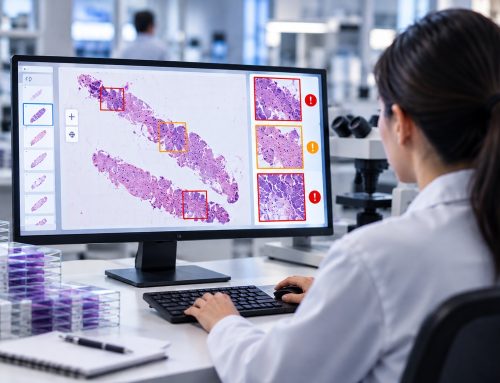
Whole-slide imaging has given histopathology a comparable opportunity. Its first achievement was to separate interpretation from the physical microscope. The more interesting possibility is what follows from that separation. If reporting no longer has to remain where the glass slide was produced, we can begin to rethink how expertise, capacity and diagnostic work are organised across the service.
This three-part series considers what a digital infrastructure makes possible, what would make it dependable, and what it could go on to enable.
Why does this matter?
The demands on histopathology are changing. Workload continues to grow in volume and complexity, while expectations of turnaround, consistency and productivity rise with it. Specialist expertise is scarce and unevenly distributed, and conventional expansion of workforce and infrastructure will not by itself provide all the capability required.
At the same time, services are consolidating, automating, developing new workforce models and beginning to use computational and precision diagnostics. Taken together, these developments create the possibility of organising diagnostic capability differently: using scale where it adds value, specialist expertise where it is needed, and digital infrastructure to connect the two.
What does this mean in practical terms?
It means loosening the link between where diagnostic material is produced and where expertise must sit. A specimen may still be processed, stained and scanned in one laboratory, but its interpretation need not remain tied to that laboratory’s reporting pool. Work could instead be directed towards the appropriate subspecialist expertise, available capacity and clinical priority across a wider service. Consolidation may continue where scale, automation, resilience or specialist concentration justify it, while interpretation becomes more distributed where that adds flexibility and access to expertise. The aim is not to impose a single organisational model, but to create more freedom in how production, interpretation and specialist capacity are combined.
What would this mean for pathologists?
It could mean a more flexible and professionally coherent way of working. Expertise could be contributed across locations, including from home where appropriate, while remaining connected to a real subspecialist team and the clinical pathways that team serves. Work could be matched to competence, capacity and priority, rather than constrained by where a pathologist happens to be based.
Contributions to each case, including primary reporting, consultation, second opinion, supervision and review, could be made visible, attributable and properly recognised. But flexibility only becomes useful if the pathologist can do more, reliably and comfortably, than view the images, assemble a report and sign it off. Pathologists need the relevant clinical context, access to previous episodes where appropriate, the ability to request, track and integrate additional work, to consult colleagues and provide training easily, and always to see what remains outstanding.
Finally, and perhaps most importantly, the system must carry the diagnostic work through to completion, rather than making images available and leaving the rest to be reconstructed around them. That is the practical distinction between remote access and genuinely distributed work: not whether a case can be viewed remotely and a report generated elsewhere, but whether the work can be progressed and completed safely elsewhere. Flexibility should be designed into the service, not added as an exception to it.
Keeping the case together
As work becomes more mobile, the diagnostic episode needs to remain coherent: to retain its epistemic integrity, with evidence and understanding kept connected at every step. A case may pass between people, sites or systems, but the pathologist should be able to pick it up with confidence, understand where it has come from and what has happened, contribute what is needed, and see clearly what remains before completion.
Preserving that coherence requires more than connectivity. Information has to remain connected to the work; allocation and outstanding actions have to be visible; communication must remain easy; responsibility must stay clear; and quality assurance has to work across the boundaries through which the episode moves.
Distributed diagnostic work needs an architecture designed around the episode itself. That architecture does not require one monolithic national system, but it does require the information, operational and quality-management structures to work together closely enough that the pathologist experiences one coherent service rather than a collection of disconnected components.
How far could this go?
The ambition should therefore go beyond digitising existing organisational boundaries. A shared digital platform within one laboratory group or network may be an important step, but the larger opportunity is to organise diagnostic work around where the right capability can be brought to bear, rather than where the case happened to enter the system. The boundary of the legacy service need not become the boundary of the digital one. As interoperability, professional networks and assurance mature, work could move across wider organisational landscapes while remaining clinically coherent and professionally connected.
Reorganisation, not replacement
Seen this way, whole-slide imaging is not a new way of performing the same reporting task. It changes one of the conditions around which histopathology has historically been organised. The opportunity is to use that freedom deliberately: to apply scale where it improves production, distribute interpretation where expertise and capacity can be used better, preserve the coherence of the diagnostic episode, and allow pathologists to contribute more flexibly without losing their clinical and professional connections.
The lesson of electrification is that the gain came not with the first motor but with the reorganisation that followed, and it came slowly, because reorganising work is harder than replacing a technology. Geography need not determine where diagnostic capability can be used, provided diagnosis remains safe, connected and accountable. The next challenge is to build the information, operational and quality architecture that makes that freedom dependable in everyday practice. We explore this in Part 2 of this series.