Author: Branko Perunovic
Editor: Sidney Ocanagil-Tunstall
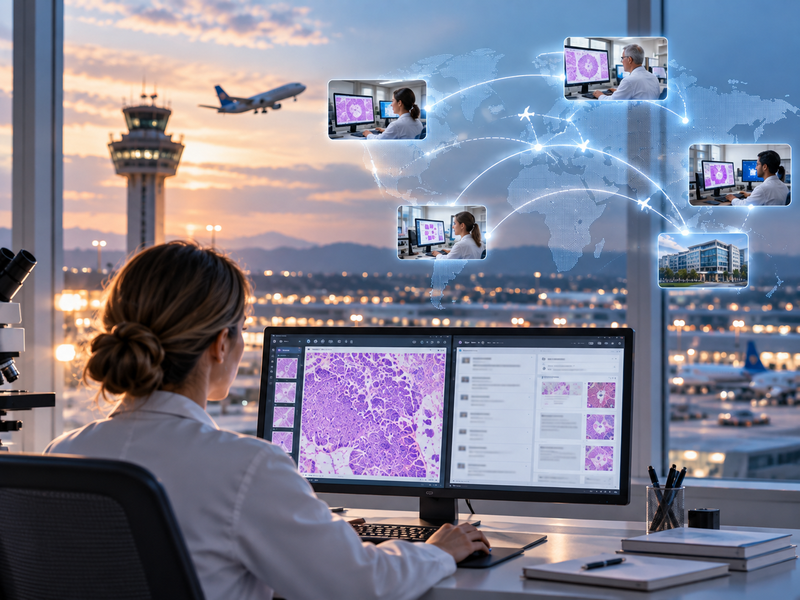
Modern aviation depends on architecture that passengers rarely see. During a single flight, an aircraft may pass between airports, control sectors and national jurisdictions, yet the flight must remain one continuous managed operation. Its identity, route, position, clearances and outstanding actions remain visible as responsibility passes between different people and organisations. Communication and handover are explicit; common standards allow each part of the system to act with confidence in the others.
Air-traffic management does not make aircraft mobile. It makes each contribution to the flight dependable, allowing complex activity to move across boundaries without losing continuity, situational awareness or accountability.
Distributed diagnostic work presents histopathology with a similar challenge. The traditional laboratory achieved much of its coherence almost invisibly through co-location. Slides, laboratory staff, pathologists, clinical information, local knowledge, supervision and responsibility were concentrated within the same organisational space. Questions could be resolved through familiar relationships; uncertainty could be escalated; the location of the work often implied who owned the next action. None of this was perfect, but proximity supplied the connective tissue that formal systems did not always need to provide. Now that diagnostic work is mobile, moving between people, sites and organisations, that coherence can no longer be assumed. It has to be designed.
Keeping the diagnostic episode intact
The answer is not to recreate physical proximity digitally, but to preserve the coherence of the diagnostic episode as the work moves. The clinical question, evidence already generated, previous material, professional contributions, decisions taken and actions still outstanding need to remain connected wherever the next part of the work is undertaken. The episode should not have to be reconstructed afresh at each organisational boundary. A pathologist receiving the work should be able to understand its state, provenance and unresolved questions quickly enough to act with confidence. That continuity is what allows the diagnosis to remain trustworthy as work passes between people and organisations.
The architecture of a distributed service
That begins with an information backbone capable of keeping the diagnostic problem intact. It is not enough for images, reports, molecular results, clinical history and previous material just to exist somewhere in digital form. Their relationships also need to be represented so that the pathologist can see how the evidence fits together, what has already been considered, and what remains uncertain. This does not require replacing every contributing system with a single national platform. Local systems can remain, provided they participate in an architecture that presents the diagnostic episode coherently across them. The realistic aim is not one system, but one coherent diagnostic service in which relevant information is available with the work, rather than reconstructed time and time again from separate applications, messages, and local knowledge.
Information alone, however, does not progress the work. A distributed service also needs an operational backbone that can see where each diagnostic episode is, what has happened, what remains outstanding, who is expected to act next and whether the work is moving towards completion. Making a case visible to another pathologist is not the same as transferring responsibility for it, and sending a request is not the same as ensuring that it has been accepted, performed and integrated. The system therefore needs to make state, ownership and next actions explicit across organisational boundaries. Without that, mobility shifts coordination work onto individuals; with it, diagnostic work can move while continuity of action is preserved.
The third requirement is a quality-management backbone that works across the same boundaries as the diagnostic episode. In a distributed service, assurance cannot stop at the laboratory door. The provenance and technical quality of material must remain clear; the competence and authority of those contributing to the diagnosis must be visible; and exceptions, delays, handovers and additional work need to be traceable. Just as importantly, the interfaces between otherwise well-performing parts of the service become objects of assurance in their own right. A diagnostic system can fail not because any individual component is unsafe, but because information, responsibility or action is lost between them. Quality management therefore has to follow the work, preserving confidence as the episode moves.
A distributed service also needs to preserve the professional relationships through which diagnosis is practised. Consultation, supervision, teaching, informal discussion and multidisciplinary interaction cannot become optional extras simply because the work is digital. If expertise is distributed without an architecture for professional communication, the result risks becoming a collection of isolated reporting transactions rather than a functioning clinical service. The aim should be the opposite: to make it easier for pathologists to find colleagues, ask for advice, contribute to subspecialist teams, review difficult work and remain connected to the clinical pathways they serve. Communication is therefore not a social layer added around the system. It is part of the infrastructure that allows distributed expertise to operate as a professional community.
Responsibility across boundaries
Responsibility therefore must remain explicit as work becomes distributed, and authority must operate at the scale of the work. A pathologist remains responsible for the diagnostic contribution they undertake. At the same time, another team or service may be responsible for additional investigations, and the wider service must ensure that the episode continues to progress. No active diagnostic obligation should be left without a visible next action, an identified person or service responsible for it, and sufficient authority to intervene if progression fails. Lord Carter’s work on pathology networks points in the same direction by emphasising genuine integration rather than loose collaboration between sites. The next step is to extend that logic to distributed diagnostic work itself: where expertise, dependencies and risk cross organisational boundaries, the governance needed to support them must be able to act across those boundaries too.
This is what turns distributed diagnosis from a technical possibility into a dependable operating model. Information, progression, assurance, communication and responsibility have to move with the diagnostic episode, so that flexibility does not come at the cost of fragmentation. The purpose of the architecture is not to control movement for its own sake, but to make movement safe enough to become routine. In that sense, it plays the same role as air-traffic management: not creating mobility, but making complex movement across boundaries trustworthy. But a service designed to move work safely also becomes more legible. Once the diagnostic system can be understood as a whole, that being its capacity, expertise, dependencies and performance, it becomes possible to build capabilities that no individual site could support alone.