The following abstract is drawn from a recently published paper in Journal of Pathology Informatics. We invite you to read the full paper and join the conversation, become a member of the Pathology News community to share your thoughts, ask questions, and engage with others around this work.
Authors: Odile Léa Zoboa,b, Clément Parfait Ndenguec, Laurine Versetd, Lemaire Bodob, Myriam Remmelinkd, George Bedianga, Joseph Mendimi Nkodoa
Abstract
Background
Digital pathology and artificial intelligence (AI) are transforming cancer diagnostics worldwide, yet their implementation in sub-Saharan Africa remains largely undocumented. The region faces a critical shortage of pathologists while bearing an increasing cancer burden, making AI-assisted diagnostics particularly relevant. However, practical deployment in resource-constrained environments raises unique technical, logistical, and educational challenges that differ substantially from those encountered in high-income settings.
Objective
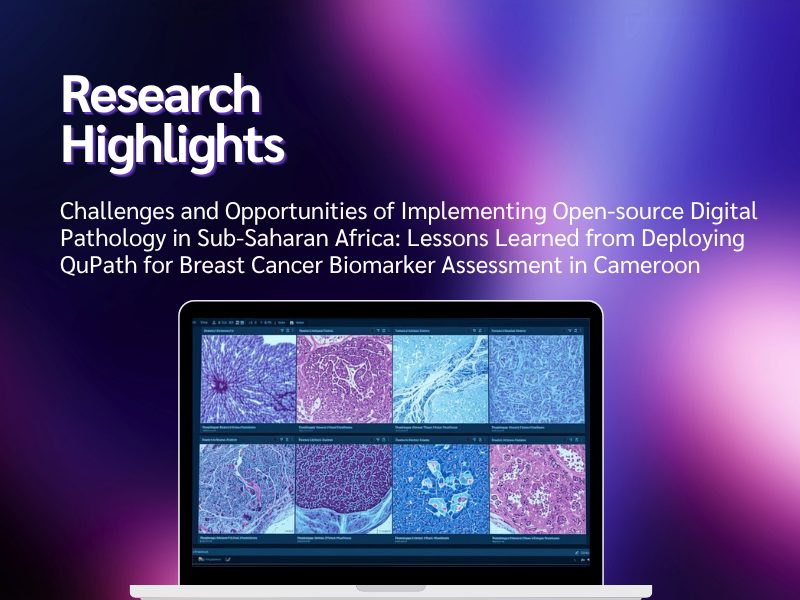
To systematically document the technical, logistical, and practical challenges encountered during the implementation of QuPath, an open-source digital pathology platform, for breast cancer immunohistochemical (IHC) biomarker assessment at a reference pathology laboratory in Cameroon, and to propose actionable solutions for similar resource-limited settings.
Methods
We conducted a prospective implementation study at the Centre Pasteur du Cameroun, Yaoundé, involving 39 cases of invasive breast carcinoma with IHC for ER, PR, Ki67, and HER2. We documented all phases of the digital pathology workflow: pre-analytical slide preparation, slide digitization (performed remotely at Erasme University Hospital, Brussels), image transfer and storage, QuPath algorithm training, and automated analysis on a consumer-grade laptop (4 GB RAM, 500 GB storage). Challenges were categorized into four domains: hardware and infrastructure constraints, pre-analytical and scanning issues, software training and optimization, and human factors including the learning curve.
Results
Of 130 IHC slides, 18 (13.8%) required re-scanning due to detection failures or blurred images despite pre-scanning quality control. The absence of a local scanner necessitated international slide shipment, adding 8–12 weeks of delay and logistical complexity. Processing on a 4 GB RAM consumer laptop averaged 20 min per case (range: 5–60 min), with frequent application freezes on large tissue sections. Image files averaged 1.5 GB each at ×40 magnification, rapidly exhausting the 500 GB local storage capacity. The QuPath random tree classifier required manual annotation of representative tumor, stromal, and lymphoid regions on all 39 HE-stained cases before deployment on IHC slides, representing approximately 15–20 h of pathologist time. Exploratory concordance analysis suggested clinically meaningful agreement with expert pathologist scoring for three of the four biomarkers assessed, with detailed analytical validation reported separately.
Conclusions
Implementing open-source digital pathology in sub-Saharan Africa is feasible but requires strategic planning around infrastructure, logistics, and training. We propose a practical framework addressing minimum hardware requirements, quality control protocols adapted to tropical environments, and a structured training program for pathologists. Our experience demonstrates that despite significant constraints, AI-assisted biomarker assessment can be successfully deployed in resource-limited settings, offering a pathway to improved diagnostic standardization where it is most needed.
Read the full article: Challenges and opportunities of implementing open-source digital pathology in sub-Saharan Africa: Lessons learned from deploying QuPath for breast cancer biomarker assessment in Cameroon – ScienceDirect
aFaculty of Medicine and Biomedical Sciences, University of Yaoundé I, Yaoundé, Cameroon
- bDepartment of Pathology, Centre, Pasteur du Cameroun, Yaoundé, Cameroon
- cDepartment of Pathology, Douala Gyneco-Obstetric and Pediatric Hospital, Douala, Cameroon
- dDepartment of Pathology, Erasme University Hospital, Université Libre de Bruxelles, Brussels, Belgium
No audio available for this article yet.
No quiz available for this article yet.