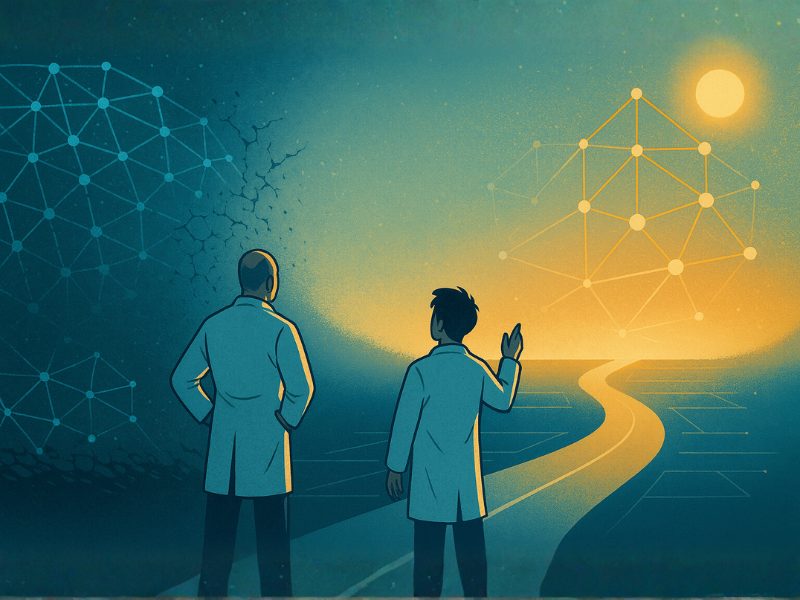
Part 1 traced the classic warning signs of disruption across NHS pathology. In part 2 we continue to apply Clayton Christensen’s theory of disruptive innovation — because disruptive innovations don’t just replace a single technology; they can dismantle entire ecosystems.The downfall of Kodak was not simply about digital cameras replacing film. It was about the collapse of a vast value network: film and chemical manufacturers, photo-finishing labs, and high-street retailers. Once digital photography became “good enough,” the old ecosystem unravelled almost overnight.
NHS value networks now face this same danger. The NHS has invested heavily in digital pathology with the tacit assumption that it will improve the performance of the current service delivery model: digitising existing workflows, integrating scanners with LIMS and PACS, and reinforcing traditional, professional and institutional structures. These are rational investments, but they preserve today’s value network.
Meanwhile, alternative value networks are beginning to emerge, built in foreign geographies, on different economics, using different skills. Outsourcing has already shown how diagnostic services can be commoditised when conditions align. AI-driven platforms, operating at near-zero marginal cost, point to the same possibility on a much larger scale.
Authors: Dr. Branko Perunovic and Dr. David Clark
Editor: Sidney Ocanagil-Tunstall
The Commoditisation Process is Already Here
The clearest sign that disruption is advancing is that commoditisation is no longer hypothetical in pathology — it is already here.
Commoditisation occurs when a service becomes standardised and interchangeable, with providers competing on price and speed rather than on the unique brand value that encompasses professional expertise and trusted relationships. Histopathology outsourcing demonstrates this vividly. During backlog crises, thousands of NHS cases were diverted to external companies offering cost-per-case contracts. These firms operate leanly, avoiding the structural overheads that NHS departments must carry — superannuation, revalidation, time for post-analytical support, teaching, quality management, and leadership duties. The result is an asymmetric threat: providers without these obligations can undercut NHS pathology while still generating attractive margins.
Digital pathology has accelerated this shift. Whole slide imaging enables the global transmission of diagnostic work, creating a marketplace where cases can be allocated to the person who can report the fastest and at the lowest cost. For agile existing outsourcing firms, AI is a natural next step; for completely new entrants, it is the logical first step. Either way, computational pathology tools can be deployed to triage, pre-screen, or even report certain case types at scale.
For the NHS, the risk is clear. What began as a pragmatic response to temporary backlogs could normalise into a different model of service delivery. Pathologists risk being repositioned from integrated consultant roles —key members of multidisciplinary teams (MDTs) delivering care, leading services, teaching juniors, and guiding quality and strategy — to remote "volume reporters" detached from the broader clinical team.
This shift aligns exactly with Christensen's framework. A core job-to-be-done in pathology — routine diagnostic reporting — is now delivered more cheaply and predictably through an alternative value-adding process. The danger:what was once an integrated, relationship-based consultant role fragments into standardised tasks, reassigned to whoever can complete them fastest and cheapest.
The Emerging Alternative Ecosystem
This commoditisation is only the first tremor, heralding the broader ecosystem disruption Clayton Christensen predicted. The alternative providers now emerging are following his playbook with remarkable precision.
Starting with non-consumption. Disruption often begins by creating a more straightforward way to do a job that incumbents struggle to supply. The cervical screening programme's shift to primary HPV testing is a powerful example within the NHS, self-sampling will be the final touch. For decades, the Pap smear relied on a value network of cytotechnologists and pathologists manually reviewing slides. Molecular HPV testing created a new, more efficient network: easier to process at scale, more sensitive, and less dependent on human interpretation. The cytology-based system was not upgraded but dismantled, with services consolidated and the dedicated workforce sharply reduced. Most samples no longer 'see a microscope'; pathologists intervene only for the small fraction of positive cases. This "good enough" automation displacing a high-volume manual craft is the precise template for how AI-driven platforms may approach routine histopathology next.
Leveraging asymmetric business models
The economic model of NHS pathology is handicapped by high fixed and transactional costs — estates, employed staff, block contracts, bundled tariffs. In contrast, well-capitalised, cloud-based AI firms can spread development costs across global markets, scaling services with near-zero marginal cost. Subscription or pay-per-use pricing is attractive to budget-holders, and growth is driven by capturing share rather than adapting to a single hospital's IT environment. Crucially, these firms can expand at their own pace and with a selective profile, focusing only on the diagnostic pathways of their choice. At the same time, NHS pathology remains obliged to provide a comprehensive service.
Exploiting modularity
Digital pathology is inherently modular: acquisition, storage, analysis, and reporting can be separated. New entrants need not replicate the entire service; they can dominate a single component. A company specialising in prostate biopsy diagnostics, for example, can sell or rent its algorithm worldwide — including to laboratories that do not have access to the volume of specialist expertise needed to match their demand. In doing so, they offer a way to reduce reporting time, increase accuracy in screening large numbers of slides, and perform the task faster and with greater consistency than traditional models.
Together, these dynamics show how the emerging ecosystem is not a variant of today's service but a fundamentally different value network.
The Incumbent's Dilemma
The vulnerability of NHS pathology is not only the result of external threats. Deep-seated systemic weaknesses within the current value network compound it. These internal barriers create the inertia Christensen described as the resource allocation trap: well-intentioned systems that continually prioritise today's demands while starving tomorrow's needs.
Fragmented Leadership and Strategy
Governance remains largely confined to individual Trusts. Investment decisions are therefore aligned with short-term, local imperatives rather than a coherent long-term strategy. The result is a patchwork of disconnected digital projects and chronic under-investment in the infrastructure that could enable system-wide change. Outdated Laboratory Information Management Systems (LIMS) are the most visible symptom: incapable of supporting integration across networks, yet rarely replaced because they are "good enough" for local needs.
Capability and Training Gaps
After decades of working within a stable model, most services have limited expertise in managing technological change of this scale. Training pathways for scientists and pathologists remain overwhelmingly aligned with manual processes, producing a workforce optimised for yesterday's practice. Skills in data, digital workflow, and computational pathology are still the exception rather than the norm.
Reinforcement from Professional Bodies
Calls to address workforce pressures often focus on expanding training numbers within the existing model, rather than re-imagining delivery. This unintentionally protects the status quo, locking resources into the old value network and slowing adoption of disruptive alternatives.
There are occasional attempts to create a new value framework. The National Pathology Imaging Co-operative (NPIC) demonstrates how shared infrastructure could be built at scale. But even here, the narrative is still framed as sustaining innovation — technology deployed to reinforce the current system rather than to redesign it.
Unless NHS pathology can overcome these structural barriers, the system will remain primed to defend its present, not prepare for its future.
A Strategic Misalignment
Clayton Christensen's framework highlights a more profound vulnerability: the services NHS pathology departments are optimised to deliver are no longer perfectly aligned with what the healthcare system actually needs to buy. His analysis distinguishes three very different business models in healthcare.
- Solution Shops. These are designed to solve complex, unstructured problems. They rely on deep specialist expertise, working in multidisciplinary teams to interpret ambiguous information and create tailored answers. Pathology examples include regionalised services such as renal pathology, sarcoma diagnostics, or the Specialist Integrated Haematological Malignancy Diagnostic Services (SIHMDS).
- Value-Adding Processes. These models transform inputs into predictable, standardised outputs. Their focus is on efficiency, scale, and eliminating variation — such as high-volume labs processing routine biopsies.
- Facilitated Networks. These connect those who need a service with those who can provide it. Digital platforms linking hospitals to remote reporting capacity, or AI-enabled marketplaces for diagnostics, exemplify this model.
The structural weakness of NHS pathology is that it has been built almost entirely as a Solution Shop. This expensive, expert-driven model is well-suited for rare or complex cases, but it also funnels high-volume routine work through a system not optimised for speed or cost. Equally, tasks that naturally fit a Facilitated Network — such as sharing slides or accessing subspecialist input — are still managed through cumbersome, ad-hoc processes.
This is precisely the misalignment new entrants exploit. Outsourcing firms have developed hyper-efficient Value-Adding Processes for routine reporting. Platform and AI providers are building scalable Facilitated Networks that connect supply and demand globally, bypassing many of the bottlenecks NHS services face.
By trying to act as a one-size-fits-all Solution Shop, NHS pathology risks being inefficient at the very routine work that sustains it, while being outpaced by competitors who can focus narrowly and deliver faster, cheaper, and more scalable answers. The strategic question is unavoidable: can NHS pathology reconfigure itself to deploy the right model for the right job, or will focused outsiders define the future instead?
The Counter-Strategy: Disrupt Yourself
A strategic response requires leaders to stop defending the old value network and instead decide where, and how, to compete in the new one. That means recognising commoditisation where it already exists, while vigorously protecting areas of genuine advantage.
- Embrace Commoditisation Where It Fits. High-volume, routine work should not be forced through an expensive Solution Shop model. Leaders should actively channel it into hyper-efficient pathways, such as regional or national reporting hubs built for speed, quality, and cost. This is not "outsourcing" but creating new internal capability explicitly designed for routine, standardisable work.
- Protect the Solution Shop. Hospital-based pathology's true competitive strength lies in solving complex problems that demand integration with clinical teams. This work — MDTs, rare disease diagnostics, complex cancer cases, genomic interpretation — cannot be commoditised or algorithmically replaced. Leadership must ring-fence consultant time for this activity, redesign job plans, and develop new consultative services that protect and extend this core value.
- Become a Network Participant. The future is not stand-alone hospital departments, but expert nodes in wider digital and computational pathology networks. Units, local and virtual, should specialise where they add unique value — for example, as regional centres in a subspecialty — while relying on the same network for efficient access to routine resources. This requires a mindset shift: from defending local autonomy to actively shaping, and benefiting from, collaborative networks.
The essential move is strategic choice. NHS pathology cannot succeed as a one-size-fits-all provider. It can remain central only by placing the right work in the right model — and by disrupting itself before outside players dictate the terms.
The Closing Window
The opportunity for a proactive response is narrowing. Just as the horse-drawn transport industry spent its final years breeding faster horses while the automobile ecosystem took shape, pathology risks perfecting a model that is steadily losing relevance.
Global demographic pressures are driving healthcare demand sharply upwards, while economic growth cannot keep pace with the rising costs of existing models. Radical changes in how care is delivered are no longer optional — they are inevitable. The widespread adoption of backlog outsourcing has already shown that external providers can deliver high volume routine biopsy reporting to the NHS. As these agile new providers expand their capabilities, unencumbered by high fixed costs, stultifying bureaucracy, and outdated IT systems, NHS pathology faces a stark choice – seize the opportunity, embrace change and help build the next system – or be displaced by it.
The central question is no longer whether digital technology will improve current operations, but whether those operations will still sit at the centre of diagnostics once alternative ecosystems mature. The value network is already shifting. NHS pathology must decide whether it will help build the next system — or be displaced by it.
The alternative is to become healthcare's Blockbuster: an organisation focused on perfecting yesterday's model, right up to the moment the doors close for the last time.
No audio available for this article yet.
No quiz available for this article yet.