

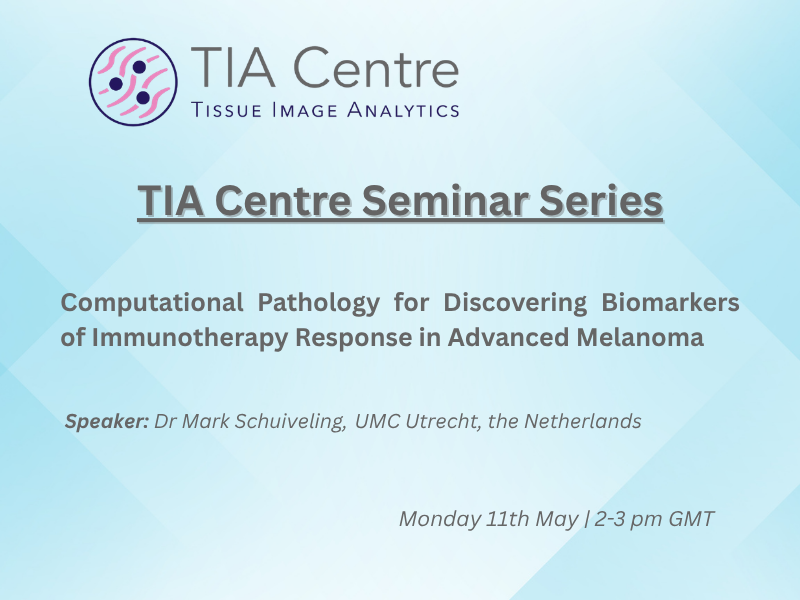

The Tissue Image Analytics (TIA) Centre hosts a seminar series for those interested in computational pathology. The series invites researchers and leaders in computational pathology and related fields to present their work and foster thought-provoking discussions.
This seminar features Dr Mark Schuiveling from UMC Utrecht, the Netherlands.
Abstract
Immune checkpoint inhibition (ICI) has significantly improved outcomes for patients with advanced cutaneous melanoma, leading to durable responses and potential long-term remission in approximately half of patients. However, it is also associated with severe and sometimes irreversible toxicity, underscoring the need for reliable biomarkers. In our group, we investigate whether computational pathology approaches add value beyond clinical data for identifying biomarkers associated with treatment response in these patients. In this talk, I will highlight our work on tumor-infiltrating lymphocytes in melanoma histopathology, as well as our recent work in the PUMA challenge, where we assessed whether additional immune cell subsets provide further associated predictive value.
Bio
Mark Schuiveling is a medical doctor and PhD candidate at the University Medical Centre Utrecht, the Netherlands. He is expected to defend his thesis in the summer of 2026 and is currently working as an internal medicine resident, after which he will begin an oncology fellowship in 2027. His research focuses on melanoma, in which he and his colleagues have assembled a multicentre dataset of digitized whole-slide images, CT scans, and clinical data, with the aim of improving prediction of response to first-line immune checkpoint inhibition in patients with advanced melanoma. His work has primarily focused on histopathological analysis, including tumor-infiltrating lymphocyte (TIL) assessment, as well as on the organization of the PUMA challenge, which investigated whether additional immune cell subtypes provide added predictive value.
