Journey to Pathology 3.0 Platform, Part 1
By Branko Perunovic
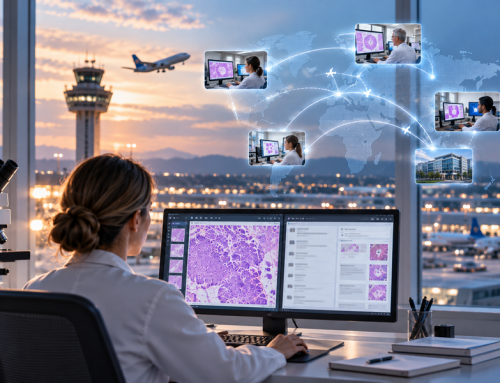
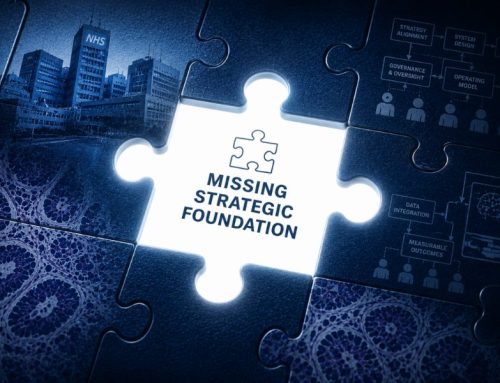
For the past ten years, I have looked forward with great enthusiasm to December because it marks my annual visit to London for the Digital Pathology Congress. This year, I have the opportunity to present our latest program. Throughout my career, I have led and contributed to many exciting initiatives, but the Intelligent Digital Pathology Platform, which I’ll be presenting at DigiPath London, stands out as one of the most exciting. Not only does it ignite my inner tech alter ego, but it also aims to address a critical missing link in the field and open up a wealth of new development opportunities.
Over the coming installments, I will share the key concepts and insights behind our program. Since January, I’ve already mentioned many of these concepts in this blog.
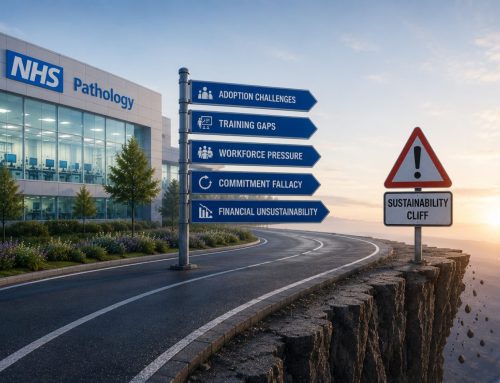
First, NHS cellular pathology services need to change their service model to have a fighting chance of overcoming a growing demand-capacity gap. Consolidating services is a step in the right direction; however, simply scaling up existing practices on a larger canvas will not suffice. The same applies to reporting on Whole Slide Images (WSI), or what we call “digital pathology.” Scanners, image management systems, and storage—those expensive objects of desire for many services—are only a part of the story. In isolation, they can relieve some pain, but replacing microscopes with screens will not solve the capacity and performance equation. The only way to do it is to increase productivity, and the old service model is not geared for that.
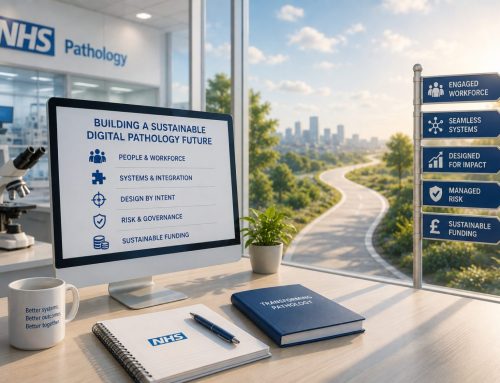
We need to have a distributed subspecialist service, and there is no single reason not to have it within the NHS Pathology Networks environment. In a nutshell, it is a platform model, and I will talk more about it in the forthcoming articles. At many levels—structural, operational, technological, financial, and cultural—this is a departure from the existing hospital pathology lab model. At many levels, it logically derives from and synergizes with the NHSE Pathology Networks Programme. I am fortunate that our team has made the right choices and put in exceptional efforts to be the vanguard of this programme.
As always, service transformation on this scale demands a blend of technological advancements and organizational development. Technology provides the tools to help us enhance accuracy, resolution, speed, safety, and convenience in our diagnostic work, but it is ultimately about enabling the team with the right resources, processes, and culture to do the work.
Second, running clinical operations at this scale requires software. The critical part of this is developing an appropriate data platform. One can run a small histology department on a napkin, but a large integrated service is a different beast. This is not about WSI but about integrating data from multiple operational systems and additional proprietary data sources in real time and using that data to run clinical operations at scale.
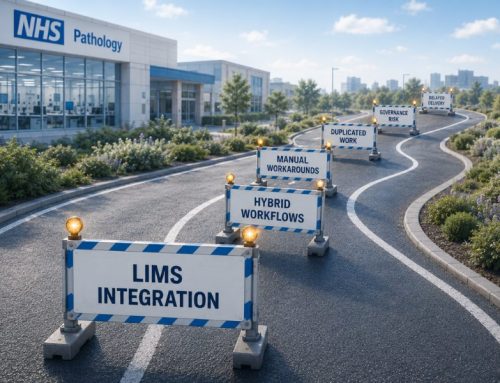
Histopathology services use a lot of commercial software—Laboratory Information Management Software (LIMS), Specimen Tracking Software (STS), and with “digital pathology” in place, we have Image Management Software (IMS)/PACS, AI tools, etc. It is unrealistic to expect commercial vendors to develop everything we require or to customize existing solutions to meet all our needs at the pace we demand. This simply does not align with their business model, and relying on the idea of purchasing fully bespoke products will only lead to frustration. Similarly, we cannot remain confined to existing products or the standardized workflows dictated by vendors’ user-averaged solutions. To truly meet our needs, we must have the capability to develop our own tools and seamlessly integrate them with commercial solutions.
We cannot buy a data platform of this kind; we need to make it, and if we do it right, it will need to be scalable and translatable. Developing such a data platform is beyond the current skills of IT teams at individual pathology services, even those as large as ours. But quickly acquiring the skills to co-develop, maintain, and further improve is a doable first step if this approach is one of the programme goals.
We were fortunate in this regard as well, as we found an excellent and dependable knowledge exchange partner with whom we have previously collaborated. The talented software development team at PA Consulting, led by the exceptionally dedicated Jen Law, has already cultivated a deep interest in and a thorough understanding of pathology.
Branko Perunovic
No audio available for this article yet.
No quiz available for this article yet.