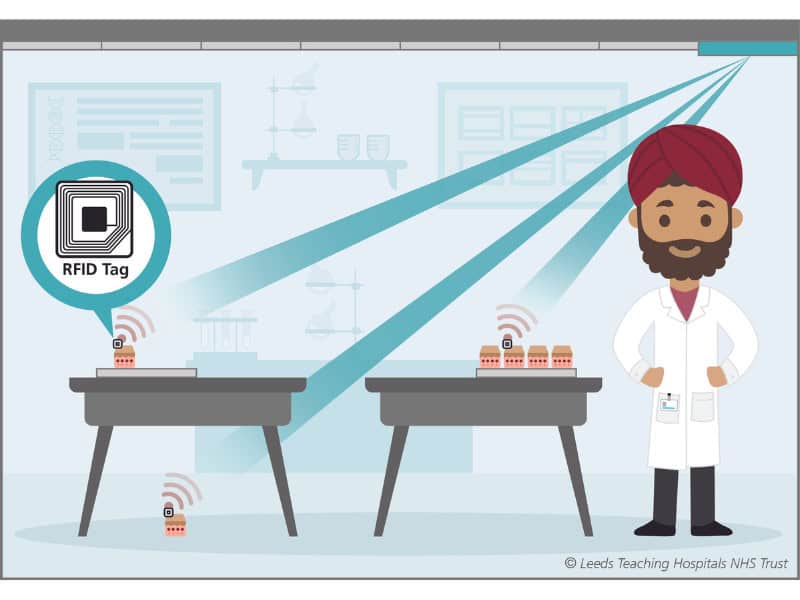
The system is based on radio frequency identification (RFID) technology which is widely used in the retail and logistics industry to track assets and has been specially adapted to help improve treatment for people with serious and life-threatening conditions.
Invented by the trust’s biomedical scientist and pathology innovation lead, Dil Rathore, this new system to prevent sample loss, speed up processing and increase efficiency in histopathology services could now be adopted by hospitals around the world.
The loss of tissue samples has potentially devastating consequences for patients including the need to redo biopsies, delays in diagnosis and administering treatment and the resulting distress this can cause.
Lost samples cost the NHS an estimated £157m in claims every year.
When samples come in, they are processed into blocks of paraffin wax which are then cut into very thin slices for microscopic examination by histopathologists.
The department at Leeds receives 60,000 cases every year, generating more than 250,000 blocks and nearly one million slides. This caseload is expected to rise as a result of an ageing population.
Existing tracking systems can only provide historic information about where a sample has been, rather than its current location, and are vulnerable to human error as they need manual scanning.
The new system allows continuous tracking by adding custom tags with RFID technology to the cassettes holding the blocks and installing antennas and readers throughout the department. The breakthrough improves the range, readability and resilience of RFID technology in the harsh processing conditions.
Initial testing at Leeds has demonstrated ‘proof of concept’ with the system set to undergo larger scale evaluation in the coming months. The trust is now looking for a partner to support the commercialisation of this innovation.Mr Rathore won funding from Leeds Teaching Hospitals NHS Trust, Leeds Hospitals Charity, Innovate UK and the Government Office of Technology Transfer to develop the real-time tracking system, which is compatible with existing histopathology management tools and is the subject of patent applications for the UK, EU and US healthcare markets.
Mr Rathore came up with the idea after working in the histopathology department and seeing the potential to automate manual processes. He developed the system with help from the Innovation Pop-Up, a support programme at Leeds Teaching Hospitals NHS Trust for clinicians and entrepreneurs with ideas for new products and services that solve healthcare challenges. Leeds Hospitals Charity has also committed £70,000 to support the Innovation Pop-Up.
Professor Phil Wood, chief executive of Leeds Teaching Hospitals NHS Trust, said:
We are very excited by the potential benefits of the system for patients, histopathology services and our trust.
This is another example of our ability to transform innovation within the NHS into new products and services that can help to improve health outcomes and make an important contribution to our wider economy.
The stress and anxiety felt by patients awaiting a potential cancer diagnosis can be made much worse if they are told their sample has been lost. Unfortunately, this ‘never-event’ happens more often than is acceptable.That’s why we came up with a real-time system to track the precise location of each sample and its movement through our histopathology department. The interpretation of changes in tissue forms the foundation of successful cancer treatment.
I am delighted that thanks to some of our generous donors leaving a gift in their will, we were able to provide £10,000 to kickstart this important work. This follows a round of innovation funding calls to which Mr Rathore put forward his proposed project.
It is thanks to our wonderful donors and gifts in wills that we are able to provide funding for innovation in our NHS hospitals. I am excited to see how this project will make a difference to the hospital experience and have an impact on patient outcomes for thousands of patients.
Notes to editors:
About Leeds Hospital Charity
Leeds Hospitals Charity is the charity partner of Leeds Teaching Hospitals NHS Trust, one of the biggest healthcare trusts in Europe.
We raise funds for projects, above and beyond what the NHS can provide, to support the latest in healthcare innovation and technology, the treatment of rare conditions and to help reduce health inequalities.
Working with local communities, schools and businesses across the city and beyond, we provide £6 million in additional funding for Leeds Teaching Hospitals NHS Trust every year, supporting one million patients and their families and 22,000 NHS staff.
Leeds Hospitals Charity is a registered charity in England and Wales (1170369) and is an accredited member of the Association of Medical Research Charities (AMRC).
About Leeds Teaching Hospitals NHS Trust, Innovation Pop Up and Building the Leeds Way
Launched in October 2021, The Leeds Teaching Hospitals NHS Trust’s Innovation Pop Up brings together entrepreneurs, researchers and clinicians to create, evaluate and adopt new products and services to transform health and social care and drive economic growth. Through our Innovation Pop-up, our clinicians are working with technology businesses and entrepreneurs, turning new ideas and emerging technologies into real world healthcare solutions.
The Innovation Pop Up is at the heart of the Leeds Teaching Hospitals NHS Trust’s future ‘Building the Leeds Way’ programme to create a new Innovation Village and a new home for Leeds Children’s Hospital, a new hospital for adults and one of the UK’s largest single-site maternity centre and neonatal unit as part of the whole site transformation of the Leeds General Infirmary (LGI) site. The future programme of capital investment and improvements as part of the UK Government’s new hospitals programme is expected to bring direct and wider economic benefits of up to £13billion in net present value terms to the city, along with around 4,000 jobs and 520 new homes. For more information, visit https://www.leedsth.nhs.uk/about-us/btlw/ and Innovation Village | Inclusive Growth Leeds. As a first stage in that development, in September 2023, the programme saw the official launch of the now completed state of the art ‘Centre for Laboratory Medicine’ at St James’s University Hospital.
Leeds Teaching Hospitals NHS Trust is one of the largest and busiest acute hospital trusts in the country. Every year the trust provides healthcare and specialist services for people from the city of Leeds, Yorkshire and the Humber and beyond. We play an important role in the training and education of medical, nursing, and dental students, and are a centre of world-class research and pioneering new treatments. With a budget of over £1.6 billion and employing over 20,000 people, in 2021/2022 there were over 1.7 million patient attendances across the trust’s hospitals. Care and clinical expertise are delivered from seven hospitals on five sites, and they are all joined by a vision to provide the highest quality specialist and integrated care.
Branksome Partners Ltd, company number 09884013 (England and Wales), is registered at 124a Main Street, Burley in Wharfedale, West Yorkshire, United Kingdom, LS29 7JP. For information about how we process personal data and monitor communications, please see our privacy policy. This email, and any files attached, is confidential and is intended solely for use of the individual or entity to whom it is addressed. It should not be disclosed to any other person, nor copies taken. If you are not the intended recipient, any reliance on, use, disclosure, dissemination, distribution or copying of this email is strictly prohibited. If you have received this email in error, please notify us and delete the email and all attachments immediately.
No audio available for this article yet.
No quiz available for this article yet.