Author: Sidney Ocanagil-Tunstall
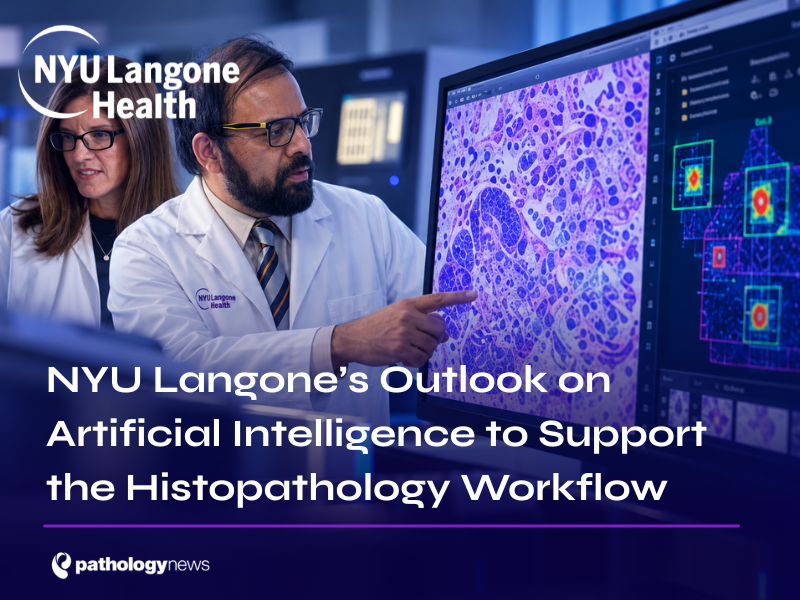
NYU Langone may have established one of the world’s most advanced large-scale digital pathology operations, but it has not yet introduced AI into its routine clinical workflow.
“Currently, we are not running AI algorithms within the pathology workflow,” explained Syed T. Hoda, MD, Director of Digital Pathology and Director of Bone and Soft Tissue Pathology at NYU Langone Health.
This is not due to a lack of interest or capability. NYU Langone is evaluating commercial technologies, developing tools internally and considering where AI could deliver the greatest value across its pathology service.
“We have a high awareness that it’s evolving,” Hoda said. “We want to be ready to implement [AI technologies].”
Waiting for greater coverage
NYU Langone’s position reflects the limited and fragmented range of clinical AI applications currently available to pathology laboratories.
“We’re aware of the external AI products,” said Hoda. “We think that this is evolving, this space, in terms of regulatory and implementation guidelines.”
For a large, subspecialised department, the difficulty is not simply finding an algorithm that performs an individual task. It is finding a sufficiently broad set of tools that can be integrated coherently across the service.
Joan F. Cangiarella, MD, Vice Chair for Clinical Operations in the Department of Pathology and Chief of Pathology Service at Tisch Hospital, described the challenge of purchasing separate products for individual tissues or applications.
“You’re sort of waiting for a package that has somewhat of a complete spectrum,” she said.
Cangiarella expects this position to change as developers broaden their portfolios and secure further regulatory authorisations. Until then, NYU Langone appears unwilling to introduce isolated tools without a clear place for them within the wider clinical workflow.
Its first AI may be built internally
While it evaluates the commercial market, NYU Langone is considering how its own academic and computational resources can be used to develop clinical tools.
“We are an academic institution,” said Hoda. “We have people on the research side, people who have ideas, and people who can create stuff and who want to create stuff.”
As a result, the first AI application introduced into NYU Langone’s pathology workflow may not be a commercial product.
“Our earliest AI will probably be an institutionally developed AI product, which will be vetted by our pathologists [and] trained by our pathologists,” Hoda explained. “That’s kind of our responsibility in academia—to also develop these things and further the science.”
This model would allow the institution to begin with problems identified by its own pathologists and develop tools around the realities of its workflow. It also places pathologists directly within the development, training and validation process.
“We have a whole department of individuals that do computational sciences,” said Cangiarella, explaining that NYU Langone is considering how to partner that expertise with its researchers “to build a clinical tool that could be helpful.”
AI around the diagnostic workflow
NYU Langone’s interest is not restricted to diagnostic algorithms. Hoda identified quality assurance and quality control as areas that could benefit from AI, although the specific applications are still being explored.
“We’re dealing with a new technology, with new ideas that are forming in real time,” he said. “The QA/QC is certainly one thing I consider.”
He also sees considerable potential in administrative and organisational tasks that sit around the diagnostic process.
“The other thing is just tasks, administrative tasks that pathologists do day to day,” Hoda said.
He described considering whether an AI agent could perform a routine activity shared by the department’s pathologists.
“Is it possible that we could have an AI agent kind of thing doing this that doesn’t affect the diagnosis or anything, but just makes everybody’s life easier in terms of moving things around and pulling things and organising?”
These applications may offer NYU Langone a route to introduce AI without immediately placing it inside the diagnostic decision. They could also address workflow friction that affects every pathologist, rather than supporting only the subset of cases covered by a particular diagnostic algorithm.
“I think there’s a huge amount of development we can do on that side of our portfolio,” Hoda added.
Allocating work by complexity and clinical importance
Work allocation is one area in which NYU Langone sees a more specific role for AI.
“Right now, we’re doing it just by number,” said Cangiarella. “You [pathologist 1] gets this many cases and you [pathologist 2] gets this many, but yours might be very detailed and difficult and take you much longer than your neighbour next door.”
An AI-supported system could assess case complexity before distribution and allocate work according to its likely demands, rather than relying on case numbers alone.
Cangiarella envisaged a system in which “the algorithm knows the complexity of the case” and uses that information to distribute cases “so that your workloads are actually equivalent.”
The same intelligence could inform the order in which cases are reviewed.
“What are the cases you should get to first?” she asked. “What are the cases that are going to make an impact?”
That prioritisation could incorporate the status of the wider patient pathway. A patient may be waiting to leave hospital, undergo another investigation or begin the next stage of treatment.
Cangiarella asked whether AI could “enhance that efficiency so that the next doctor who’s treating that patient can move on and not wait for the diagnosis”.
The longer-term vision
Looking further ahead, Cangiarella envisages AI supporting a case from the point at which the slide is scanned.
“Looking 10 years to the future, I would see it as the scanner scanning a slide and sort of saying, ‘It’s likely this. These are the stains you should order.’”
This would extend AI beyond identifying a potential diagnosis. The system could help determine the ancillary tests required, assess the complexity and urgency of the case, and route it to the appropriate pathologist.
Cangiarella sees it “really helping” not only with the diagnosis, but also in identifying “the diagnostic ancillary tests that need to be done”.
NYU Langone is not using these capabilities today, nor does the discussion suggest that it has committed to a particular commercial platform or implementation timetable. Its current position is one of deliberate readiness: evaluating external products, building internal expertise and identifying where AI can improve the workflow without introducing technology for its own sake.
Its first meaningful use of AI may therefore come not from automated diagnosis, but from the intelligence surrounding it. Quality control, administrative support, case allocation and clinical prioritisation. The digital foundations are in place. NYU Langone is now deciding where AI may be required and where it deserves to sit on top of those foundations.