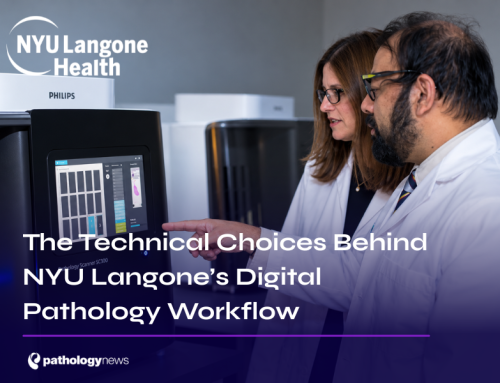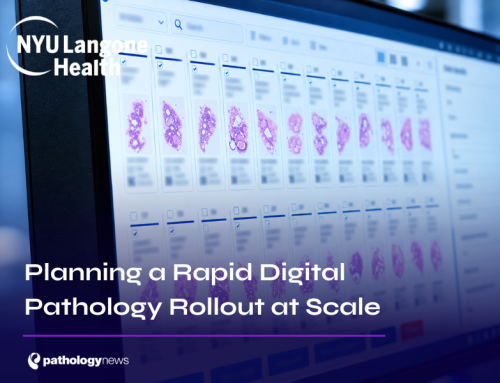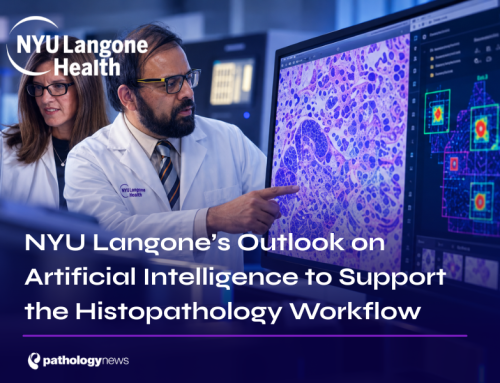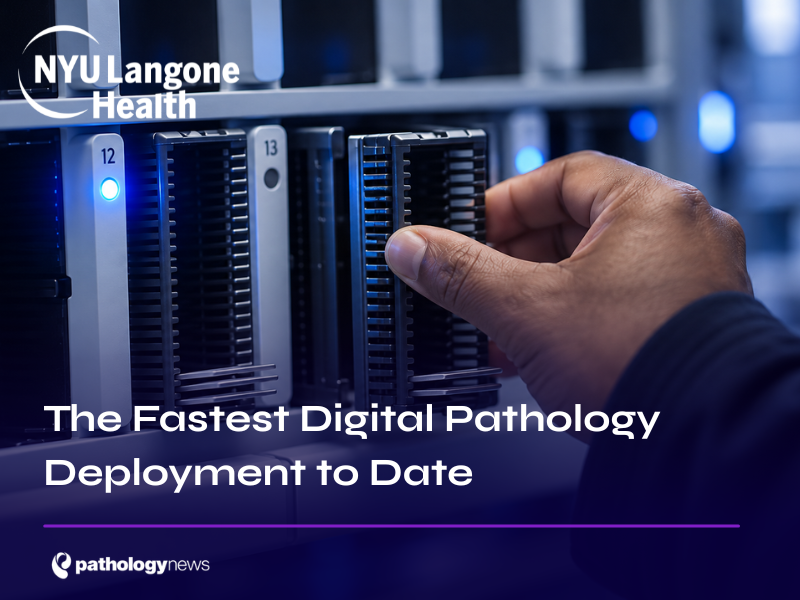
There is no official catalogue comparing the speed of digital pathology deployments. However, NYU Langone’s transition stands as the fastest large-scale implementation the Pathology News team has encountered. In just one year and 12 days (September 2024 to September 2025), the organisation moved a vast, fully subspecialised surgical pathology department to 100% digital sign-out.
Signals for Change
NYU Langone prioritises diagnostic accuracy, operating on a strictly sub-specialized diagnostic model. I.e. individual pathologists were tasked with a single sub-speciality. As the institution scaled from a single Manhattan hub to a five-hospital system spanning Brooklyn, Long Island, and multiple boroughs of New York City, maintaining that sub-specialty sign-out across all sites became a logistical liability. Staffing a roster of niche diagnostic experts at every regional hospital started to put stress on a system not designed for this breadth and scale of diagnostic demand. Consequently, physical slides had to be continually routed via courier to wherever the appropriate sub-specialists who had capacity were stationed.
Relying on physical transport across New York City traffic introduces unmanageable delays and risks to slide integrity. As Dr. Cangiarella remembers, “[we had to] ship those slides in the mail and hope that they made it to your desk.”
NYU Langone’s mandate to maintain uniform quality and safety metrics across the expanding network was another driver for digitisation. Digital image acquisition and routing means a complex soft tissue biopsy taken at a satellite site receives the exact same diagnostic scrutiny as one taken at the flagship campus.
What’s more, this meant connecting isolated specialists across the network at the push of a button.
“Maybe we have all the renal pathologists, most of them are sitting in Manhattan,” explained Dr. Cangiarella. “So, if the neuropathologist that sits in Long Island needs help, they just press the button and they take a look at it.”
By decoupling the pathologist’s physical location from the point of care, digitization transformed a geographically fragmented hospital network into a centralized diagnostic engine with a highly predictable, trackable workflow.
Ripping Off the Band-Aid
To condense a typical decade-long deployment into a single year required aggressive C-suite alignment. Championed by a former Dean with a background in radiology who understood the imperative of image digitization, the NYU Langone team started their digitisation discussions.
“I still remember the Dean’s mandate, ‘Rip off the Band-Aid’” recalled Dr. Joan Cangiarella.
At NYU Langone, reaching “fully digital” meant a hard operational cutoff: the complete cessation of physical glass distribution to faculty for surgical pathology.
Enterprise Scale and Centralized QA
To manage diagnostic distribution across campuses, NYU opted for a centralized scanning infrastructure rather than distributing hardware equally across all five hospitals. Tabletop scanners handle immediate intraoperative frozen sections remotely, while high-throughput scanning is consolidated to maintain strict quality control over an immense clinical volume.
To convey the scale of operational throughput at NYU Langone, the organisation encompasses over 220,000 annual surgical cases, generating upwards of 2,000,000 slides per year. Managing this immense clinical volume requires a highly capable infrastructure consisting of 15 whole-slide scanners strategically centralized at two main hubs, which in turn supports a diagnostic roster of more than 95 fully sub-specialized pathology faculty members across the network.
A Learned Approach
NYU Langone’s approach was meticulously researched and planned. A critical failure point for early digital adopters outside of NYU Langone was treating scanners as an endpoint.
“The original method 10 years ago was that you’re just tacking on these machines at the end,” noted Dr. Syed Hoda, Director of Bone and Soft Tissue Pathology.
Instead, NYU Langone reverse-engineered the entire process from the pathologist’s desktop backward. They mapped exactly how and when cases needed to hit specific sub-specialists’ screens. For instance, instantly routing a renal case from Brooklyn to a specialist in Manhattan.
What Comes Next
For NYU Langone, the initial investment in digital infrastructure represented baseline readiness rather than the final destination.
“I think of it as a train coming,” explained Dr Hoda. “We have to be on the platform in order to consider getting on the train.”
Getting onto that platform, however, required far more than installing scanners. It demanded executive alignment, a clear business case and a technology partner capable of supporting change at an institutional scale. Behind the go-live sat decisions about scanning capacity, LIMS integration, image management, data storage, network performance and quality control. Just as importantly, NYU Langone had to bring its pathologists, histotechnologists and digital pathology coordinators through an entirely new way of working.
Across this Key Labs showcase, Pathology News goes behind the scenes with the people who delivered that transition. We explore how NYU Langone designed and validated its infrastructure, worked with Philips to implement the system, maintained quality across an immense clinical workload and embedded digital sign-out into everyday practice. We also examine what this new foundation means for subspecialist access, workload balancing, remote working and the eventual integration of AI and multimodal diagnostics.
The speed of NYU Langone’s deployment may be the headline. The decisions, infrastructure and people behind it that made all of this possible are the real story.