The following abstract is drawn from a recently published paper in Journal of Pathology Informatics. We invite you to read the full paper and join the conversation, become a member of the Pathology News community to share your thoughts, ask questions, and engage with others around this work.
Authors: Toby C. Cornisha, Shubham Dayalb, David Ferberb, Joseph Chiwesheb, Robert Monroeb
Abstract
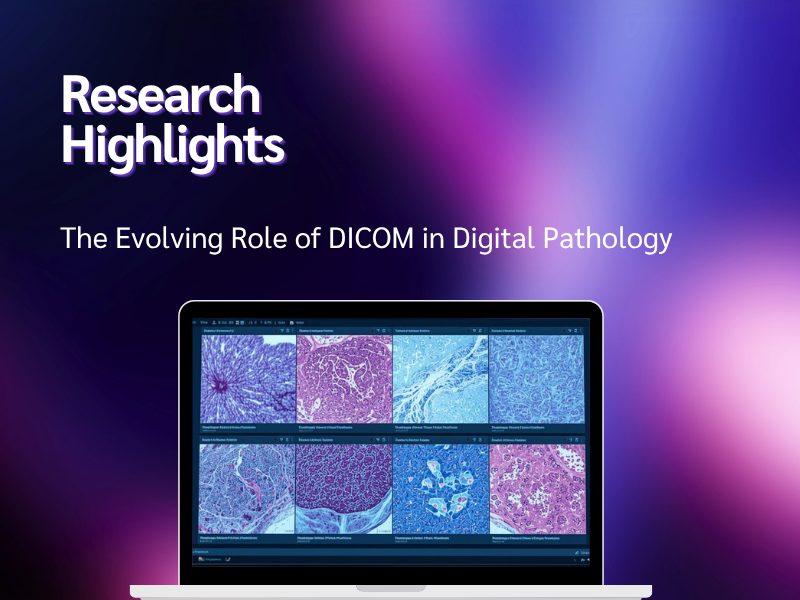
Digital pathology has emerged as a technology with the potential to transform anatomic pathology by enabling remote consultation, computational analysis, streamlined workflows, and more efficient archival of histopathological slides. Interest in digital pathology has steadily grown as health practitioners increasingly recognize its potential to enhance patient care. In the United States, at least 10 whole-slide scanners have been cleared or approved by the Food and Drug Administration (FDA), reflecting a growing confidence in this technology. However, widespread adoption has been hampered by the continued proliferation of proprietary, vendor-specific whole-slide image formats that limit interoperability between systems. Whereas commonly used whole-slide image formats, such as SVS, iSyntax, BIF, MRXS, and NDPI, have proven adequate for siloed deployments, they are less well-suited for integration into enterprise imaging solutions. The Digital Imaging and Communications in Medicine (DICOM) standard, which revolutionized radiology over three decades ago, offers a vendor-neutral whole-slide image format that enables seamless exchange of images and metadata across systems, supporting efficient workflows, accurate diagnosis, and secondary use such as artificial intelligence research. This article discusses the use of DICOM in digital pathology, the key benefits it provides, the clear need for digital pathology vendors to adopt it as a native storage format, and other opportunities and barriers to adoption. As digital pathology matures and computational pathology applications proliferate, DICOM adoption represents a critical step toward an interoperable, vendor-neutral imaging ecosystem.
Read the full article: The evolving role of DICOM in digital pathology – ScienceDirect
- aDepartment of Pathology, Medical College of Wisconsin, Milwaukee, WI 53226, USA
- bLeica Biosystems Richmond Inc., Deer Park, IL 60010, USA
No audio available for this article yet.
No quiz available for this article yet.