Data derived from Garrad E, at al. Abstract 9001. Presented at: ASCO Annual Meeting; May 29-June 2, 2026; Chicago.
Key takeaways:
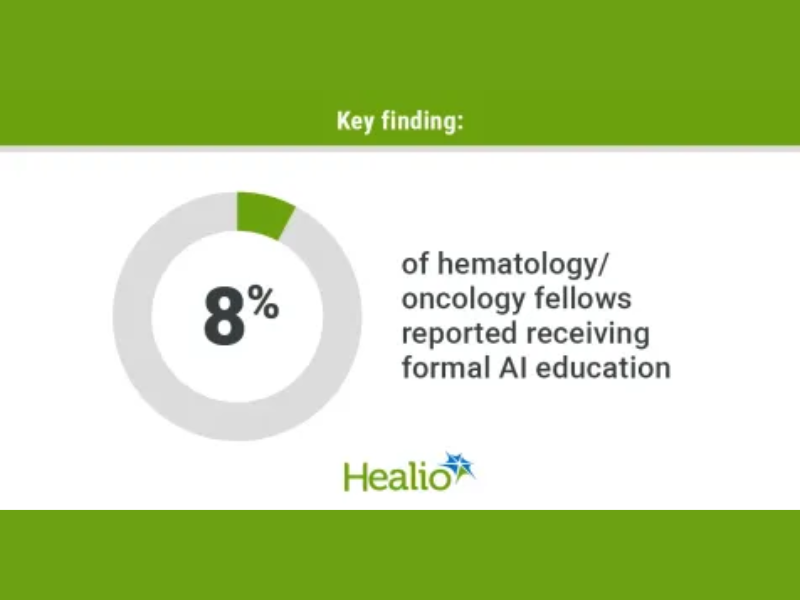
- Three-quarters of hem/onc fellows report using AI tools but only 8% received formal AI training.
- This may lead to inconsistent use, overreliance, de-skilling or uncertainty about accuracy.
Hematology/oncology fellows have embraced AI for educational or clinical purposes but they rarely receive formal training to guide use of these tools, according to survey results presented at ASCO Annual Meeting.
“Standardized curricula are needed for fellows to learn responsible use of AI tools,” Evan Garrad, MD, internal medicine resident at University of Illinois Chicago, said during a presentation.
No structured curriculum
Medical education already has undergone a rapid and dramatic evolution, shifting from textbooks, didactics and lectures toward digital formats such as podcasts, question banks and asynchronous lectures, Garrad said.
“Now we are entering a new phase — an AI-driven phase — in which trainees will use large language models and other tools to access, synthesize and apply medical information,” Garrad said. “This, of course, begs the question: How are we training fellows for competent AI use?”
Lack of sufficient AI training can lead to inconsistent use, overreliance or uncertainty about accuracy. It also may contribute to de-skilling — a decline in a person’s ability to think critically about or perform certain tasks once they start to rely on automated systems to perform them — or “never skilling,” meaning trainees rely on AI so often that they fail to develop certain foundational skills or knowledge.
Garrad and colleagues aimed to evaluate AI use for clinical or educational purposes among hematology/oncology fellows in the United States. Investigators also assessed fellows’ attitudes toward AI and whether they received training in its use.
The researchers conducted a multicenter survey of hem/onc fellowship programs, including those that participated in a prior trial that showed a supplemental podcast curriculum could improve fellows’ comfort with and knowledge of medical topics.
Investigators distributed a REDCap survey online to program directors, who recruited fellows to participate.
Primary outcomes included fellows’ self-reported utilization of and attitudes toward AI, as well as their perceived barriers to AI use.
Researchers received responses from 124 fellows, who represented 18 (60%) of the 30 programs invited to participate. The final analysis included 118 fellows with complete data.
‘This matters’
Medical education resources most used by fellows included National Comprehensive Cancer Network guidelines (92%), question banks (86%) and reference websites (86%).
AI tools — such as ChatGPT — ranked fourth, with nearly three-quarters (74%) using them. However, only nine fellows (8%) reported receiving formal AI education.
“AI use is common, but formal training is rare,” Garrad said.
Further analyses showed 91% are satisfied with hem/onc didactics, but a comparable percentage reported believing that AI tools are useful for medical education (93%) and having a positive attitude toward AI tools (86%). Most (82%) also expressed a desire for more targeted AI training.
“This suggests fellows recognize the potential of AI, but they also recognize they need a framework for using it responsibly,” Garrad said.
Investigators assessed how fellows use AI for education-related tasks. The most common uses included to clarify difficult concepts (86%), summarize journal articles (83%), learn about emerging research (75%) and identify personal knowledge gaps (59%).
“Interestingly, educational use was less common for more structured educational tasks, such as generating board-style questions or practicing patient case simulations,” Garrad said. “This pattern may reflect where fellows see the most immediate value, using AI to support understanding and synthesis rather than replacing the traditional teaching and assessment method.”
An analysis of AI exposure in clinical settings showed the most common uses are AI-assisted documentation tools (51%), clinical decision support (42%) and imaging/pathology analysis tools (12%). Nearly one-third (31%) of fellows reported no AI exposure in clinical practice, a finding that Garrard said highlights variability across institutions.
Nearly all fellows (92%) indicated they expect their use of AI to increase in the next 5 years.
The investigators have developed a curriculum called AI-HOPE. The acronym for which stands for artificial intelligence in hematology/oncology pilot education.
The curriculum will be distributed in three phases, beginning with a multisite pilot at several U.S. hem/onc fellowship programs. Once refined based on feedback from fellows and faculty, the effort could be scaled nationwide.
Researchers acknowledged study limitations, including selection of programs based on prior interest in the topic and the fact participating fellows predominantly represented academic centers, potentially limiting generalizability.
Still, the findings provide valuable insights for fellowship program leadership, as well as fellows trying to incorporate AI into training, Garrad said.
“Ultimately, this matters for patient care,” he said. “Without training, there is a risk for inappropriate reliance on AI. With training, there is an opportunity to improve clinical reasoning [and] safety.”
Perspective
Debra A. Patt, MD, PhD, MBA, FASCO
I remember starting medical school in 1995, moving into my apartment in the Texas Medical Center and putting in the first personal computer I had bought. At that time, we did not use computers in clinical practice, our routine work or our day-to-day activities. We certainly did not have them at our fingertips managing our calendars and every aspect of our communication. I say that to draw an analogy to where we are today with AI, as we are all struggling with how we are going to incorporate this important tool in our daily lives.
This study has some serious strengths. The REDCap survey is a HIPAA-compliant and highly secure mechanism for data collection. The study explores the “why” — the attitudes toward AI among fellows and how they are using it. It reflects on the self-reported use of AI in hematology and oncology fellowship training, the use of contrasting educational platforms and the absence of formal training.
Regarding limitations, because the survey instrument explored hem/onc fellows who had previously participated in digital platforms, it might introduce some bias by selecting for digital natives. Some of the survey questions have a lack of discernment around which AI tools specifically are helpful. There may be some lack of objective data about what exactly is in curricula today, as well as a lack of ability for statistical analysis.
How this will evolve is more important for cancer care than any other medical subspecialty. The pace of change is rapid, and we are using these tools to help us deliver cutting-edge cancer care to our patients. We are in the age of digital transformation of systems, with different sectors and cohorts in different places, but ripe to adopt change.
If we want to maximize the impact of these tools, how can we be facilitators of change?
AI adoption in health care is relatively low, and there are a lot of important reasons. AI has limitations but, in health care, it is not like we can try it and quickly fail because [what we do affects] patient lives. The stakes are much higher.
There is a lack of trust and explainability in how we use some systems. There are workflow and integration challenges, as all of us are operating within technically complex systems of care like electronic health records and practice management systems.
There is insufficient training and education. There are costs and reimbursement gaps. There are privacy and data governance concerns, as well as issues around security. Regulatory and liability uncertainty is fragmented and changing.
More specific to cancer care, we have an aging population and increased survivorship. Cancer incidence and prevalence is increasing, and patients often need prolonged support.
We have workforce challenges in so many job families — particularly in nursing — that support cancer care. We will have more patients while the oncology workforce is diminishing, and that poses a real challenge in our ability to have a supply-and-demand match.
We need to work more efficiently and effectively and incorporate the complexity of management that many of these systems use that can support our patients and the business of cancer medicine.
As Dr. Garrad said, this matters now. With AI training, we can have critical evaluation, safe integration and novel connections. Without that training, we can have uncertainty in accuracy, inconsistent use, overreliance risk and difficulty managing some of the challenges that we have.
What can we do to help? Change management is critical. This is really difficult and managed best with multichannel communication. There needs to be engagement of clinicians and administrators in tool development and implementation to ensure alignment with responsible principles. We need training on these tools and responsible use. We need to encourage financial incentives for adoption, and understand and manage the risks and liability.
Our professional societies can play an important role, helping to manage change and being a force multiplier in this ecosystem. I chair ASCO’s AI task force. We released responsible use guidelines for AI in oncology, as have other organizations. This is really important to provide a fundamental framework about where decisions are made, as well as how we understand bias, hallucinations and errors that will be present.
I also serve as president of Community Oncology Alliance. Our meeting this year centered around innovation, and we showed that agentic tools will interact with the patient journey in meaningful ways. We invited vendors who are doing chart summarization and clinical trial enrollment facilitation to present to try to help oncology change.
This begs another question to those [in the field] who are clearly passionate about AI in oncology: How will [they] stand at the intersection of digital transformation and cancer care to be the change that we need for our organizations? We will only get better together.
Debra A. Patt, MD, PhD, MBA, FASCO
Texas Oncology
The US Oncology Network
Disclosures:
Patt reports employment with Pediatrix Medical Group, Texas Oncology and The US Oncology Network, as well as stock or other ownership interests in Pediatrix Medical Group. She also reports consulting/advisory roles with, research funding to her institution from, or travel, accommodations and expenses from Amgen, AstraZeneca, Eisai, Eli Lilly & Co., Merck, Pfizer, Roche and Seagen.
Source:
Garrad E, at al. Abstract 9001. Presented at: ASCO Annual Meeting; May 29-June 2, 2026; Chicago.
Disclosures:
Garrad reports no relevant financial disclosures. Please see the study for all other authors’ relevant financial disclosures.
No audio available for this article yet.
No quiz available for this article yet.