
RlapsRisk® BC


Prognostic risk profiling for breast cancer
Next-generation AI testing from routine H&E to inform the treatment pathway for early breast cancer patients
Relapse risk assessment helps oncologists select the best treatment plan for patients
Incidence is high. Every 14 seconds, across the globe, a woman is diagnosed with breast cancer.4
Since 2008, worldwide breast cancer incidence has increased by more than 20 percent.4
Approximately 10% of all patients will relapse after their initial treatment.5
Nearly 70% of patients fall into the ER+/HER2- subgroup where there are a variety of treatments for oncologists to consider.
Risk of recurrence plays a significant role in the prognosis of the largest patient subgroup, ER+/HER2-.
Those who relapse enter a chronic disease phase and are significantly more likely to have worse outcomes. It’s pivotal to identify these patients as early as possible to adapt their treatment strategies and evaluate their eligibility for treatment escalation, including newer targeted therapies, like CDK4/6 inhibitors1 2.
Identifying patients who are unlikely to relapse is also critical and a challenge. These patients may be able to safely avoid chemotherapies3, which often carry harsh side effects. But the risks attributed to relapse prompt oncologists to be conservative to avoid wrongly classifying high-risk patients, causing many to be potentially over-treated.
Current testing methods either lack consistency in accuracy6 7 8 do not address all subgroups effectively9 10 or they are expensive and not always accessible11, such as gene expression tests. The stakes are high for risk assessment in early breast cancer to limit the number of patients who are under or over treated.
RlapsRisk® BC outperforms standard testing in accurately classifying patients as high or low risk in studies
International clinical studies show that RlapsRisk® BC can more precisely stratify patients into high and low risk groups than both traditional clinical factors assessments and gene expression tests*.
In the pre-specified pooled analysis, It significantly separated patients into two groups of risk with an hazard ratio of 7.42 (95% CI, 4.32–12.75). With a consistently high Negative Predictive Value (NPV) across different cohorts (88% – 97.4%), RlapsRisk® BC demonstrates it can also support safe identification of low risk patients. It also reclassifies those patients in the intermediate clinical risk category, and adds novel pathological based insights into the therapeutic decision making workflow12.
By adding additional information to the diagnostic workflow, used stand-alone or in combination with genomic signatures, RlapsRisk® BC shows potential to help clinicians both reduce overtreatment and identify patients at higher risk who may benefit from adjuvant chemotherapy and other precision therapies12.
Pathology-based risk profiling makes precision testing more accessible and scalable

Identifies typically difficult to classify subpopulations, such as grade 2 patients12.

With a quick turn around time, results are ready in time for the tumor board.

By analyzing routine multi-modal data, level the playing field for patients with greater access to precision testing and personalized care.

RlapsRisk® BC’s AI image analysis is an independent prognostic factor12, delivering critical tissue-level insights beyond standard clinical variables.
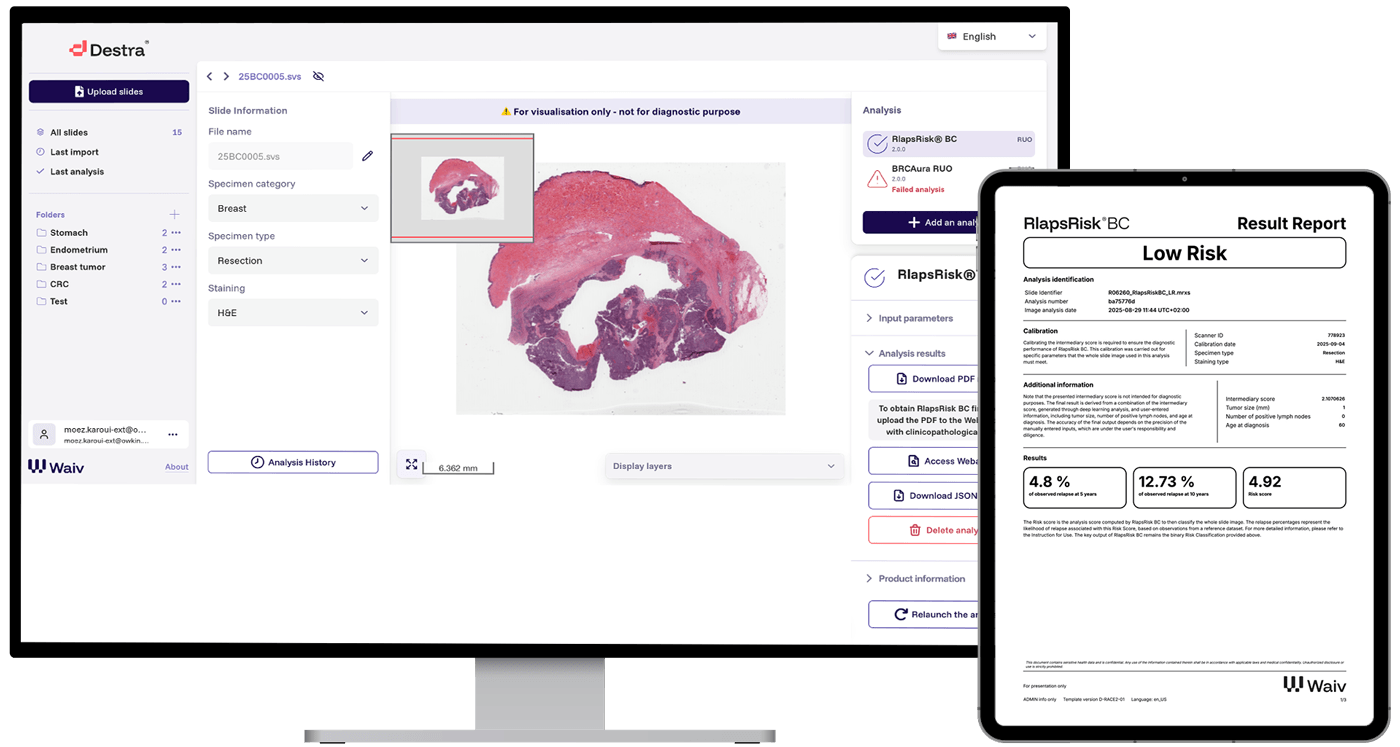
Meeting pathologists where they are to deliver results where they’re needed

Suitable for adults with primary invasive early breast cancer (ER+/HER2-).

Combines image analysis and patient clinical information: age, number of invaded lymph nodes, and tumor size.

Easily accessible and supports pathologist interpretation.

Deployment is feasible across existing IMS systems or IT settings.
RlapsRisk® BC’s development and clinical studies set the foundation for product robustness and generalizability
Developed and evaluated with high-quality imaging data from varied clinical settings and geographic regions.
RlapsRisk® BC and previous prototypes have been tested in various international lab settings, for three years.
Product development fostered in collaboration and informed by international breast oncology and pathology experts.
| Solution Type | Specific AI Algorithm/App |
|---|---|
| Deployment Environment | Research Use Only (RUO) |
| Target | Breast Cancer |
| Platform Dependency | Platform Agnostic |
| Deployment Options | Hybrid (Cloud analysis, local viewer) |
More Solutions from Waiv

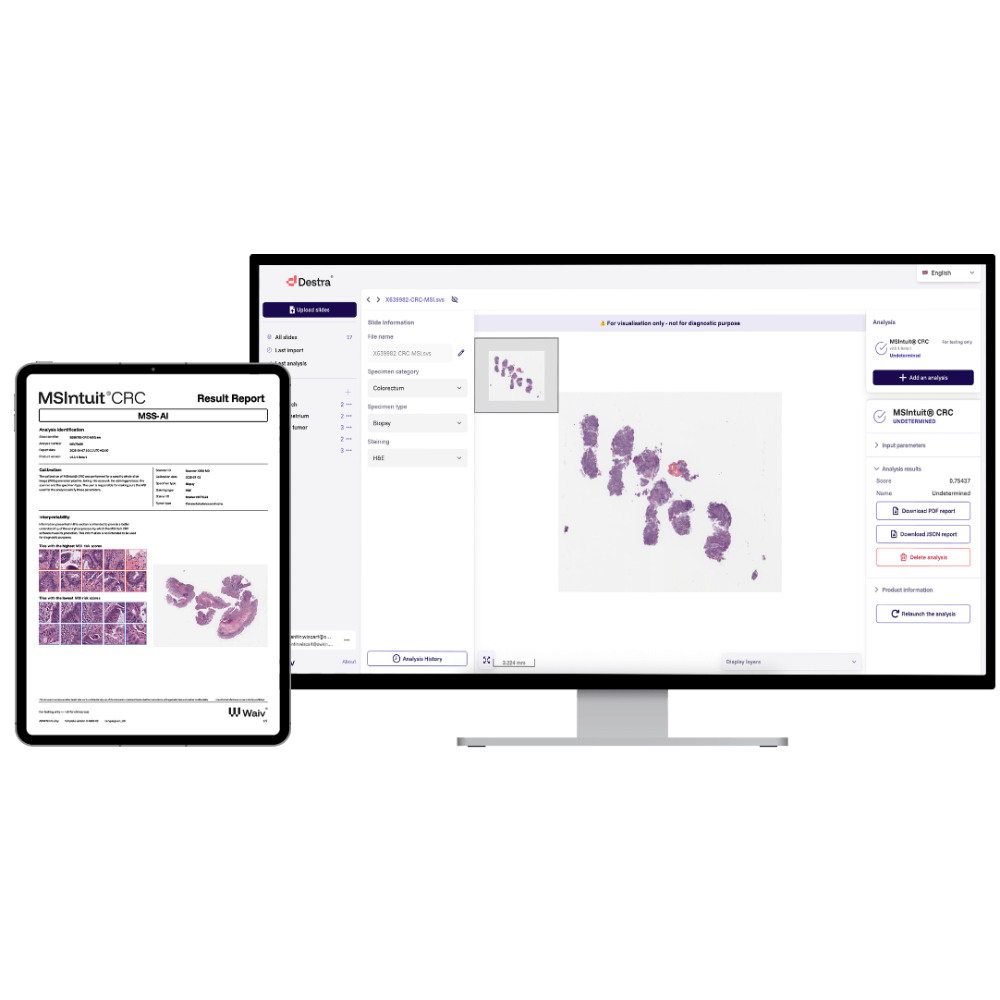
Compare Solutions
Get Pathology News Delivered to Your Inbox
Learn More
Waiv News
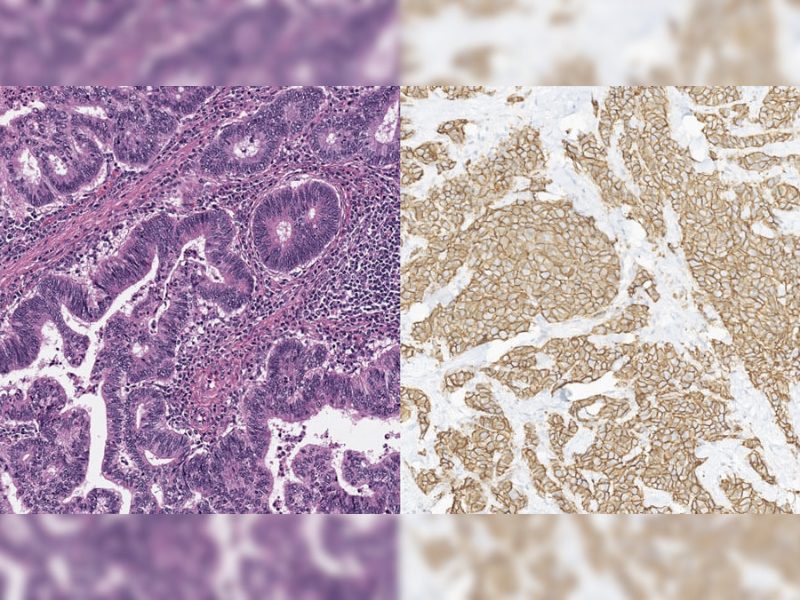
Waiv Enters Collaboration with Daiichi Sankyo to Deliver AI-Derived Biomarkers for ADC Program
Editor2026-05-08T10:36:28+00:00May 7, 2026|
![Figure 1: Fine-tuning improves robustness and performance jointly. Each foundation model is shown before (open circle) and after (filled circle) fine-tuning. The x-axis is the average PathoROB robustness index over three datasets, where higher values indicate greater robustness; the y-axis is the normalized rank sum over the HEST, THUNDER and Patho-Bench benchmarks, rescaled to [0, 1] so that 1 corresponds to the best achievable performance.](https://www.pathologynews.com/wp-content/uploads/2020/07/embedding-figure-800x600-1.png)
Meet Phaet and Mascaret: two pathology foundation models built to generalize across labs
Editor2026-07-30T12:56:01+00:00July 30, 2020|



Reviews
There are no reviews yet.