Author: Sidney Ocanagil-Tunstall
Approaching histopathology digitisation for the first time can feel overwhelming. Between scanners, new nomenclature, infrastructure, integration, and validation, the process quickly becomes complex.
Being at the centre of this, it’s easy to lose sight of why you wanted to take your lab on this journey in the first place and where the real impact lies.
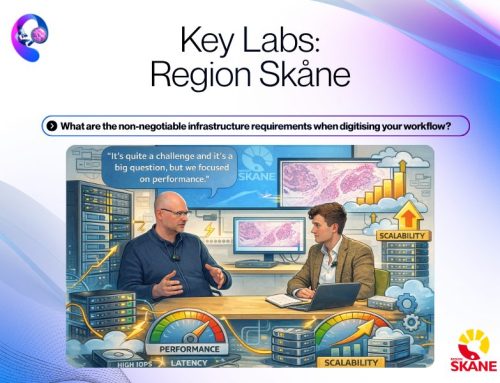
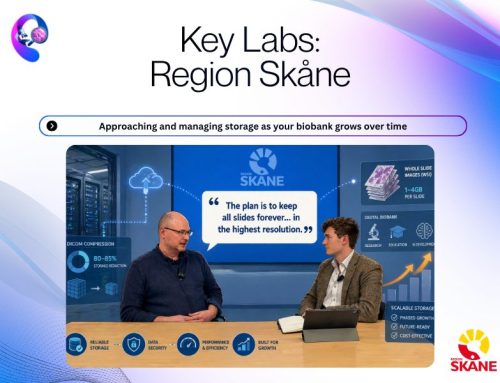
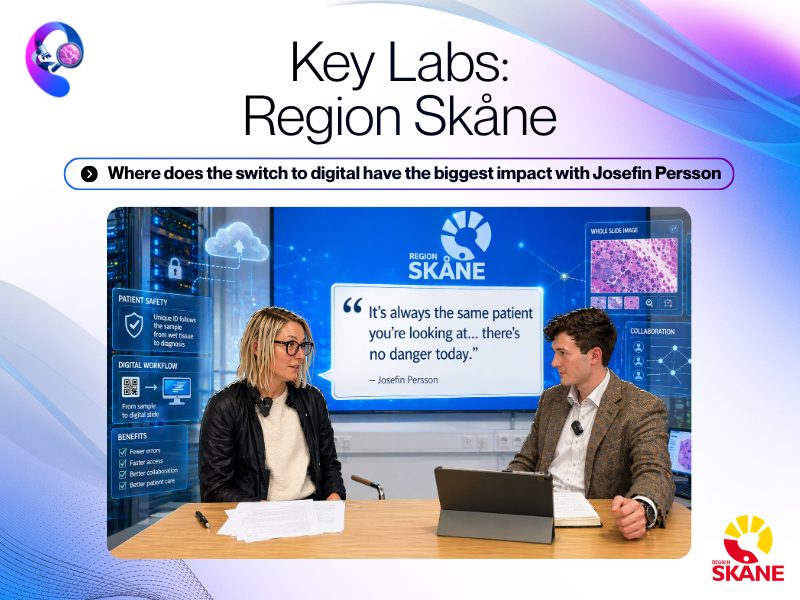
Given the opportunity presented to the Pathology News team at Region Skåne, Sweden, one of the first histopathology labs to go paperless, our team went back to basics and asked, ‘where does the switch to digital actually have the biggest impact?’
It was clear, the biggest impact for Josefin Persson, Head of Unit, was patient safety. “It’s always the same patient you’re looking at… there’s no danger today.” Thanks to patient samples carrying unique QR codes and a unique identifier that follows the sample from wet tissue to diagnosis there is no chance of mixing one sample for another.
In a traditional glass-based workflow, maintaining the link between slide, case, and patient depends on a chain of manual steps: labelling, handling, transporting, and matching. Each step introduces the potential for error and a patient sample mix-up which can have dire consequences further down the line.
At Region Skåne, that risk has been designed out. Thanks to the laboratory information system (LIS) the same patient sample is tracked throughout its journey down the lab’s workflow.
But the benefits don’t stop with patient safety. Creating whole slide images means slides stop moving, physically anyway. Before digitisation in the case of a remote consultation, slides were packaged, transported between the network’s four sites, registered on arrival, and physically distributed to pathologists.
“We were sending slides to each other every day,” Persson explains. “Nowadays we are not sending any slides.”
Even across short distances, this introduced delays. Transport could take hours, followed by further handling before a case was ready to be reviewed. Now, cases are available instantly, shared across sites with a click, and accessed simultaneously by multiple pathologists at once if needs be.
With the entire network’s whole slide image repository at the pathologist’s fingertips, turnaround times (TAT) improved dramatically. With an overall reduction from “over 20 days to around 12… we save lots of time in the laboratory,” says Persson. “And for the pathologist, it’s much better… they don’t have to search for slides.”
The impact of this extends beyond TAT alone. Once cases no longer need to move, neither do the people reviewing them. Geography becomes almost irrelevant and with Region Skåne operating across multiple sites, collaboration on cases was possible instantaneously. There’s no need to depend on transport and moving cases between sites for consultation.
“You just call your colleague and say, can you go into this case and help me out?”
Josefin, was also keen to point out that slide quality had increased thanks to the digitised workflow. Histotechnologists can review the whole slide image before it reaches the pathologist, providing immediate feedback on whether preparation has been carried out correctly. If a slide is suboptimal, it can be identified early. Equally, if the pathologist decides that a recut is needed, they can request it instantly through the LIS. What emerges is a tighter feedback loop between preparation and diagnosis, one that was largely absent in a glass-based workflow.
At Region Skåne, we are now looking at a completely different workflow, superior to its predecessor with communication and patient care a clear priority in its design and execution.
No audio available for this article yet.
No quiz available for this article yet.