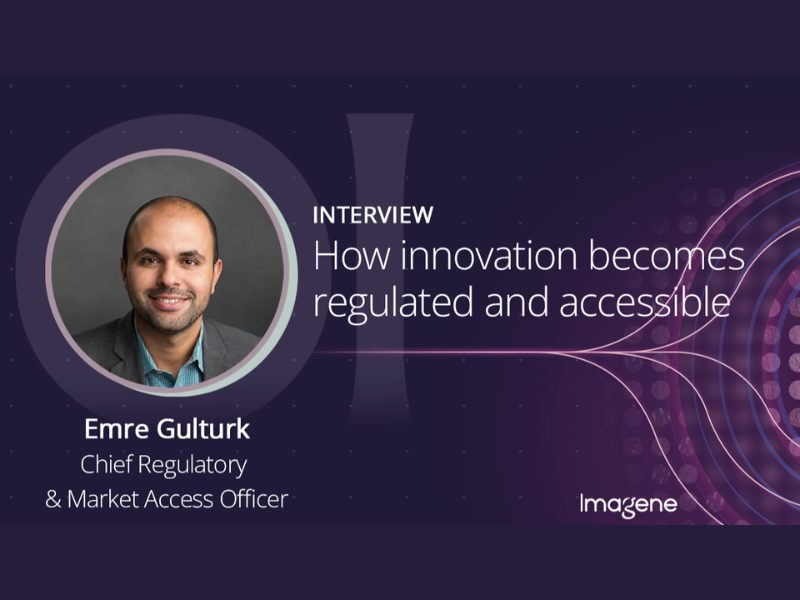
Interview with Emre Gültürk, Chief Regulatory & Market Access Officer, Imagene AI
You have spent more than 15 years working across regulatory, quality and market access for increasingly sophisticated software and AI-enabled medical technologies. What made Imagene AI the right next step for you?
Imagene wasn’t a new company to me. I had worked with the team as an advisor since 2022, which gave me time to understand both the technology and the people behind it. I saw how the team approached difficult scientific questions, how quickly they were able to learn, and how seriously they took the responsibility that comes with developing technology that could influence drug development and, ultimately, patient care.
Over those years, the company reached a point where regulatory, quality and market access needed to become even more closely connected to its growth. That made the opportunity especially compelling. I wasn’t joining to build functions around an unfamiliar technology; I was joining a team I already knew and respected, at a stage where my experience could help shape not only how products are developed and validated, but also how they reach the market and demonstrate value.
What ultimately drew me to Imagene was the practical potential of the platform. There is an enormous amount of information in a routinely collected pathology image. Being able to uncover that information quickly, without requiring additional tissue or lengthy testing, could change how biopharma companies develop therapies and identify the patients most likely to benefit from them. For me, the opportunity was not simply to develop another AI product, but to help determine how these insights could be translated into evidence and tools that are genuinely useful in drug development and patient selection.
You were closely involved in a landmark regulatory milestone for digital pathology AI with Paige Prostate. What did that experience teach you about what it actually takes to move pathology AI from strong performance data to a regulated and commercially viable product?
One of the clearest lessons was that strong performance data, on their own, are not enough. A model may produce impressive results in development, but a regulator needs to understand much more: who the product is for, exactly how it will be used, where it fits into the clinical workflow, and what happens when real-world conditions differ from the development environment.
With pathology AI, details matter enormously. The data must represent the intended patient population and account for differences in laboratories, scanners, staining practices and clinical settings. The evaluation also has to reflect how pathologists actually work with the product. It is not only a question of whether the algorithm performs; it is whether the overall system, including the user, can deliver a safe and reliable result.
The experience also reinforced that regulatory authorization is not the end of the journey. A product must fit into existing workflows, address a recognized clinical need and offer value that is clear to laboratories, healthcare systems and payers. Those questions affect how the evidence should be generated and how the product should be designed from the beginning.
Moving AI from promising research to a regulated and commercially viable product therefore requires clinical, regulatory, quality, engineering, product and market access teams to work together early. Most importantly, everyone needs to stay focused on what the technology will do for the physician, the patient and the healthcare system, not simply on what the model can do technically.
What regulatory, evidence or reimbursement considerations should biopharma teams be thinking about at the beginning of a diagnostic AI/CDx program rather than after the technology has already been developed?
Teams should begin by being very precise about the question the technology is meant to answer: what exactly is the intended use? Will it be used to select patients for a clinical trial, support a treatment decision, identify a biomarker for further study or eventually serve as a companion diagnostic? These may sound like variations of the same idea, but they can lead to very different development plans, evidence requirements, regulatory pathways and commercial models.
That clarity should influence how data and specimens are collected from the start. Teams need to know whether their dataset represents the population and clinical setting in which the product will be used. They should also think about sources of variability, including tissue preparation, staining, scanning and site-to-site differences, before those factors become problems that are difficult to address retrospectively.
For a potential companion diagnostic, the diagnostic and therapeutic strategies cannot be developed in isolation. The timelines need to be aligned, and the clinical trial must be designed to generate evidence that can support both programs. Early discussions with regulators can help confirm that the intended pathway and evidence plan are appropriate.
Market access and reimbursement deserve the same early attention. Regulatory authorization does not automatically lead to adoption, coverage or payment. Teams need to understand who will use the test, who will pay for it, where it fits in the care pathway and what evidence will demonstrate its clinical and economic value. Bringing these perspectives together early can prevent costly redesigns and increase the likelihood that a promising technology becomes a product that is actually used.
What are you most looking forward to building at Imagene, and where do you believe the company has the greatest opportunity to make an impact?
I am looking forward to building an integrated regulatory, quality and market access organization that grows with the company and supports the way Imagene innovates. At this stage, we have a valuable opportunity to put the right foundations in place before processes become difficult to change. That means creating practical systems that give teams confidence in how work is performed and documented, while preserving the speed and curiosity that make a growing company successful.
I also want these functions to be active partners in development. Our role should not begin when a product is nearly finished or when a regulatory submission is being prepared. We should be involved in early conversations about intended use, evidence, risk, clinical value and the path to adoption. Looking at those questions together helps ensure that we are developing products that can be authorized, trusted, reimbursed and successfully incorporated into real-world practice.
Imagene’s greatest opportunity is to make more of the information already present in pathology images useful. Today, answering important biomarker questions can require additional tissue, time and testing that may not always be available. If we can obtain meaningful insights from routinely collected images, we may be able to help biopharma teams make decisions earlier, design better trials and identify patients more efficiently.
What excites me most is the possibility of connecting that speed with real scientific, clinical and economic value. The impact will come not only from developing sophisticated AI, but from turning it into reliable and accessible solutions that researchers, biopharma partners, clinicians and healthcare systems can trust.
Interested in continuing the discussion? Emre will be a panel speaker at Biomarkers, CDx & Precision Medicine US 2026, September 23–24. He will participate in two panel discussions on the integration of biomarkers, companion diagnostics, spatial biology and AI, and on the evidence and commercialization strategies needed to advance AI-enabled companion diagnostics.
Connect with Emre and the Imagene AI team in San Diego – Schedule a meeting
Share this article


Follow us
Get Pathology News Delivered to Your Inbox