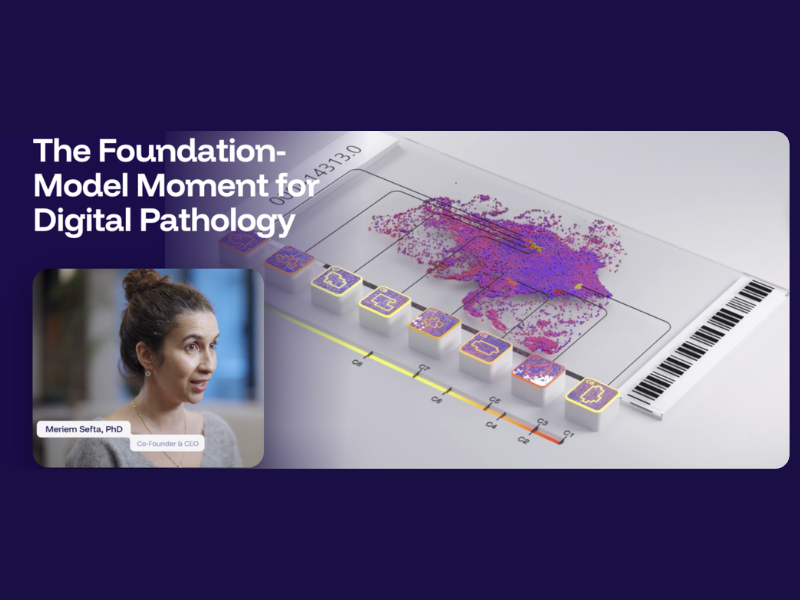
In a wide-ranging conversation on the Base to Base Biotech podcast with host Jim Cornall, Waiv CEO and Co-Founder Meriem Sefta traced the company’s journey from an internal Owkin project to an independent business, the opportunity in digital pathology and why foundation models could change how cancer diagnostics are developed and delivered.
Author: Rachel MacMaster
Every company has a founding moment, when a technical insight and a market opportunity line up. For Waiv, that moment came from a simple realization: pathology, one of the richest sources of information about a patient’s cancer, had barely been touched by AI.
Speaking with biotech journalist Jim Cornall on the Base to Base Biotech podcast, Meriem went back to that starting point: the convergence of new data, new technology and timing that led to Waiv.
The company’s story starts inside Owkin, where Meriem led an internal business unit exploring how AI could be applied to biomedical research. Digital pathology quickly stood out.
“We realized we have this new untapped source of data in oncology, and we have this deep learning tech that has allowed us to analyze these images and drive more insights from them.”
For that opportunity to emerge, two things had to happen. Pathology slides needed to be digitized at scale, and AI needed to become sophisticated enough to interpret them. Those developments were beginning to converge, opening up a largely untapped source of oncology data.
Unlocking more from the pathology slide
A single digitized pathology slide contains around two gigabytes of data. Yet much of the information encoded in the tissue is difficult, or impossible, to quantify through visual assessment alone. AI changes what can be extracted from that image.
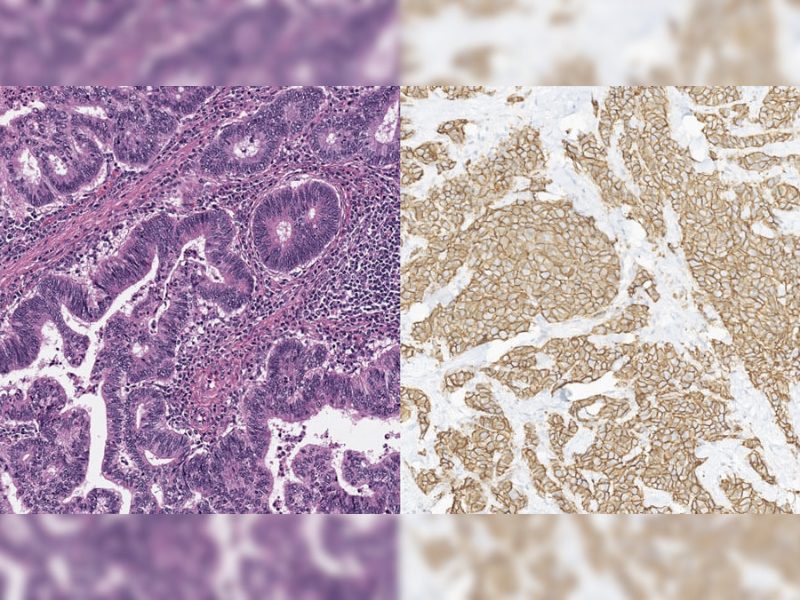
Meriem pointed to a companion diagnostic with FDA Breakthrough Device Designation as an example. The AI calculates the ratio of a targeted protein’s expression between the membrane and cytoplasm of individual cells, then computes a score across the slide. It is a level of quantitative analysis that couldn’t be performed by eye.
The significance goes beyond doing existing pathology tasks faster. It creates measurements that weren’t previously possible, turning routinely generated tissue images into quantitative data that can inform diagnosis, prognosis and treatment decisions.
Why this matters for drug development
The same capability has implications much earlier in the drug-development process.
As cancer treatment becomes increasingly targeted, identifying the patients most likely to benefit from a therapy depends on finding and measuring the right biomarkers. Computational pathology can help researchers interrogate tissue at scale, identify signals associated with treatment response and stratify patients more precisely.
It can also help tackle a growing practical challenge in precision oncology: the number of potentially relevant biomarkers is increasing faster than health systems can routinely test for them. AI analysis of existing pathology images could help identify patients most likely to carry a particular biomarker and prioritize them for confirmatory testing. This is already playing out in our successful industry partnerships, Waiv, for example, works with AstraZeneca and MSD to apply this approach to biomarker identification and patient stratification in their oncology pipelines, and with Daiichi Sankyo on related precision oncology work.
For patients, that could mean reaching the right test and treatment sooner. For drug developers, it could improve patient selection and accelerate clinical development.
The foundation-model shift
Foundation models are central to how Waiv approaches that problem. Trained on millions of pathology images, these models learn broad representations of tissue that can then underpin more specialized systems built for specific clinical questions. Meriem compares the principle to an experienced pathologist who has already seen an enormous volume and variety of cases before being asked to assess the next one.
The value becomes particularly clear when datasets are small. Biomarker discovery studies and early clinical trials may involve relatively few patients, making it difficult to build powerful AI models from scratch. Starting with a model already trained across large pathology datasets creates a much richer base from which to look for meaningful signals.
Waiv’s latest foundation models, Phaet and Mascaret, push this further by addressing a known weak point in pathology AI: models that cluster patients by scanner and lab rather than by underlying biology. Built with a model-agnostic recipe that resolves this at the encoder level, both achieve robustness across sites without trading off performance. In an independent evaluation by Radboud University Medical Center, Mascaret ranked first among all models assessed.
That opens up applications across the oncology pathway, from predicting relapse risk in early-stage breast cancer to identifying biomarkers and patients most likely to respond to a particular therapy, with the added assurance that signals identified in one lab are more likely to hold in another, a critical property for companion-diagnostic development.
From specialist tool to infrastructure
Meriem’s longer-term vision goes further. She sees AI becoming part of the infrastructure of healthcare, with patient data analyzed early in the care pathway to help determine what happens next.
Digital pathology could also make advanced diagnostics more accessible. Molecular testing can require specialist laboratories, equipment and sample handling. AI pathology primarily depends on digitizing a slide and being able to process the resulting image, creating the potential to bring sophisticated diagnostic capabilities to health systems where specialist expertise is harder to access.
For all the momentum around AI diagnostics, Meriem believes the market remains early. The next phase will depend on clinical evidence, regulation and adoption: turning increasingly powerful models into tools that can be used routinely to improve patient care.
Share this article


Follow us
Get Pathology News Delivered to Your Inbox

![Figure 1: Fine-tuning improves robustness and performance jointly. Each foundation model is shown before (open circle) and after (filled circle) fine-tuning. The x-axis is the average PathoROB robustness index over three datasets, where higher values indicate greater robustness; the y-axis is the normalized rank sum over the HEST, THUNDER and Patho-Bench benchmarks, rescaled to [0, 1] so that 1 corresponds to the best achievable performance.](https://www.pathologynews.com/wp-content/uploads/2020/07/embedding-figure-800x600-1.png)