Author: Sidney Ocanagil-Tunstall
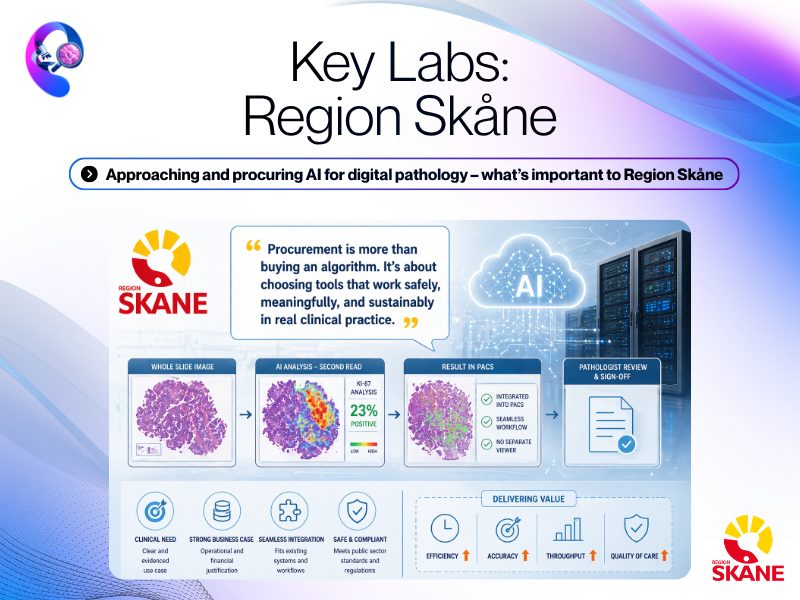
Procurement is more than buying an algorithm. In clinical practice, procuring artificial intelligence (AI) for digital pathology means choosing tools that can work safely, meaningfully, and sustainably within a live diagnostic environment.
That question is now becoming a practical one for Region Skåne. In 2026, the Region Skåne team was at the beginning of their own AI journey, exploring how algorithms might support selected parts of their pathology workflow.
“Well, we’re just starting out by implementing different workflows with the help of AI… we see this as a huge opportunity for us to streamline our workflows.” Said Jurko Zoric, Senior Strategic Advisor
For Region Skåne, however, AI is not being introduced into an immature setting. The lab has been operating as a well-established digital pathology service since spring 2019. That matters. Any algorithm the team considers must fit into an already established workflow, infrastructure, and reporting environment. As a public-sector organisation, they must also satisfy a higher threshold before any technology can be seriously considered.
“We work in the public sector here meaning we need to have a strong business case and strong use case before we can consider a technology like AI. A strong business case means we have to save some money somewhere in the process and a strong use case would mean there’s a clear clinical need.”
That distinction is important. At Region Skåne, interest in AI alone is not enough. Procurement begins with two questions: does the tool answer a genuine clinical need, and can it justify its place operationally and financially within the service?
Approaching AI for the first time, Region Skåne’s philosophy is straightforward: automate what can be automated, where it makes sense to do so. One of the first areas under consideration is triage. The ambition is to use algorithms to analyse cases before the pathologist begins work, allowing cases to be prioritised at the start of the day.
This gets to the heart of what the team appears to value in AI. The point is not to introduce technology for its own sake, but to identify where it can remove friction from the workflow and support more efficient use of pathologist time.
Beyond triage, the team is also implementing Visiopharm’s Ki-67 image analysis solution for breast cancer to support pathologists in routine practice. Here again, the discussion is not simply about whether the algorithm performs well. It is about how the tool can be built into the lab’s existing systems in a manner that is best for the physicians and ultimately the patient.
“There’s two ways to implement this product; you can have the viewer from Visiopharm along with their heat maps helping you to make your assessment. But we decided that we didn’t want any viewers at all, we just wanted the result from the AI directly into our picture archiving and communications system (PACS).”
This is an important procurement lesson. Performance and algorithm accuracy alone are not enough. Your chosen vendor must also be able to support implementation in a way that complements the vision of the lab. For Region Skåne, that meant avoiding a separate viewer and instead ensuring that the AI output could flow directly into the PACS environment already used by pathologists.
In practice, the value of an algorithm depends not only on what it can do, but on whether it can be deployed in a way that suits the workflow around it. But procurement is only the beginning. Once an algorithm has been selected and implemented into the workflow, the next obvious question is, ‘what sort of relationship will the pathologist share with the algorithm?’
Most labs refer to the AI’s result as the ‘second read’. “You have to consider this [the second read] as a suggestion for the physician.” The AI is not there to replace the reporting pathologist or override professional judgement. It is there to offer an additional assessment, one that can support decision-making but not make the decision itself. The final sign-off remains with the histopathologist.
Where the pathologist and AI agree, the result can be accepted. Where they do not, the whole slide image is reviewed by a panel of physicians. In other words, the value of the AI for image analysis lies not in removing the human from the process, but in creating another layer of review within the process.
Interestingly, Jurko explained that Region Skåne’s validation studies showed the second read to be more accurate than the human pathologist. Even so, the team’s approach remains cautious and clinically grounded. The algorithm may perform strongly, but it is still treated as an aid to judgement rather than a replacement for it.
This may be one of the clearest insights from Region Skåne’s early AI journey. Procuring AI for digital pathology is not simply a question of buying the most advanced model or the product with the strongest headline performance. It is about selecting tools that answer a real clinical need, make sense within the economics of the service, fit cleanly into established workflows, and can be used in a way that suits the pathologist.
The challenge is not just to find an algorithm that works. It is to find one that works in your environment, for your workflow, and for the people responsible for diagnosis.
No audio available for this article yet.
No quiz available for this article yet.